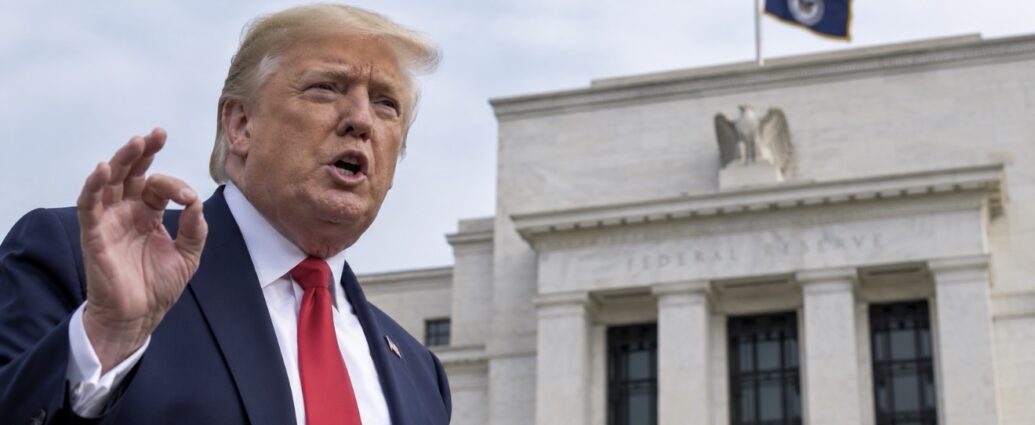
President Donald Trump renewed pressure on the Federal Reserve Friday to lower interest rates, saying policymakers “must get smart” even as a stronger-than-expected August jobs report gave the central bank more reason to remain cautious.
The clash is becoming increasingly clear.
Trump wants cheaper borrowing costs.
The latest economic data are giving the Fed an argument for keeping rates high.
That tension is now one of the most important stories in U.S. markets.
Trump Wants Rates Lower
Trump has repeatedly argued that U.S. interest rates are too high and that lower rates would reduce borrowing costs for businesses, homebuyers and the federal government.
On Friday, he again pressed the Fed to move lower, saying the United States should have some of the lowest interest rates in the world.
He also tied the issue to trade, warning that countries benefiting from large trade surpluses with the United States could face consequences if interest rates remain too high.
The broader message from the White House is simple:
High rates are making American business less competitive.
But the Jobs Report Complicates That Argument
Friday’s employment report showed the U.S. economy added 162,000 jobs in August, much stronger than many economists had expected.
That matters because the Federal Reserve watches the labor market closely when deciding whether the economy can handle higher interest rates.
If hiring is strong and unemployment remains relatively low, the Fed has less reason to rush into rate cuts.
A strong labor market can also keep wage growth elevated.
And if wages rise too quickly, businesses may raise prices to cover higher labor costs.
That can keep inflation above the Fed’s 2% target.
Markets Immediately Saw the Conflict
Treasury yields moved higher after the jobs report as investors reduced expectations for near-term rate cuts.
That is the market’s way of saying:
The economy may still be too strong for the Fed to ease aggressively.
Higher Treasury yields can quickly affect the rest of the economy.
Mortgage rates can rise.
Corporate borrowing gets more expensive.
Auto loans become more costly.
Commercial real estate financing becomes harder.
That is exactly why Trump is pushing in the opposite direction.
Why the Fed May Resist Political Pressure
The Federal Reserve is designed to operate independently from the White House.
Its job is to manage inflation and employment, not to set rates based on political preferences.
Fed officials have repeatedly emphasized that policy decisions will depend on economic data.
That means the central bank is unlikely to cut rates simply because the president wants it to.
If inflation remains elevated and hiring remains strong, policymakers may decide that lower rates would risk reigniting price pressures.
Trump’s Business Argument
From Trump’s perspective, high rates create real economic costs.
Businesses financing equipment, buildings, inventory or expansion pay more.
Homebuilders face weaker demand.
Consumers pay more for mortgages, credit cards and vehicles.
The federal government also pays more interest on its debt.
Lower rates would ease all of those pressures.
That is why Trump has made monetary policy a much more public political issue than most presidents typically do.
The Fed’s Counterargument
The Fed’s concern is that cutting too soon can create a bigger inflation problem later.
If rates fall while the economy is still expanding quickly, households and businesses may borrow and spend more.
That additional demand can push prices higher.
The Fed learned during the post-pandemic inflation surge how difficult it can be to regain control once inflation becomes entrenched.
So policymakers are trying to avoid repeating that mistake.
What It Means for Businesses
For businesses, this fight matters because interest rates affect almost every major financial decision.
A company deciding whether to open another location may wait if financing is too expensive.
A manufacturer may delay buying new equipment.
A developer may postpone a project.
A consumer may decide not to buy a house.
That slows economic activity.
But if rates are cut too aggressively and inflation rises again, businesses face higher labor, transportation and material costs.
There is no painless option.
The September Fed Meeting Just Became More Important
The Federal Reserve meets again later this month.
Before that meeting, policymakers will receive additional inflation data.
Those numbers could determine which side of the debate gains the advantage.
If inflation cools sharply, Trump’s argument for lower rates becomes easier to make.
If inflation remains stubborn and the labor market stays strong, the Fed may decide that cutting rates would be premature.
That leaves markets caught between two powerful forces.
The White House wants cheaper money.
The Federal Reserve wants proof that inflation is under control.
And Friday’s jobs report gave the Fed more reason to wait.
JBizNews Desk | Washington
© JBizNews.com All Rights Reserved. Reproduction or distribution without written permission is prohibited.