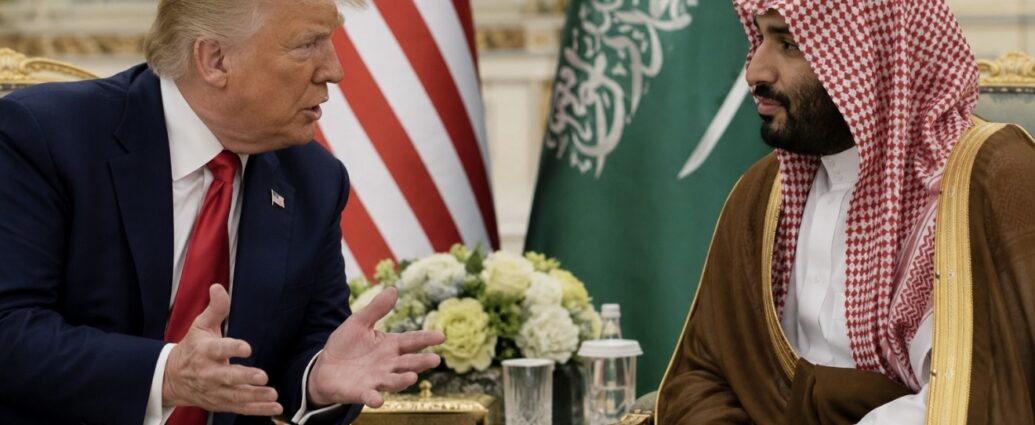
President Donald Trump threatened to use America’s defense relationship with Saudi Arabia as leverage during a disagreement over military operations in the Strait of Hormuz, according to reports published Tuesday citing U.S. officials familiar with the discussions. The reported dispute centered on Saudi Arabia’s reluctance to allow U.S. forces to use its territory and airspace during a proposed mission to protect commercial shipping through one of the world’s most important energy chokepoints.
The disagreement reportedly arose during planning for Project Freedom, a U.S. operation announced earlier this year to help escort commercial vessels through the Strait of Hormuz after maritime traffic was disrupted during the conflict between the United States and Iran. The narrow waterway carries roughly one-fifth of the world’s seaborne oil, making any disruption a major concern for global energy markets and international trade.
According to the reports, U.S. military planners sought access to Saudi airspace and facilities to support surveillance aircraft, refueling operations, and other logistical missions connected to the effort. Officials cited in the reports said Saudi leaders declined to provide the level of cooperation Washington requested, creating friction between two longtime allies.
The reports say President Trump later raised Saudi Arabia’s dependence on American-made missile-defense systems during discussions with Saudi officials, suggesting future defense support could become an issue if cooperation did not improve. Neither government has publicly confirmed that such a warning was issued.
A White House official disputed portions of the reporting, saying regional allies had been informed about the operation in advance. Saudi officials also rejected suggestions that they had blocked U.S. access, maintaining that military cooperation between the two countries remains strong and that discussions reflected rapidly changing conditions during a regional crisis.
The episode nevertheless highlights the importance of the decades-long defense partnership between Washington and Riyadh. Saudi Arabia relies heavily on U.S.-built air-defense systems, including Patriot missile batteries manufactured by RTX and THAAD systems produced by Lockheed Martin, to defend critical infrastructure, population centers, and energy facilities from missile and drone attacks.
Those systems require a continuous supply of interceptor missiles, replacement parts, software upgrades, technical support, and maintenance from U.S. defense contractors. Any disruption in that relationship could have significant consequences for both countries and for the American defense industry, which counts Saudi Arabia among its largest foreign customers.
Beyond defense contracts, the broader economic implications extend to global energy markets. The Strait of Hormuz remains one of the most strategically important waterways in the world, serving as the primary export route for much of the Middle East’s oil production. Any threat to shipping through the strait can quickly influence crude oil prices, gasoline costs, freight rates, and inflation worldwide.
Although commercial traffic has largely resumed following the easing of military tensions, investors continue to monitor relations between Washington, Riyadh, and Tehran for signs that regional stability could change. Even temporary uncertainty can affect commodity markets and increase volatility across global financial markets.
For U.S. businesses, the relationship with Saudi Arabia stretches well beyond military cooperation. American companies maintain major investments throughout the kingdom in energy, technology, aviation, engineering, and infrastructure, while Saudi investment funds continue to play a significant role in financing projects across the United States.
Analysts say the reported dispute illustrates how closely diplomacy, national security, and global commerce are intertwined. Decisions involving military access or defense cooperation can have immediate consequences for oil prices, international shipping, government contracts, and corporate investment planning.
While both governments continue to emphasize the strength of the U.S.-Saudi partnership, the reports underscore that even close allies can face difficult negotiations when military operations and regional security are at stake. Markets will continue watching for any signs that differences between Washington and Riyadh could affect energy supplies or defense cooperation in the months ahead.
JBizNews Desk
© JBizNews.com All Rights Reserved. Reproduction or distribution without written permission is prohibited.