By JBizNews Desk
May 10, 2026
President Donald Trump declared Sunday that federal agencies must prioritize American-made products in government purchasing, escalating a White House procurement crackdown that could reshape supply chains for thousands of contractors competing for a share of the federal government’s roughly $700 billion annual purchasing budget.
“ALL FEDERAL AGENCIES MUST BUY AMERICAN — NO EXCUSES!” Trump stated Sunday, according to reporting published by The Hill, reinforcing an economic agenda the administration says is designed to steer taxpayer dollars back toward U.S. factories, industrial suppliers, steel producers, and technology manufacturers.
The directive intensifies a broader America-first procurement strategy that has steadily expanded since Trump returned to office in January. Administration officials have increasingly framed federal purchasing policy not only as an economic issue, but also as a national-security priority following supply-chain disruptions exposed during the COVID-19 pandemic and the global semiconductor shortages that followed.
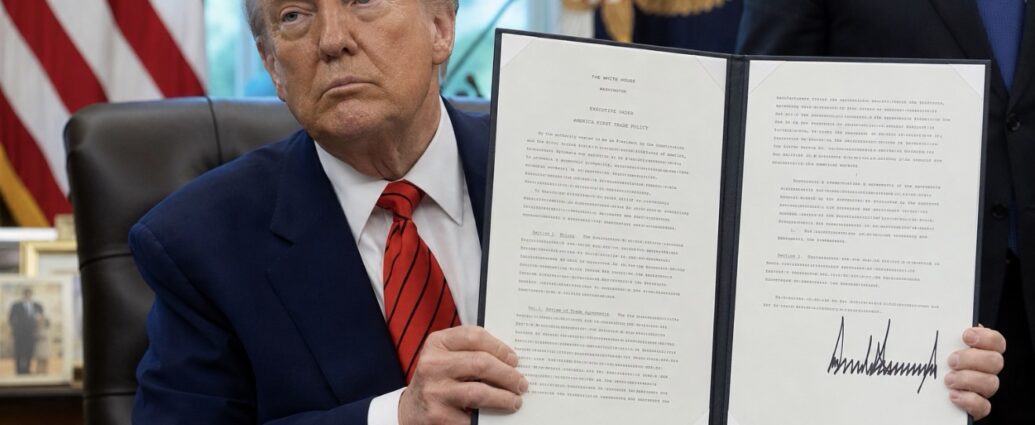
The latest announcement builds on Trump’s “America First Trade Policy” executive order signed on his first day back in office, which directed the U.S. Trade Representative and senior trade advisers to review international procurement agreements — including the World Trade Organization Agreement on Government Procurement — to determine whether they disadvantage American manufacturers and workers.
That review laid the groundwork for a series of procurement-focused executive actions throughout 2025 and into 2026 aimed at narrowing waivers, tightening enforcement standards, and increasing scrutiny of foreign-made products entering the federal supply chain.
On March 13, Trump signed another executive order instructing the Federal Trade Commission to prioritize investigations into allegedly misleading “Made in USA” claims, citing concerns that some foreign manufacturers may improperly market products as American-made in order to gain access to patriotic consumers and federal contracts.
That same order directed agencies overseeing government procurement contracts to more aggressively verify compliance with domestic-origin requirements tied to the Buy American Act and related federal purchasing rules. Contractors found to have falsely represented products as American-made could face removal from procurement eligibility and possible referral to the Department of Justice for enforcement under the False Claims Act.
Senior administration officials have argued that loopholes and exemptions inside procurement law allowed foreign suppliers to continue accessing billions of dollars in federal spending despite longstanding domestic-preference laws already embedded in federal policy.
The White House has repeatedly emphasized that even a relatively small portion of procurement spending flowing overseas represents economic activity that could otherwise support American jobs and manufacturing capacity.
According to administration officials citing prior procurement studies, foreign vendors received roughly $12 billion out of approximately $430 billion in analyzed federal procurement spending during one recent study year — a figure the White House argues should be reduced further wherever possible.
For manufacturers, industrial suppliers, defense contractors, and construction firms, stricter enforcement could create significant new demand opportunities tied directly to federal spending. Companies involved in steel, aluminum, infrastructure materials, semiconductors, transportation equipment, and industrial technology are expected to closely monitor how aggressively agencies implement the directive.
Industry analysts say the policy could particularly benefit domestic producers already expanding U.S.-based manufacturing operations amid broader efforts by corporations to reduce dependence on overseas supply chains.
At the same time, procurement attorneys warn the practical implementation of tighter Buy American rules may prove far more complicated than the political messaging itself.
Compliance with the Buy American Act often requires detailed analysis of where products are manufactured, how much of their component value originates overseas, and whether products qualify as “domestic end products” under federal procurement standards. Products assembled inside the United States may still fail compliance thresholds if too many components are sourced internationally.
Government contracting specialists also warn broader enforcement could trigger an increase in bid protests, procurement disputes, compliance reviews, and legal challenges among competing contractors.
Critics of aggressive Buy American enforcement argue that limiting access to foreign suppliers too broadly may increase procurement costs for federal agencies by reducing competition, particularly in specialized industrial and technology sectors where global supply chains remain deeply integrated.
Trade analysts additionally caution that tougher domestic-preference rules in Washington could encourage retaliatory procurement restrictions from foreign governments that purchase American-made industrial, aerospace, and defense products.
Still, the administration appears prepared to absorb those risks as part of a broader economic strategy centered on domestic manufacturing, industrial independence, and reduced reliance on foreign production.
Trump’s latest directive signals the White House intends to move beyond symbolic support for American manufacturing and toward far stricter operational enforcement inside federal purchasing systems themselves — a shift that could materially alter how contractors source products, structure supply chains, and compete for government business in the years ahead.
As agencies begin translating the President’s directive into procurement policy, manufacturers and contractors across multiple sectors are preparing for what could become the most aggressive Buy American enforcement environment in decades.
— JBizNews Desk
© JBizNews.com. All rights reserved. This article is original reporting by JBizNews Desk. Unauthorized reproduction or redistribution is strictly prohibited.