Everyone knows “give me your tired, your poor, your huddled masses yearning to breathe free,” are the most famous lines of Emma Lazarus’ poem, “The New Colossus.” But what some might not know is the line before it: “From her beacon-hand glows world-wide welcome.”
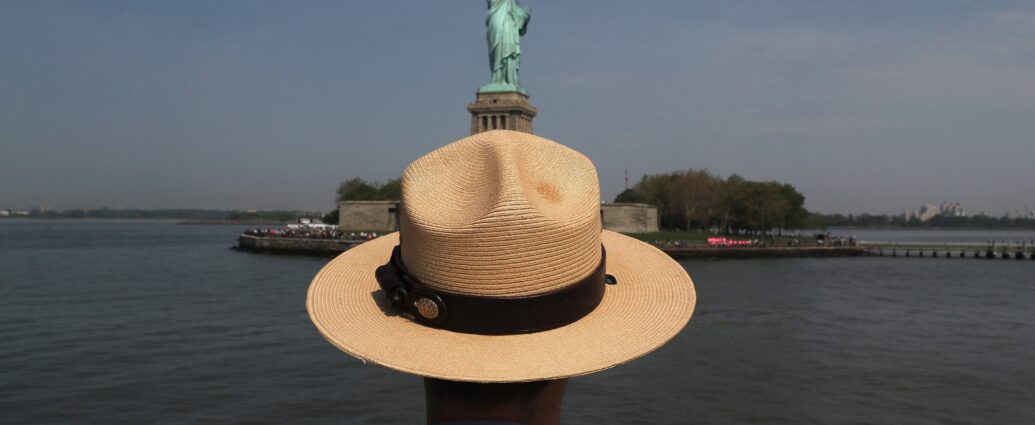
I read, and sometimes stared at the bronze plaque inscribed with that poem for eight hours a day, every day, for a year in 2016. Unlike the plaque (and the building it was in), my location was golden: overlooking the New York Harbor, 20 stories off the ground (following 13 flights of intertwining double-helix stairs), chatting with visitors from across the country and around the world about the Statue of Liberty, explaining the symbolism of the tablet (inscribed with July 4, 1776); the lifted foot (breaking from chains); the points on her crown (we simply just don’t know). I was a National Park Ranger, at the Statue of Liberty no less, and during the National Park Service Centennial at that. I and a team of other rangers welcomed a record high of 4.5 million visitors to the Statue that year, often from other countries looking to celebrate the awes and wonders of the national parks system.
They lucked out, because now, a decade later, any foreign visitors to select national parks are subject to an international visitor surcharge as part of the “America-first” pricing plan, which was pitched as a $90 million-a-year fix. And now, half a year into the surcharge, the government says it has brought in just $22.5 million.
Six months after the federal government began charging foreign tourists extra to enter America’s most popular national parks, the fee has raised $22,531,075, Interior Secretary Doug Burgum reportedly told the Daily Signal—roughly a quarter of the $90 million the administration projected for its first year.
The Congressional Research Service noted projecting this revenue “has been challenging… because NPS has not collected systematic data on numbers of international park visitors,” and the government’s own annual FLREA fee-revenue report still lags two years behind, currently covering only fiscal year 2023. Until a newer report or an outside audit surfaces, Burgum’s numbers are the only numbers available.
‘Preserving opportunities for American families’
President Donald Trump signed Executive Order 14314 on July 3, 2025, stating the intention of the surcharges was “to preserve these opportunities for American families in future generations by increasing entry fees for foreign tourists.” Then at a rally in Iowa, he said: “The national parks will be about America first. We’re going to take it.”
The department announced the new pricing last November and it took effect Jan. 1. Foreign visitors now pay $250 for an annual America the Beautiful pass, up from $80, or $100 per person on top of standard entrance fees at 11 of the busiest parks, including Yellowstone, Yosemite, and Zion.
But Burgum said the shortfall is just early-stage growth, not failure, telling the Daily Signal the policy has “created a sustainable funding stream” for the park system.
Still, the rollout hasn’t gone smoothly. Five Senate Democrats, led by Alex Padilla, Catherine Cortez Masto, and Ron Wyden, wrote to Burgum twice, arguing the fee violated the Federal Lands Recreation Enhancement Act, which requires public notice and comment before recreation fees are changed. Interior implemented the fee on schedule anyway, which meant park staff suddenly had to determine who is and isn’t a U.S. resident at the gate.
The NPS has always required resident pass holders to show photo ID; what’s new is non-pass holders at the 11 surcharge parks now face a verbal residency check. The Guardian reported delays at entrances in the fee’s first week, and Padilla and his colleagues have separately asked whether residency data collected at the gate could be shared with other federal agencies, something Interior hasn’t answered.
Neither the Department of Interior nor the National Park Service have responded to Fortune’s requests for comment.
But none of this makes the underlying idea unusual. Charging tourists more than locals is common practice well beyond U.S. borders: The Louvre raised its non-EU ticket price nearly 50%, to $37; South Africa’s Kruger National Park charges foreign visitors $35 a day versus $8 for residents; Kenya’s Masai Mara charges foreigners $200 versus $24 for residents; and Ecuador charges foreign adults $200 to enter Galápagos National Park versus $30 for citizens. Britain has debated, but not adopted, a similar museum surcharge, opting instead for a city-level “tourist tax” on overnight stays.
What’s different about the U.S. version is its timing: International visits to the U.S. fell 5.5% in 2025 even as global travel grew elsewhere, with foreign tourists spending $14 billion less than in 2024, and one analysis found 46% of travelers said they were less likely to visit the U.S. because of the president’s policies.
Charging tourists more only raises real money if the tourists keep showing up, and right now, fewer of them are.
This story was originally featured on Fortune.com