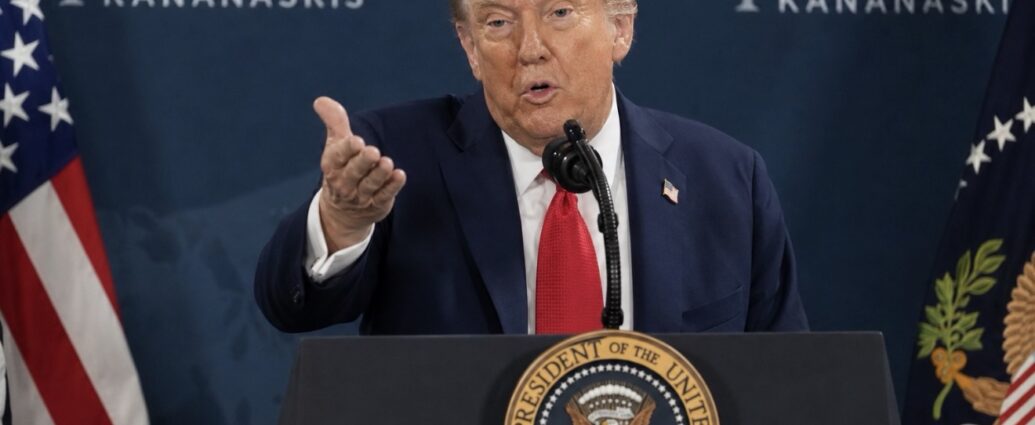
On Wednesday, after U.S. officials released the full text of his 14-point agreement with Iran, President Donald Trump defended the deal at a news conference closing the G7 summit in France. But the bigger story was the backlash — not just from his own party, but from inside his own cabinet — alongside polls showing his standing at the lowest levels of either term.
The agreement ends the U.S. naval blockade of Iranian ports, reopens the Strait of Hormuz to commercial ships, lifts sanctions and sets a 60-day window for nuclear talks. It also opens the door for Iran to access up to $300 billion to rebuild its infrastructure, funded by other countries. For American households, the stakes are simple: the strait carries about 20% of the world’s oil and gas, and its closure since February 28 pushed up fuel and grocery prices.
Much of the anger comes from Trump’s usual allies. Senator Ted Cruz of Texas said the president was getting very poor advice, warning against “giving billions of dollars to theocratic lunatics who want to murder us.” Former Vice President Mike Pence said the deal “smacks of the kind of appeasement” the administration once rejected. Senator Bill Cassidy of Louisiana called it “the worst foreign policy blunder in decades,” and former U.N. Ambassador Nikki Haley warned Iran would spend any money it receives on its nuclear program and regional proxies.
The criticism set off a public family fight. Donald Trump Jr. accused Cruz of “lying thru his teeth,” insisting the United States is not handing Iran any money.
Conservative media piled on. Ben Shapiro called the deal “a disaster,” Erick Erickson called it “an American surrender,” and former adviser Steve Bannon urged the White House to keep the sanctions in place. Fox News host Mark Levin and the editors of National Review demanded the administration release the full text. Republican leaders were more guarded but uneasy: Senate Majority Leader John Thune said he wanted more information, and Senator Lisa Murkowski of Alaska said she was waiting to hear what the “corresponding win” for the United States would be.
The split runs into the cabinet as well. According to reports, Defense Secretary Pete Hegseth, Secretary of State Marco Rubio and CIA Director John Ratcliffe privately raised doubts about the agreement, while Vice President JD Vance and envoy Steve Witkoff — joined by Jared Kushner — pushed it through as its principal architects. The fracture reflects a broader reshuffling of who holds Trump’s ear: when the strikes began, isolationists such as Tucker Carlson and Marjorie Taylor Greene were sidelined after arguing he had abandoned “America First”; now many of the hawks who supported the military campaign are among the loudest critics of the deal. Throughout the conflict, Trump has managed Iran policy through a small inner circle after significantly reducing the role of the National Security Council.
The debate also tests Trump’s longstanding reputation as a dealmaker because the agreement falls short of the war’s original goals. At the news conference, Trump defended Iran’s right to retain ballistic missiles, saying “they have to have some because other people have some” — capabilities that had previously been targeted by U.S. and Israeli strikes. Months ago he had demanded Iran’s “unconditional surrender”; on Wednesday he framed the agreement as a way to avoid a broader economic crisis.
He still has defenders. Senator Lindsey Graham of South Carolina said the United States was “off to a good start” while expressing doubt that Iran would ultimately abandon its nuclear ambitions, though he called on Vance, whom he described as the deal’s architect, to defend it before Congress. Senator Rand Paul of Kentucky said he stood with Trump on pursuing peace. Representative Brian Mast of Florida argued the United States is “$300 to $500 billion ahead” after destroying much of Iran’s military and nuclear infrastructure.
The political challenge for the president may be the polling. A NPR/PBS News/Marist survey put his approval rating at 36%, with 59% disapproving — the widest gap of either term — and only about a third approving of his handling of the economy, below Joe Biden’s lowest marks. NPR reported that the decline extended even into some of the voter groups that helped return him to office. A Reuters/Ipsos poll found 35% approval overall, 29% approval on Iran, and 22% approval on the cost of living, while 53% said the war was not worth it. Both surveys were conducted largely before the agreement’s details became public. An Economist/YouGov poll highlighted the dilemma: 68% want a deal that ends the war quickly, but only 34% support an agreement that allows Iran to keep its enriched uranium.
For the economy, the math is straightforward. If the Strait of Hormuz remains open and the ceasefire holds, gasoline, diesel and shipping costs could ease through the remainder of 2026 — the relief Trump is counting on before November, with Brent crude already falling to around $83 per barrel. But if the truce collapses, or if the concessions to Iran continue to dominate the political debate, the strait could close again and erase those gains, leaving the president exposed on the issue voters consistently rank as their top concern: the cost of living.
JBizNews Desk
© JBizNews.com All Rights Reserved. Reproduction or distribution without written permission is prohibited.