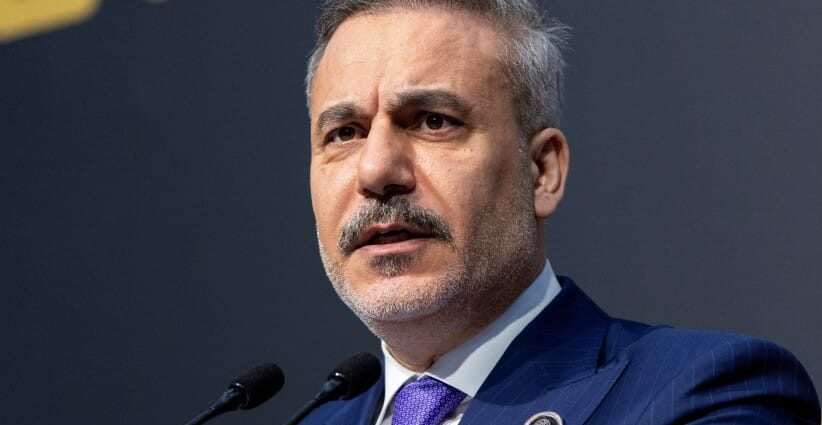
“I think there is no reason to have an open conflict,” Turkish Foreign Minister Hakan Fidan told The National on Friday, only a week after making far more critical comments on CNN Türk, decried by Israeli politicians as genocidal.
Complaining of the alleged anti-Ankara rhetoric coming from Jerusalem, Fidan directed criticism at Prime Minister Benjamin Netanyahu’s coalition and select members of the opposition, but asserted that “there are still very sane and good people with wisdom and strategic minds in Israel.”
“Not all of them are like Netanyahu and some people, but Netanyahu and some people, as they get closer to the elections, they need an enemy. They were at war with Hamas, Hezbollah, and Iran, and now they need another enemy,” Fidan told the Emirati site, adding that he believed Ankara was being shifted into that role.
The comments were far more moderate than the ones made on CNN, where he complained: “These people (in reference to Israel) have become a burden that humanity can no longer bear.”
“No matter which framework you use, there is no parameter under which these people can be sustained,” Fidan said in the earlier interview.
Gallia Lindenstrauss, a senior research fellow at the Institute for National Security Studies specializing in Turkish foreign policy, told The Jerusalem Post that the interview with The National was Fidan’s way of clarifying his previous remarks and “distancing his criticism from Israel as a whole to the actions of the current Israeli government.”
“His statement that there are ‘reasonable’ people was especially reassuring that should Israel have another government, things might look different between Israel and Turkey,” she assessed.
That same interpretation was offered to the Post by Istanbul-based geopolitical analyst Burak Can Çelik, who said that the current abrasiveness of Ankara’s comments on Israel doesn’t suggest “a permanent and irreversible strategic break” from the Jewish state. Rather, in Fidan’s approach, “security, balance of power and changing regional conditions are as decisive as ideological discourse.”
“Today, the two countries are in a controlled competition. However, while discourses and dynamics change rapidly in the Middle East, geography and common interests are permanent,” he noted. “Before October 7, relations between Turkey and Israel had always been at a good level, with joint collaborations in terms of trade, technology, culture and tourism, so these discourses may be a signal of controlled softness.”
Israel, Turkey clash over F-35 sale
Foreign Minister Gideon Sa’ar condemned Fidan’s earlier comments, alleging that they amounted to a “clear call for genocide” and said his words would not go unchallenged, marking yet another confrontation between Israeli and Turkish officials over public statements made. The sudden shift has been interpreted by some as tied to Ankara’s wider goals, specifically the acquisition of F-35 fighter jets.
Ankara recently hosted US President Donald Trump for a NATO summit, and the president expressed a clear willingness to remove the sanctions blocking Ankara’s path to the fighter jet.
“Turkey has been, in many ways, much more loyal than other countries that we think would be loyal. … It’s a great plane, it’s the best, currently the best plane by far. And it’s certainly something we will consider,” Trump said, announcing that Washington would be dropping sanctions against Ankara originally placed over Turkey’s possession of Russian S-400s.
The issue of Turkey’s rhetoric has already been raised by a group of bipartisan American lawmakers, who penned a letter to Trump complaining that the potential F-35 sales were concerning given statements by the officials, and Ankara’s relationship with Iran.
Israel, a major ally of Washington, has also been vocal in its opposition to the NATO country receiving the F-35s, Dr. Hay Eytan Cohen Yanarocak, a Turkey expert at the Moshe Dayan Center for Middle Eastern and African Studies at Tel Aviv University, noted to the Post. He argued that Fidan is trying to quell Israeli fears about the acquisition of the fighter jets.
“Unless these statements are accompanied by tangible confidence-building measures, such as ending unilateral sanctions against Israel, halting the systematic delegitimization campaign against it, and restoring people-to-people ties by resuming direct flights between Istanbul and Tel Aviv, they should be regarded as lip service,” Yanarocak argued.