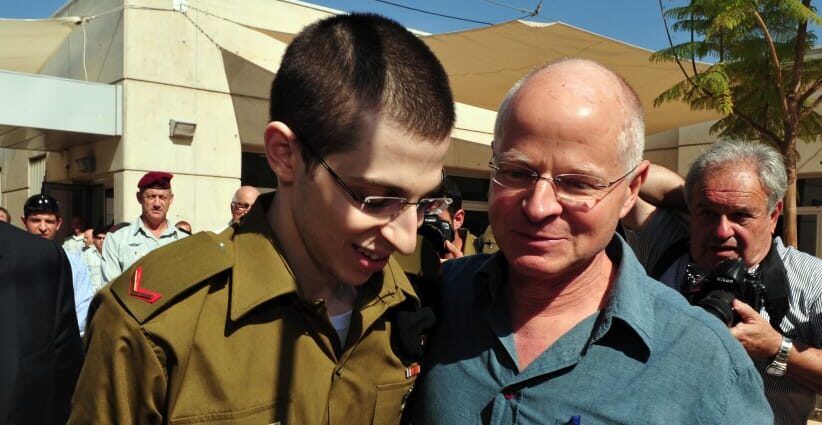
The Defense Ministry on Thursday marked the twentieth anniversary of Hamas’s kidnapping of Gilad Schalit to Gaza by releasing never-before-seen military logs detailing the events of that fateful day minute-by-minute.
According to the ministry, the new records rest mostly on reports that an IDF command center received in real time via communications devices with soldiers in the field, as well as handwritten reports and updates.
Schalit was later released back to Israel in 2011 in a deal that had support from more than 80% of the public at the time, but since the mid-2010s has become overwhelmingly unpopular due to the more than 1,000 Hamas prisoners released.
Regarding the story, the vast majority of the basic narrative released on Thursday was previously reported, but the new material highlights the utter confusion and problematic critical delays in the IDF’s reaction time to the cross-border abduction.
Hamas captured Corporal Schalit when its operatives emerged from a tunnel dug into Israeli territory to successfully surprise and ambush his tank team, killing Lt. Hanan Barak and Staff Sergeant Pavel Slutske, early in the morning of June 25, 2006.
Newly released documents show confusion on the day of the attack
Schalit was lightly wounded in the attack and taken back to Gaza.
According to the newly released records, the first report regarding the attack came at 5:13 a.m., noting numerous explosions had been heard near Kerem Shalom, with the initial view being that Hamas had fired rockets into the area.
At 5:14 a.m., only a minute later, the log noted “there are casualties.”
Next, the documents show an order on IDF walkie-talkies “send a battle helicopter” to the area.
Shortly after, soldiers reported that the tank team had been hit by an anti-tank missile, that at least one Hamas operative had been hit, and that at least another one had been involved.
Almost 90 minutes after the ambush, soldiers in the field reported in on their walkie-talkies that at least one unnamed “soldier was missing from the tank.”
Minutes later, a commander called out the “Hannibal” order, which at the time would have allowed IDF soldiers to take all measures, including shooting Schalit along with his captors, to prevent his abduction.
Around a decade later, the IDF modified the Hannibal Protocol to allow aggressive use of force, but not firing on potentially abducted soldiers themselves.
This issue would creep into both the 2014 and 2023 wars with Hamas.
Around 7:15 a.m., IDF soldiers radioed in that they had discovered a helmet and a bloodstained flak jacket near the Gaza border.
It would take them around 45 more minutes to identify that Schalit was the soldier who had been kidnapped.
Schalit’s parents led a nationwide campaign pressing for a prisoner exchange deal.
Over the five years of his captivity, Schalit’s parents led a nationwide campaign pressing for a prisoner exchange deal.
Among those released in the exchange was Yahya Sinwar, who by 2017 rose to become Hamas’s leader and eventually the mastermind of Hamas’s October 7, 2023, invasion of southern Israel, which killed 1,200 people and led to the abduction of 251 others.
Schalit was discharged from the military in 2012 with the rank of sergeant major.
But the Schalit deal and its ripple effects were another factor that led to a 50-day war between Israel and Hamas in 2014.
At the time, there were more incidents of Palestinians who had been released in the deal, returning to terror, with one assassinating senior police official Baruch Mizrahi.
In response to that growing threat and to Hamas kidnapping three teenage Israelis in the summer of 2014, the IDF re-arrested 60 Schalit deal releasees.
In 2017, The Jerusalem Post reported exclusively that the original plan had been to hold these releasees in administrative detention only for a few months to apply short-term pressure on Hamas to give up the three kidnapped teenagers (who it turned out had already been killed) and to carry out fewer terror operations.
However, the Post reported that then IDF West Bank Chief Prosecutor Lt. Col. Maurice Hirsch intervened and convinced the Shin Bet and other officials to send 48 out of the 60 Palestinians back to prison for much longer periods of years as the price for returning to terror, which violated the terms of their release.
Hirsch told the Post, “One of the recommendations… related to a prisoner who had been released in the Schalit deal… The information gathered… indicated that he had indeed breached the conditions of his release.”
“We can approach a committee which is equivalent, possibly to the parole board… and claim that that person had breached the conditions of their release and therefore he had to return to serve the rest of the sentence… from the original trial,” Hirsch added.
He noted that, “This specific person was brought to me because of his background and I then said to the security forces, this person cannot go to administrative detention. But we should approach the committee for canceling the conditional release in order to return him to prison.”
Analyzing the circumstances of the discussion, he said, “Obviously, the security forces hadn’t thought of this option previously, for had they thought of that option before I brought it up, they would naturally have brought this person with the recommendation to bring him before that same committee… The security force… much appreciated my suggestion.”
While Israel managed to send many of these Schalit deal releasees back to prison, Hamas claimed that one of the critical reasons that it went to war with Israel later in 2014 was over these re-arrests.
The kidnapping of Schalit also served Hamas as a model for kidnapping Hadar Goldin in 2014, and for various other ambushes it undertook from tunnel attacks over the years.
Schalit married around a decade after his release and now works as a sports journalist, mostly staying out of the limelight.