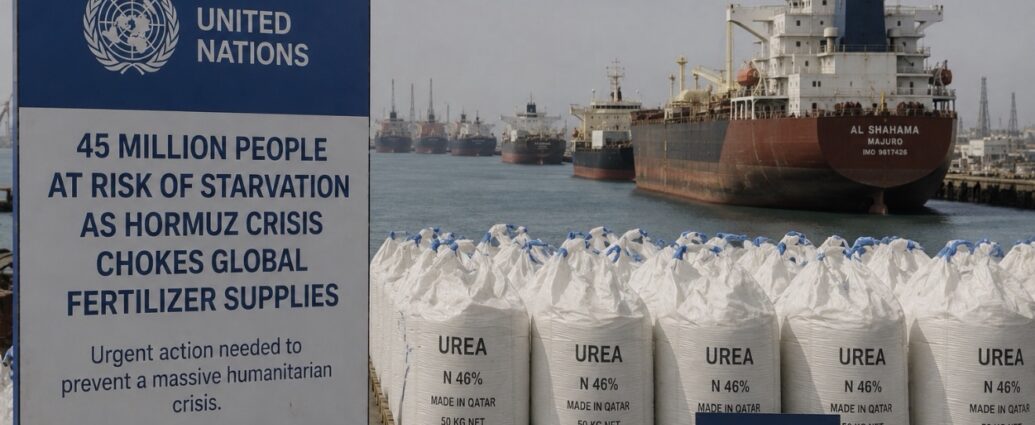
GENEVA — The United Nations warned Monday that the ongoing disruption in the Strait of Hormuz is no longer simply an energy crisis — it is rapidly becoming a global food emergency that could push tens of millions of people toward hunger and starvation within weeks if fertilizer shipments are not restored.
The warning marks one of the starkest humanitarian assessments yet tied to the escalating Iran conflict and underscores how deeply the blockade is beginning to affect the global economy beyond oil markets alone.
Jorge Moreira da Silva, executive director of the U.N. Office for Project Services and head of a task force monitoring the growing food supply threat, said the world is approaching a critical point.
“We have a few weeks ahead of us to prevent what will likely be a massive humanitarian crisis,” Moreira da Silva told French news agency AFP. “We may witness a crisis that will force 45 million more people into hunger and starvation.”
The warning stems from the Persian Gulf’s central role in global fertilizer production and export infrastructure.
Countries surrounding the Gulf account for approximately:
- 30% to 35% of global urea exports
- 20% to 30% of global ammonia exports
Both products are essential components in modern fertilizer production and are critical to maintaining agricultural yields across large portions of the developing world.
Farmers throughout:
- South Asia
- Sub-Saharan Africa
- Latin America
- Parts of Southeast Asia
depend heavily on fertilizer shipments that normally transit through the Strait of Hormuz.
But since the joint U.S.-Israeli military campaign against Iran began in February — and Tehran effectively moved to close or heavily restrict traffic through the waterway — many of those supply chains have been severely disrupted for more than ten weeks.
The consequences are beginning to compound globally.
Fertilizer shortages are arriving on top of already elevated agricultural production costs caused by surging oil and fuel prices.
Modern farming relies heavily on diesel fuel, transportation networks, irrigation systems, and mechanized equipment — all of which become more expensive as energy prices rise.
At the same time, fertilizer shortages directly threaten crop yields themselves.
Lower fertilizer availability can reduce agricultural output dramatically, particularly in lower-income countries where farmers already operate with minimal margins and limited reserves.
The resulting risk is not simply higher food prices — but actual shortages.
The U.N. warning Monday followed similarly grim comments from Saudi Aramco CEO Amin Nasser, who said the broader supply disruption now unfolding across energy and commodity markets may take years to normalize even under optimistic scenarios.
“If the Strait of Hormuz opens today, it will still take months for the market to rebalance,” Nasser warned earlier Monday. “And if its opening is delayed by a few more weeks, then normalization will last into 2027.”
Several Gulf energy producers have already declared force majeure conditions during the crisis.
Qatar halted portions of natural gas production earlier in the conflict, while other Gulf exporters have struggled with shipping constraints tied directly to the security environment in and around the strait.
The humanitarian risks are now moving rapidly from theoretical concern to operational emergency.
Global food systems operate on tightly synchronized planting, shipping, and harvesting cycles. Fertilizer disruptions lasting only several weeks can have effects that ripple across multiple growing seasons.
That reality is increasingly alarming governments, food producers, commodity traders, and humanitarian organizations alike.
For businesses, the implications extend far beyond agriculture alone.
Food manufacturers, grocery retailers, restaurant chains, transportation firms, and commodity markets all depend on stable agricultural output and predictable fertilizer availability.
Further disruptions could intensify inflation pressures that consumers worldwide have already struggled with for years following the pandemic, energy volatility, and supply chain fragmentation.
The humanitarian consequences could be even more severe in poorer nations already facing economic fragility, drought conditions, or political instability.
The figure cited Monday by the United Nations — 45 million people potentially pushed toward hunger or starvation — reflects not a distant scenario, but what officials describe as the leading edge of a rapidly escalating food security threat.
And as the ceasefire between Iran and the United States remains fragile and negotiations continue to deteriorate, the world’s most strategically important shipping corridor is increasingly becoming not only an energy chokepoint — but a growing fault line for global food stability itself.
JBizNews Desk
© JBizNews.com. All rights reserved. This article is original reporting by JBizNews Desk. Unauthorized reproduction or redistribution is strictly prohibited.