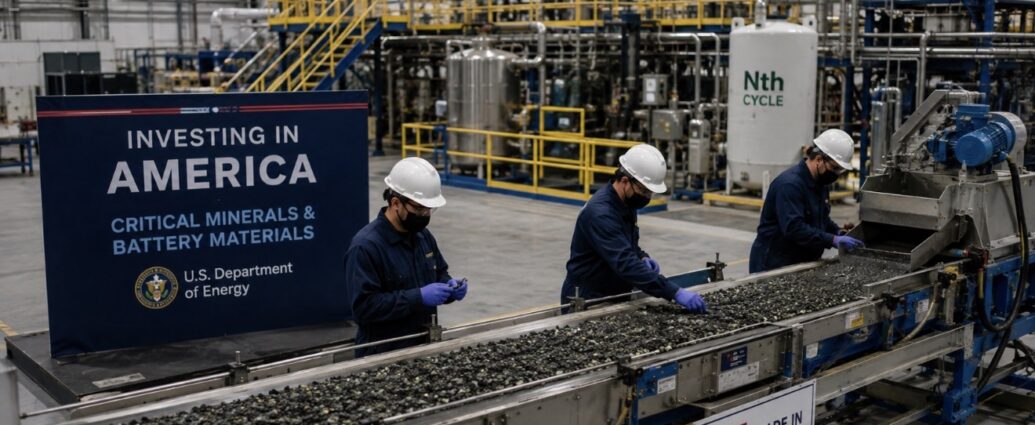
The United States is putting another $500 million into seven domestic critical-mineral and battery projects, backing everything from lithium extraction in Utah to what could become the country’s only cobalt refinery as Washington tries to reduce one of the most consequential vulnerabilities in American manufacturing.
The Department of Energy selected the projects from hundreds of applications under its battery-materials processing and manufacturing programs. Three companies — Lilac Solutions, Jervois and Nth Cycle — are receiving $100 million each, while additional grants will support battery recycling, electrolyte chemicals and next-generation anode materials.
The money is not simply about electric vehicles.
Lithium, cobalt and other battery materials increasingly sit at the intersection of automobiles, consumer electronics, power storage, artificial intelligence infrastructure and national defense. Many of those supply chains remain heavily dependent on foreign processing, particularly China.
That dependence is what Washington is trying to change.
Lilac Solutions will receive $100 million for a direct-lithium-extraction facility at Utah’s Great Salt Lake. The BMW-backed company expects the operation to open by 2028 and eventually produce about 5,000 metric tons of lithium annually.
Direct lithium extraction is important because it attempts to pull lithium from brines without relying on the enormous evaporation ponds traditionally associated with lithium production. If the technology proves commercially viable at scale, it could open domestic resources that previously were difficult or uneconomic to exploit.
Another $100 million is going to Jervois, which controls a large cobalt deposit in Idaho.
The company plans to build what would be the only cobalt refinery in the United States.
That distinction illustrates the problem Washington is confronting. America can possess mineral deposits underground and still remain dependent on another country if it lacks the facilities needed to process those materials into usable industrial products.
Cobalt is used in certain batteries, electronics and defense applications. Jervois was taken private last year following a restructuring brought on partly by weak cobalt prices, demonstrating another difficulty in rebuilding domestic mineral supply chains: American projects must compete against global producers that can often supply material more cheaply.
The government is effectively trying to make strategically important projects viable even when commodity markets alone may not provide enough incentive to build them.
Nth Cycle will receive another $100 million to construct a facility processing “black mass” — the concentrated material created when used lithium-ion batteries are shredded.
Black mass contains recoverable lithium, nickel, cobalt and other valuable metals.
Instead of shipping those materials abroad for processing, Washington wants more of that recycling chain to remain inside the United States. The administration earlier this month blocked exports of black mass, increasing the pressure to develop enough domestic capacity to handle it.
Three additional companies will receive $50 million each.
Princeton NuEnergy is working on technology that reprocesses battery cathode materials. Arcanum Ventures produces chemicals used in battery electrolytes. Coreshell Technologies is developing silicon-based battery anodes as an alternative to graphite, another material whose global supply chain is heavily concentrated overseas.
The arithmetic explains why these projects matter.
Building a battery in America does not create a genuinely domestic supply chain if the lithium, cobalt, graphite, cathode materials and electrolyte chemicals still have to cross oceans before reaching the factory.
A disruption at any one of those stages can slow production regardless of where final assembly occurs.
That vulnerability has become more important as batteries move beyond electric cars.
Large battery systems increasingly stabilize power grids and support data centers. Defense contractors need critical minerals for weapons and electronics. Automakers are investing billions in U.S. battery plants. Consumer-electronics companies depend on many of the same materials.
The result is that minerals once treated largely as commodities are increasingly being viewed as strategic infrastructure.
President Donald Trump has said he wants the United States to become a global minerals superpower, and the administration has been using grants, loans, government investments, trade restrictions and other tools to accelerate domestic production.
The $500 million announced Thursday is relatively small compared with the tens of billions being invested in American semiconductor and battery factories.
But it targets something those factories cannot operate without: the materials entering through their front doors.
America has spent years building more capacity to manufacture advanced products domestically.
Washington’s next challenge is making sure the country can also supply what those factories are made from.
JBizNews Desk | Washington
© JBizNews.com All Rights Reserved. Reproduction or distribution without written permission is prohibited.