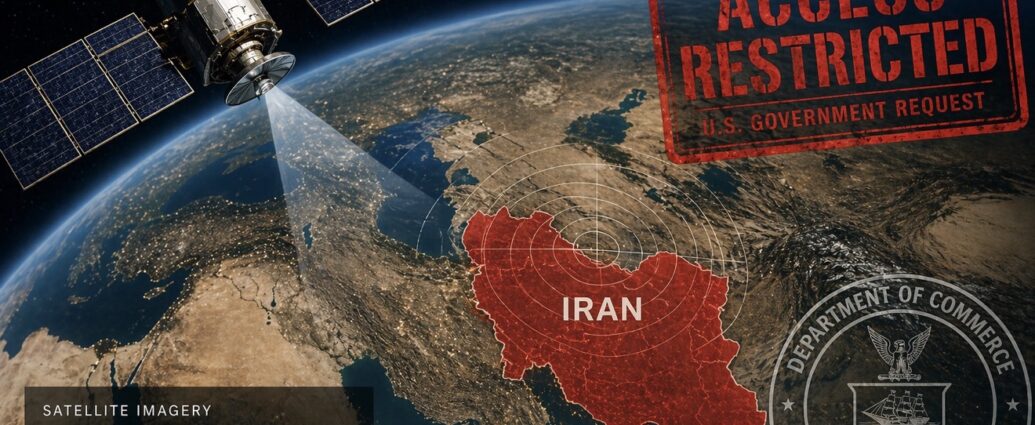
WASHINGTON, D.C. — A sweeping U.S. government move to restrict satellite imagery over Iran is sending ripples through the global Earth-observation industry, forcing companies, investors, and intelligence users to confront a core vulnerability: commercial space businesses ultimately operate at the discretion of government power.
San Francisco–based Planet Labs PBC, one of the world’s largest commercial satellite imaging providers, said on April 5 it would indefinitely suspend distribution of imagery covering Iran and the broader Middle East conflict zone following a direct request from U.S. authorities. The restriction, retroactive to March 9, replaces the company’s prior 14-day delay policy with a far tighter “managed access” system, limiting availability of both its high-resolution SkySat and medium-resolution PlanetScope data. “These are extraordinary circumstances,” the company told customers, adding it is working “to balance the needs of all stakeholders.”
The directive stems from escalating hostilities that began on February 28, when the United States and Israel launched coordinated strikes against Iranian targets. Iran’s subsequent missile and drone responses across Israel and the Gulf have transformed the region into one of the most tightly contested environments for commercial imaging since the Iraq War. The Pentagon, declining to comment publicly, has characterized the restrictions as tied to sensitive national security considerations.
At the center of the policy is a little-known but powerful legal tool: “shutter control.” Under the Land Remote Sensing Policy Act of 1992, U.S.-licensed satellite operators must comply with federal directives that can limit or halt data collection and distribution during national security events. The authority is overseen by the Department of Commerce, led by Secretary Howard Lutnick, in coordination with the Department of Defense. By accepting federal licenses through the National Oceanic and Atmospheric Administration (NOAA), companies effectively agree to these constraints as a condition of doing business.
The implications are profound for a sector long marketed as independent, transparent, and commercially driven. Analysts estimate the Earth-observation market at roughly $5 billion globally, with growth fueled by demand from agriculture, climate monitoring, defense, and financial services. But the Iran blackout is testing whether that model can withstand direct government intervention at scale.
For Planet Labs, the tension is particularly acute. The company built its brand — and its 2021 public listing — on the promise of open, near-real-time global imagery accessible to commercial clients, researchers, and media organizations. At the time of its IPO, Planet projected that commercial customers would account for nearly 70% of revenue by 2026. Instead, commercial revenue represented just 18% in 2025, underscoring the company’s continued reliance on government contracts even before the latest restrictions.
Competitors are navigating the situation differently. Vantor, the rebranded successor to Maxar Technologies, said it had not received a direct order from Washington but has implemented its own “enhanced access controls” in conflict zones, including parts of the Middle East. Those measures can restrict who is permitted to task satellites or purchase imagery. BlackSky Technology Inc., another major U.S. provider, has not publicly detailed its response, though both companies derive roughly half their revenue from U.S. defense and intelligence agencies.
The uneven application of restrictions highlights a deeper structural divide in the industry. Companies like Planet, which historically emphasized open access, face sharper disruptions when data flows are curtailed. By contrast, firms with heavier government ties are often already operating within controlled-access frameworks, making compliance less visible to end users.
Beyond corporate balance sheets, the blackout is already affecting a wide ecosystem of analysts, watchdogs, and international organizations. Groups such as the International Atomic Energy Agency (IAEA) and open-source intelligence platforms like Bellingcat have relied heavily on Planet’s daily imagery to monitor nuclear facilities, verify military activity, and document human rights conditions. Without that steady stream of data, independent verification of events inside Iran has become significantly more difficult.
“No other U.S. company provides the same breadth of open access that Planet historically has,” said Jeffrey Lewis, director of the East Asia Nonproliferation Program at the Middlebury Institute. The sudden loss of that visibility, he noted, creates blind spots not just for governments but for the global public.
Some customers are already shifting to alternatives. European providers, including those affiliated with the European Space Agency, and commercial operators in Asia face no obligation to comply with U.S. directives. China, which operates the largest Earth-imaging satellite network outside the United States, is also emerging as a potential beneficiary as users seek uninterrupted data sources.
Investors have long flagged shutter control as a latent risk in the sector, but the Iran restrictions represent one of the most expansive uses of that authority in decades. While government contracts provide stable baseline revenue, forced data blackouts can erode the value proposition for commercial clients who depend on timely, unrestricted access.
The episode is prompting a broader reassessment of the industry’s future. Can a business built on transparency and real-time intelligence coexist with national security constraints that can instantly override commercial operations? Or will the sector increasingly evolve into a quasi-governmental extension, where access, pricing, and availability are shaped as much by policy as by market demand?
For now, the answer remains unsettled. But as geopolitical tensions intensify and space-based infrastructure becomes more central to both warfare and commerce, the Iran blackout is likely to serve as a defining case study — one that will shape how investors, regulators, and companies value control in the final frontier.
JBizNews Desk