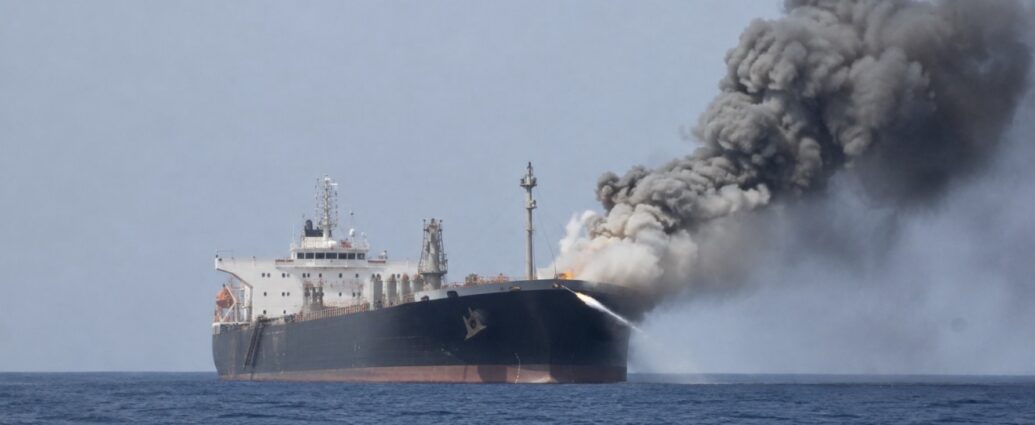
A U.S. military helicopter fired into the rudder of a Panama-flagged container ship in the Gulf of Oman early Tuesday, deliberately wrecking the vessel’s steering rather than sinking it, after the crew ignored warnings from the American forces enforcing the naval blockade of Iran’s ports. The ship afterward appeared to be trying to move its crew onto another civilian vessel, and there were no immediate reports of casualties.
The vessel is believed to be the Vela Nova. The United Kingdom Maritime Trade Operations reported an incident involving a container ship and military forces in the Gulf of Oman, having first logged the vessel as a tanker; maritime risk group Vanguard and a security source separately assessed that the Vela Nova was struck by a missile roughly 71 nautical miles off Pakistan’s coast.
The targeting choice is the whole point of the operation. American forces have been aiming at rudders, engine rooms and smokestacks — the parts that make a ship move — so the vessel stops where it is instead of burning or going down with its cargo and crew. It is enforcement by immobilization, and it has become the standing method along this stretch of water.
How the blockade works now
Washington first imposed the blockade on Iranian ports on April 13. It came off in late spring, then went back on in mid-July after talks between the two sides collapsed. Since U.S. forces reimposed the blockade on July 13, they have redirected 55 commercial vessels, disabled two and boarded two to enforce compliance, according to figures Central Command released Sunday. Those numbers predate Tuesday’s incident.
The pattern is consistent: ships heading for Iranian terminals are hailed, warned repeatedly, and told to turn around. Most comply and are redirected. The ones that keep going get shot in the machinery.
The price at the pump end of the chain
For business readers, the number that matters is crude. Oil jumped about 5% Monday as confidence faded that Washington and Tehran would reach a deal to restore traffic through the Strait of Hormuz, with West Texas Intermediate settling at $82.13 a barrel and Brent at $87.72. By early Tuesday, Brent was trading near $92.54, roughly $5 above the prior morning and about $25 higher than a year ago.
The gap between the two benchmarks is the tell. Analysts described Monday’s move as pure Hormuz risk pricing rather than a fresh demand story, and flagged the widening Brent-WTI spread as the clearest evidence that this is Middle East supply risk, not global consumption, driving the tape. WTI, priced at Cushing, Oklahoma, barely moved Tuesday. Brent, which prices the barrels that actually have to sail past the shooting, did the moving.
Shipping costs are carrying the same premium. War-risk insurance for vessels in the region has climbed to between 7.5% and 10% of hull value — a charge that lands on every cargo, not just oil, and gets passed down the line to the buyer.
There is a strategic reserve angle as well. U.S. Strategic Petroleum Reserve stocks have dropped below 300 million barrels, the lowest since January 1983, as the conflict has dragged on. The cushion Washington would normally use to blunt a price spike is thinner than it has been in four decades.
Diplomacy running alongside the shooting
Tuesday’s strike landed in the middle of an active negotiating track. Pakistan’s defense minister told Bloomberg the two sides are close to “some sort of an arrangement,” pointing to signals from the past few days, while Qatar said Oman-Iran negotiations have reached an advanced stage with positive feedback from both parties. Iran’s foreign ministry spokesman countered that the United States has not come to the table seeking genuine talks or peace.
Tehran’s asking price has not moved. Iran wants the blockade ended, sanctions lifted and compensation for war damages before it agrees to fully reopen Hormuz, and has declined direct talks with Washington for now. President Trump told Axios the U.S. is “only semi-negotiating,” and indicated he would lean on the blockade to squeeze Iran’s economy rather than order another round of airstrikes.
That is the trade every shipper, refiner and insurer is now pricing: an economic siege that Washington intends to keep tightening, a Tehran that will not reopen the waterway until the siege lifts, and a shipping lane where the cost of guessing wrong is a missile in the engine room. Until one of those three changes, the risk premium stays in the barrel — and in the freight rate.
JBizNews Desk | New York
© JBizNews.com All Rights Reserved. Reproduction or distribution without written permission is prohibited.