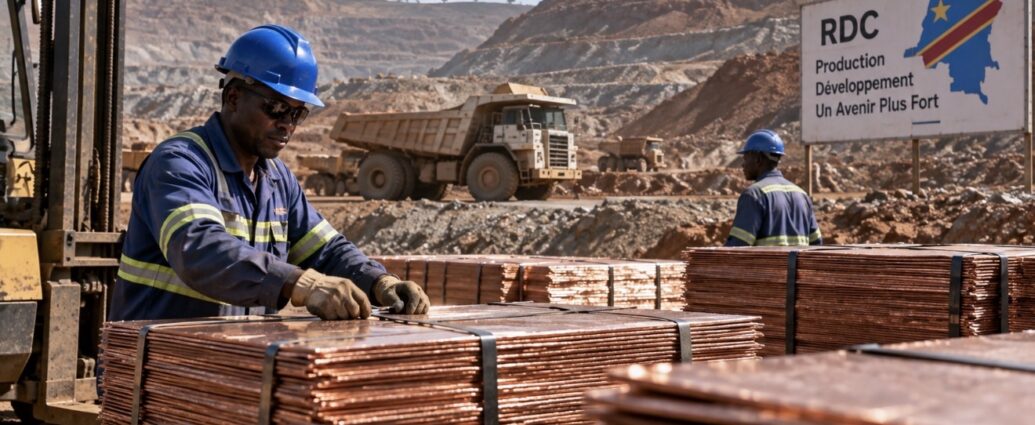
WASHINGTON — U.S. imports of copper from the Democratic Republic of Congo surged to a record in July, showing how American manufacturers are increasingly turning to Africa for one of the most important metals powering factories, electrical infrastructure, vehicles and data centers.
Copper cathode shipments from Congo reached 53,290 metric tons in July, according to U.S. trade data.
That gave Congo 23.9% of all U.S. copper imports for the month.
Total U.S. copper imports also exceeded 220,000 tons for the first time.
The numbers are striking because the United States imported less than 32,000 tons from Congo during all of 2024.
In a single month this summer, U.S. buyers brought in substantially more Congolese copper than they had during that entire year.
The shift reflects several forces hitting the copper market at once.
Copper prices have risen sharply.
Demand remains strong from power grids, electric vehicles, industrial equipment and artificial-intelligence data centers, all of which require huge amounts of electrical wiring and infrastructure.
At the same time, U.S. buyers have been trying to secure metal ahead of possible new tariffs.
That has created strong incentives to find additional sources.
Congo is now becoming one of them.
The country is already the world’s second-largest copper producer, behind Chile, and production has expanded significantly in recent years.
Historically, much of that copper has flowed toward China.
But U.S. industrial buyers are increasingly willing to purchase Congolese material directly.
Price is a major reason.
Congolese copper is generally not approved for delivery against U.S. COMEX futures contracts, unlike certain brands from countries such as Chile, Peru and Zambia.
Because of that, it can trade at meaningful discounts.
Reuters reported that some U.S. buyers have been able to purchase Congo copper at discounts of roughly $550 to $800 per metric ton compared with COMEX-approved brands.
For manufacturers buying thousands of tons of metal, those savings can become significant.
Improving quality has also helped.
Some American copper-rod mills and tube manufacturers that previously preferred other sources are becoming more comfortable using Congolese material.
That gives Congo a chance to become a much more important part of the U.S. industrial supply chain.
The timing matters.
Washington has spent years warning that China controls too much of the global supply chain for critical minerals.
Copper is not as rare as lithium or rare-earth elements, but it is arguably just as important to modern infrastructure.
Every major expansion of the electric grid requires copper.
So do transformers, factories, electric vehicles, renewable-energy installations and data centers.
AI adds another layer of demand because the enormous power systems serving new data centers require huge amounts of copper wiring and electrical equipment.
That means securing diversified copper supplies is becoming an economic-security issue.
The surge from Congo also shows how trade policy can redirect physical commodities.
China’s imports of Congolese copper declined during the first seven months of the year, while more metal moved toward U.S. buyers.
That does not mean America is replacing China as Congo’s dominant customer.
But the direction is changing.
For U.S. manufacturers, the immediate attraction is cheaper copper.
For Washington, the larger opportunity is building stronger commercial ties with one of the world’s most important mineral-producing countries.
And for Congo, rising U.S. demand could reduce its dependence on a single major buyer.
The July numbers therefore represent more than an unusual trade spike.
They show how the global scramble for the metals behind electricity, manufacturing and AI is beginning to reshape who buys from whom.
JBizNews Desk | Washington
© JBizNews.com All Rights Reserved. Reproduction or distribution without written permission is prohibited.