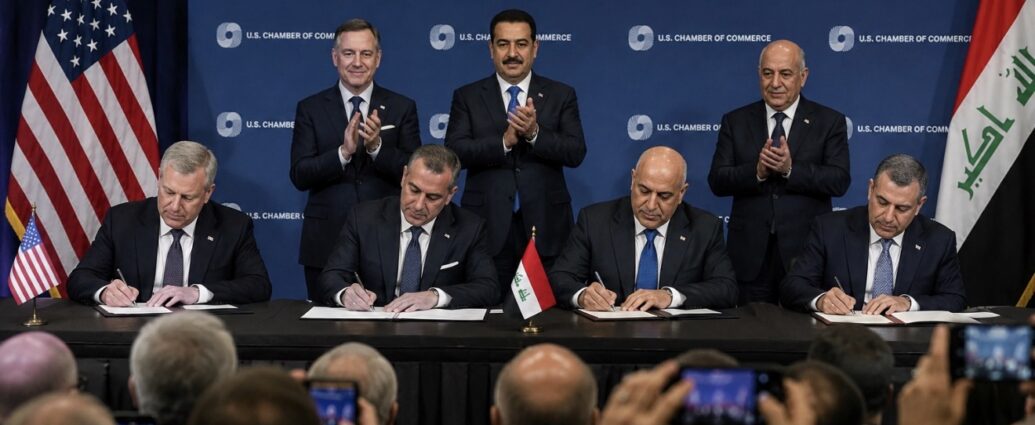
American and Iraqi officials announced more than $60 billion in commercial agreements covering energy, infrastructure, healthcare, technology and investment projects, highlighting expanding economic ties between the two countries.
WASHINGTON — The U.S. Chamber of Commerce announced Friday that American and Iraqi companies, together with the two governments, signed more than 50 agreements and memoranda of understanding totaling over $60 billion during the U.S.–Iraq Business Summit, marking one of the largest commercial initiatives between the two nations in recent years.
The agreements span energy, healthcare, communications, financial services, technology, infrastructure and industrial development, reflecting Iraq’s effort to diversify its economy while expanding opportunities for American companies seeking to invest in one of the Middle East’s largest emerging markets.
The summit brought together senior officials from both governments along with executives representing a broad cross-section of American industry. Organizers described the gathering as a turning point in the bilateral relationship, shifting the focus from decades of security cooperation toward long-term economic growth driven by private-sector investment.
Energy remained a central component of the discussions, with several companies announcing new commercial partnerships intended to expand oil and natural gas production, improve electricity generation and modernize critical infrastructure. At the same time, numerous agreements extended beyond the energy sector, underscoring Iraq’s broader economic ambitions.
Healthcare companies explored expanding access to medical technology and hospital services, while communications and technology firms announced initiatives aimed at strengthening Iraq’s digital infrastructure. Financial institutions also outlined plans to increase banking cooperation and support future commercial investment throughout the country.
Executives participating in the summit said Iraq offers significant long-term opportunities because of its large population, abundant natural resources and growing demand for modern infrastructure. Government officials emphasized that attracting foreign investment remains a national priority as Iraq works to create private-sector jobs, strengthen public services and reduce dependence on government spending supported by oil revenues.
The summit also demonstrated increasing interest from major American corporations in expanding their presence in Iraq after years in which security concerns often limited commercial activity. Business leaders said stronger economic ties could create new opportunities for trade, investment and technology transfer while supporting long-term economic stability.
Although the announced value exceeded $60 billion, officials noted that many of the agreements are memoranda of understanding or framework agreements that will require additional negotiations, financing, regulatory approvals and final contracts before projects move into construction or operation. The total therefore reflects the potential value of the announced commercial commitments rather than funds that have already been invested.
For the United States, the summit reinforces a strategy of strengthening relationships through commerce and private investment. For Iraq, the agreements represent an opportunity to accelerate economic development, attract international capital and broaden cooperation with one of its largest trading and investment partners.
If successfully implemented, the agreements could support thousands of jobs, expand infrastructure development and deepen commercial ties between the United States and Iraq for years to come.
JBizNews Desk | Washington
© JBizNews.com All Rights Reserved. Reproduction or distribution without written permission is prohibited.