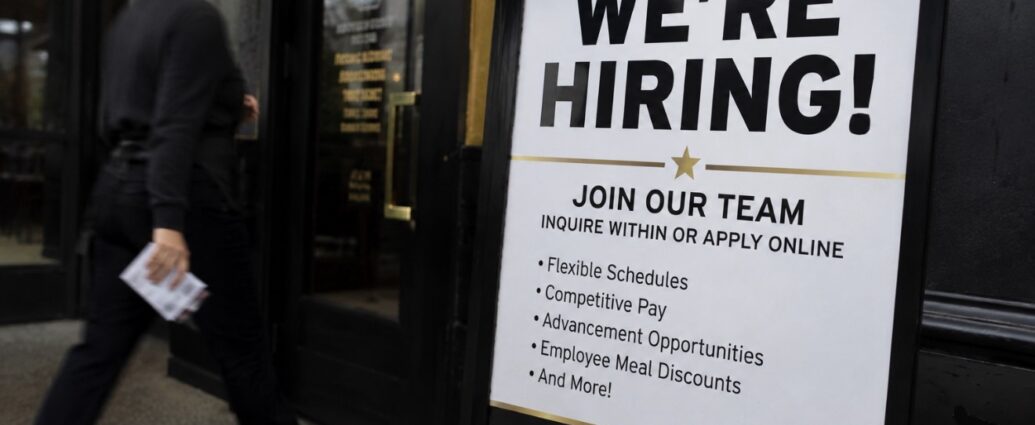
The American job market showed surprising resilience this spring. According to the U.S. Bureau of Labor Statistics, whose Job Openings and Labor Turnover Survey for April was released Tuesday, June 2, the number of open positions rose to 7.6 million — a jump of 731,000 from March and the highest level in nearly two years, since May 2024. The figure blew past the 6.8 million that economists surveyed by Dow Jones had expected, pushing the number of available jobs back above the total of unemployed workers.
The internals were more mixed than the headline suggests. Hiring actually slowed, with companies bringing on 5.12 million workers, down 419,000 from March, while total separations eased to 5.0 million. Within that, quits held about steady at 3.0 million and the quits rate slipped to 1.9%, its lowest in years — a sign that fewer workers feel confident enough to leave a job voluntarily. Layoffs and discharges stayed contained at 1.7 million, a rate of 1.1%, with retail trade actually shedding fewer jobs than the month before.
The surge in openings was narrow. Nearly all of it came from one category: professional and business services, which added 668,000 postings. Some economists read that as evidence pushing back on fears that artificial intelligence is gutting white-collar demand. Health care and social assistance added about 89,000 openings. Financial activities went the other way, with openings falling 134,000, and most other industries changed little.
Beneath the numbers is a split between big and small employers. According to Indeed’s Hiring Lab, openings at the very largest establishments — those with 5,000 or more workers — stood about 81% above their pre-pandemic level, by far the strongest of any group. But those giants account for less than 5% of all openings. The roughly 90% of postings tied to employers with fewer than 1,000 workers have been comparatively flat since mid-2024, meaning the typical small business is holding steady rather than booming.
Economists described a “low-hire, low-fire” market that is stable for now but vulnerable. “For now, the labor market remains mostly stable,” said Matthew Martin, senior U.S. economist at Oxford Economics, who warned that the Iran war could test hiring as household spending and uncertainty weigh on firms. Noah Yosif, chief economist at the American Staffing Association, cautioned that one report does not make a trend.
The data matters for businesses because a steady job market underpins consumer spending, which drives most of the U.S. economy, and for the Federal Reserve, which watches JOLTS for signs of slack. Under new Chair Kevin Warsh, the Fed has shifted its worry from labor weakness to inflation driven by tariffs and soaring energy costs, and is widely expected to hold rates steady. The next read arrives soon: the BLS is scheduled to release the May JOLTS figures on June 30, which will show whether April’s rebound in demand held up.
JBizNews Desk
© JBizNews.com All Rights Reserved. Reproduction or distribution without written permission is prohibited.