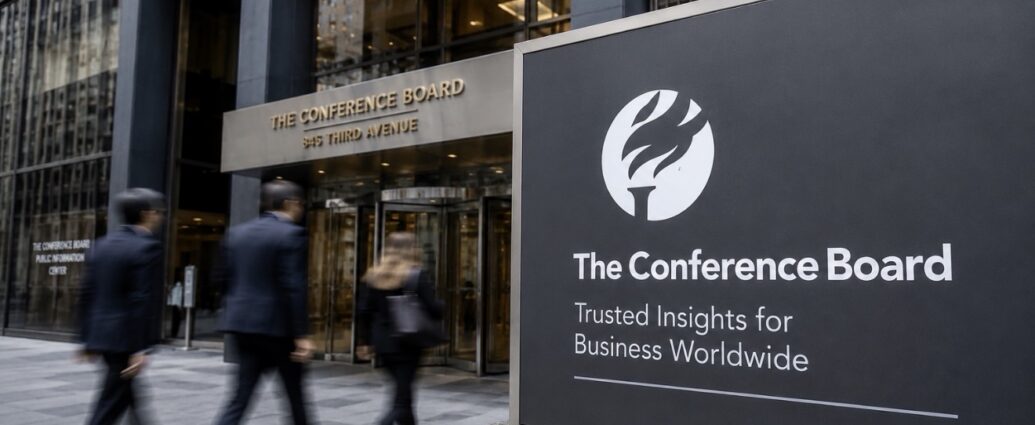
NEW YORK — The Conference Board’s Leading Economic Index (LEI) declined 0.2% in June, partially reversing gains recorded over the previous two months as weaker consumer expectations and a slowdown in residential building permits outweighed improvements in financial market indicators. The report, released Monday, July 20, also raised the organization’s 2026 U.S. GDP growth forecast to 1.9% from 1.8%, citing continued strength in business investment tied to artificial intelligence.
The LEI, one of the nation’s most closely watched forward-looking economic indicators, fell to 99.1 in June after increasing in May. While the monthly decline points to slower momentum in parts of the economy, the Conference Board emphasized that the overall pace of deterioration has moderated significantly compared with late 2025.
According to the Conference Board, consumer expectations weakened and building permits declined across most housing categories, becoming the largest negative contributors to the index. Positive contributions from the Treasury yield spread and other financial indicators were not enough to offset those headwinds.
Despite the monthly setback, the organization said the broader picture has improved. The LEI declined only 0.3% during the first half of 2026, compared with a 1.1% contraction during the second half of 2025, suggesting economic conditions have stabilized even as growth slows.
One of the report’s most notable conclusions was its more optimistic growth outlook. The Conference Board increased its 2026 GDP forecast to 1.9%, explaining that while consumer spending has softened, strong corporate investment in artificial intelligence infrastructure and technology continues supporting overall economic activity as inflation gradually improves.
The Leading Economic Index combines ten forward-looking indicators, including manufacturing orders, unemployment claims, consumer expectations, stock prices, building permits and the Treasury yield spread. Economists monitor the index because it has historically provided an early indication of turning points in the business cycle several months before broader economic trends become apparent.
For businesses, today’s report presents a mixed picture. Housing-related industries could face continued pressure if residential construction remains subdued, while companies connected to artificial intelligence, cloud computing, semiconductors and digital infrastructure continue benefiting from elevated capital spending by corporations.
Financial markets are also likely to focus on the report’s implication that the U.S. economy is slowing without entering recession. Stable labor markets, moderating inflation and continued investment in technology have helped offset weakness in more interest-rate-sensitive sectors such as housing.
For consumers, weaker expectations may translate into more cautious spending in the months ahead. However, continued job growth and business investment suggest the economy still maintains important sources of resilience despite elevated borrowing costs.
Investors will continue watching upcoming reports on inflation, employment, manufacturing activity and consumer spending to determine whether June’s decline represents a temporary pause or the beginning of broader economic slowing during the second half of the year.
Overall, Monday’s report reinforces an increasingly balanced outlook: economic growth is moderating, housing remains under pressure, consumer optimism has softened, but sustained investment in artificial intelligence continues providing meaningful support for the broader U.S. economy.
JBizNews Desk | New York
© JBizNews.com All Rights Reserved. Reproduction or distribution without written permission is prohibited.