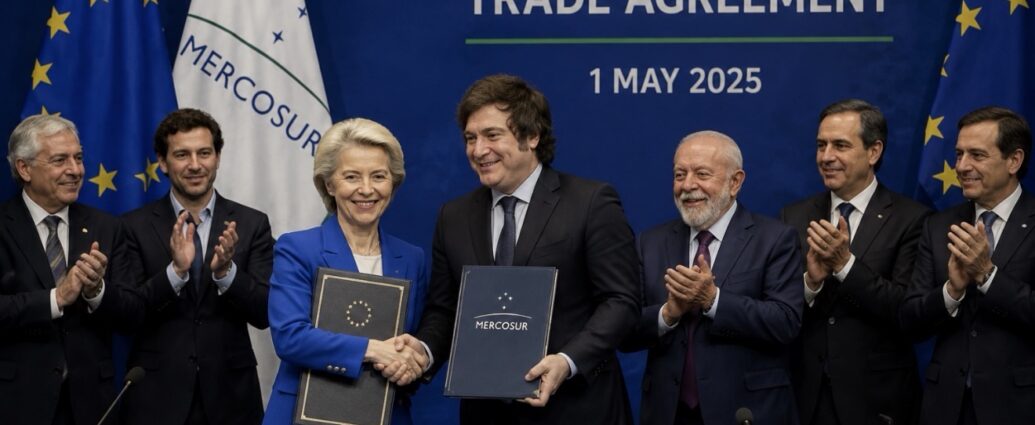
The trade barriers President Donald Trump raised to protect American industry are pushing some of the country’s biggest trading partners closer together. After more than two decades of stalled negotiations, the European Union and Mercosur — the South American bloc made up of Brazil, Argentina, Uruguay, and Paraguay — put their trade agreement into provisional effect on May 1, according to the European Commission. Officials on both sides say U.S. tariffs helped push the long-delayed deal across the finish line.
The agreement creates a trading zone of roughly 700 million people. It lowers tariffs on products including automobiles, machinery, and pharmaceuticals, saving European companies an estimated €4 billion each year. In return, exports of European agricultural products such as wine, spirits, chocolate, and olive oil are expected to rise significantly across South America.
The driving force, by many accounts, was Washington. Trump’s tariffs, including an additional 40% duty on Brazilian goods on top of existing rates, gave both blocs a stronger incentive to diversify their trading relationships. Former Brazilian diplomat Roberto Jaguaribe said uncertain trade relations with the United States naturally encourage countries to seek new partners, while former trade official Larissa Wachholz called the agreement a major turning point in Brazil’s traditionally protectionist trade policy.
The impact is already reaching smaller businesses. In Brazil, producers of cachaça — the sugarcane spirit used to make the caipirinha cocktail — see a rare opportunity to expand into Europe as tariffs fall and access to new markets improves. Distillers say exports could grow dramatically once the agreement is fully implemented.
For American businesses, the agreement presents a competitive challenge. Every tariff barrier the United States builds gives foreign competitors another reason to trade with one another instead. European and South American companies will now enjoy preferential access to each other’s markets that U.S. exporters do not receive. American manufacturers of machinery, aircraft parts, industrial equipment, and other products selling into Brazil may increasingly find themselves undercut by European rivals whose tariffs have been reduced or eliminated.
Mercosur is not stopping with Europe. Since Trump returned to office, the bloc has accelerated negotiations with other major economies, completing an agreement with four non-EU European countries while opening new talks with Canada, Japan, and the United Arab Emirates. Brazil, whose largest trading partner is China, is positioning itself at the center of an increasingly multipolar global trading system rather than relying heavily on any single country.
The agreement also extends beyond trade. Member nations pledged to uphold democratic institutions and remain committed to the Paris climate agreement, commitments European officials say have taken on added importance as the United States has stepped back from several international climate initiatives. The deal also strengthens Europe’s access to strategic raw materials, including niobium, a metal used in MRI scanners, aerospace components, and advanced technologies. The EU currently imports about 82% of its niobium from Mercosur countries.
There are still hurdles ahead. France, backed by its influential farming sector, continues to oppose portions of the agreement, and the pact will require formal approval from the European Parliament before taking full legal effect. Safeguards also allow either side to limit imports that threaten sensitive industries such as beef, poultry, and sugar.
Even so, tariffs are already being reduced on thousands of products, and businesses on both continents are moving quickly to capitalize on the new opportunities.
For Brazil, which also faces a U.S. investigation over alleged unfair trade practices, officials say there is little appetite to return to the protectionist policies of the past. The broader lesson is that global trade is not necessarily shrinking because of tariffs—it is increasingly being rerouted. As the United States becomes a more difficult market to access, many of the world’s largest economies are choosing to deepen trade with one another instead, leaving American exporters at risk of being left outside some of the world’s fastest-growing trade partnerships.
JBizNews Desk
© JBizNews.com All Rights Reserved. Reproduction or distribution without written permission is prohibited.