By JBizNews Desk | May 11, 2026
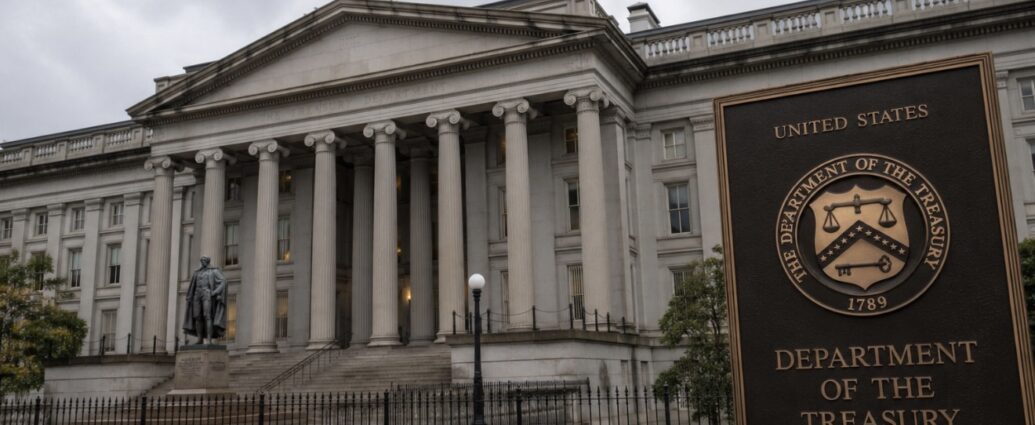
The U.S. Treasury Department confirmed this week that the federal government needs to borrow significantly more money than previously expected, intensifying pressure across bond markets and raising concerns that higher interest rates could continue spreading through mortgages, business lending and household borrowing costs for months ahead.
In its official quarterly borrowing announcement, the Treasury said it expects to issue $189 billion in privately held net marketable debt during the April-through-June 2026 quarter, approximately $79 billion more than projected just three months earlier.
The increase reflects weaker-than-expected federal cash flows as government spending continues running well above incoming revenue.
For the following quarter covering July through September, the Treasury expects to borrow an additional $671 billion, highlighting the enormous financing demands now confronting U.S. debt markets.
Across the full fiscal year, the Office of Management and Budget projects the federal deficit will reach approximately $2.065 trillion, surpassing the Congressional Budget Office’s estimate of $1.853 trillion and placing the federal government on pace to borrow more than $166 billion every month.
The broader debt picture has become increasingly difficult for markets to ignore.
Total U.S. national debt is now approaching $39 trillion, while the CBO estimates the Treasury paid nearly $530 billion in interest expense during just the first six months of fiscal 2026 — equivalent to roughly $88 billion per month and more than $22 billion every week.
Annual federal interest payments have now climbed above $1.2 trillion, rivaling combined government spending on major federal priorities including education and defense.
“$2 trillion deficits used to be unheard of, and then they only occurred during major recessions,” said Maya MacGuineas, president of the Committee for a Responsible Federal Budget. “It’s beyond scary that $2 trillion deficits are now the norm. Markets will only tolerate our unsustainable borrowing for so long.”
Warnings about America’s fiscal trajectory are increasingly coming not only from policy groups but also from some of the world’s most influential financial leaders.
Federal Reserve Chair Jerome Powell has repeatedly described the long-term U.S. debt path as “unsustainable,” while JPMorgan Chase chief executive Jamie Dimon has warned that rising deficits, elevated inflation and expanding Treasury issuance could eventually trigger instability in the bond market itself.
Economist Mohamed El-Erian has similarly cautioned that the sheer scale of government borrowing could place persistent upward pressure on Treasury yields and tighten financing conditions throughout the broader economy.
Those concerns are already beginning to appear in market pricing.
The yield on the 30-year U.S. Treasury bond has climbed back toward 5%, a psychologically important threshold that directly affects mortgage rates, corporate borrowing costs and consumer lending benchmarks.
Long-term yields at those levels increasingly signal something larger than normal interest-rate volatility. Investors are demanding greater compensation to hold long-duration government debt because of mounting concern over how much Treasury supply must now be absorbed by private investors, foreign reserve managers, banks and institutional funds.
The Federal Reserve Bank of New York’s term premium measures — which estimate the additional yield investors require to hold longer-term bonds instead of repeatedly rolling short-term debt — have also risen sharply alongside the borrowing increase.
Bond strategists say the move reflects a more structural repricing of fiscal risk rather than ordinary market fluctuations tied solely to Federal Reserve policy expectations.
The growing Treasury supply problem is also colliding with renewed inflation pressures tied partly to the Iran conflict and surging energy costs.
The Treasury Borrowing Advisory Committee, which includes senior fixed-income market participants advising the government on debt issuance strategy, noted in its latest report that oil prices have risen nearly 60% since the start of the Iran conflict and almost 80% since the beginning of 2026.
That surge has sharply increased inflation expectations globally.
According to the committee’s analysis, one-year inflation swaps have climbed roughly 100 basis points in Europe and approximately 75 basis points in the United States since the conflict began, forcing investors to reassess expectations for central bank rate cuts.
The Federal Reserve’s preferred inflation gauge, the Personal Consumption Expenditures (PCE) index, accelerated to 3.5% year-over-year in March, driven heavily by rising energy prices and tariff-related pressures.
That combination has complicated expectations that the Fed would begin aggressively lowering rates later this year.
For ordinary Americans, the consequences of rising Treasury yields are increasingly tangible.
Mortgage rates have climbed alongside long-term government borrowing costs, making home purchases more expensive and worsening affordability pressures across the housing market.
Corporate borrowing costs have also increased, raising the cost of financing expansions, hiring and investment activity for businesses already navigating slower economic growth.
Consumer credit markets are being affected as well.
Auto loans, credit cards, small-business lending and commercial financing products frequently price directly off Treasury benchmarks, meaning rising federal borrowing costs eventually flow through into household budgets and business expenses throughout the economy.
Market analysts say the concern is no longer simply the size of America’s debt, but the speed at which new borrowing must now be financed in an environment of higher inflation, geopolitical instability and elevated interest rates.
The Securities Industry and Financial Markets Association has long described Treasury securities as the foundational benchmark underlying virtually all dollar funding markets.
That means stress in the Treasury market rarely stays isolated.
When government borrowing expands rapidly while investors demand higher yields to absorb that debt, the effects spread through housing, credit markets, corporate financing and consumer borrowing simultaneously.
The Federal Reserve may eventually reduce short-term interest rates if economic growth weakens further.
But many bond investors increasingly believe the long end of the Treasury market is beginning to impose its own discipline on Washington’s fiscal trajectory — and that discipline is arriving in the form of persistently higher borrowing costs.
What the latest Treasury data ultimately reveals is a federal government continuing to spend aggressively at precisely the moment markets are becoming less willing to finance those deficits cheaply.
And unless borrowing needs begin slowing meaningfully, Wall Street is signaling that the era of low-cost government debt may be ending far faster than Washington expected.
JBizNews Desk