The United Arab Emirates is pressing ahead with a multibillion-dollar plan to route its oil, gas and cargo around the Strait of Hormuz entirely, the country’s foreign trade minister said in an interview laying out the strategy in mid-June. Dr. Thani Al Zeyoudi, the UAE’s Minister of Foreign Trade, said the Gulf state is working toward what he called “zero Hormuz dependency” — and that it will keep building whether or not the waterway stays open. The National
“We’re moving toward having zero Hormuz dependency, and that’s regardless of whether it’s open or not,” Al Zeyoudi said. “It’s going to open and we hope that will happen quickly, but we will not stop the new plan.” Bloomberg
The timing is pointed. The Strait of Hormuz — the narrow channel between Iran and Oman — normally carries about a fifth of the world’s crude oil and liquefied natural gas. Iran has effectively controlled the strait since shortly after the war with the United States began on February 28, virtually shutting the passage for roughly 20% of the world’s oil. NPR That closure drove fuel, food and shipping costs higher around the globe.
A June 15 interim peace deal between Washington and Tehran is meant to reopen the strait and lift the dueling naval blockades NPR, and oil prices fell sharply on the news. But shippers remain cautious, and Iranian officials insist they will impose a transit fee once the deal’s 60-day window expires. Council on Foreign Relations That uncertainty is exactly what the UAE says it wants to design out of its economy.
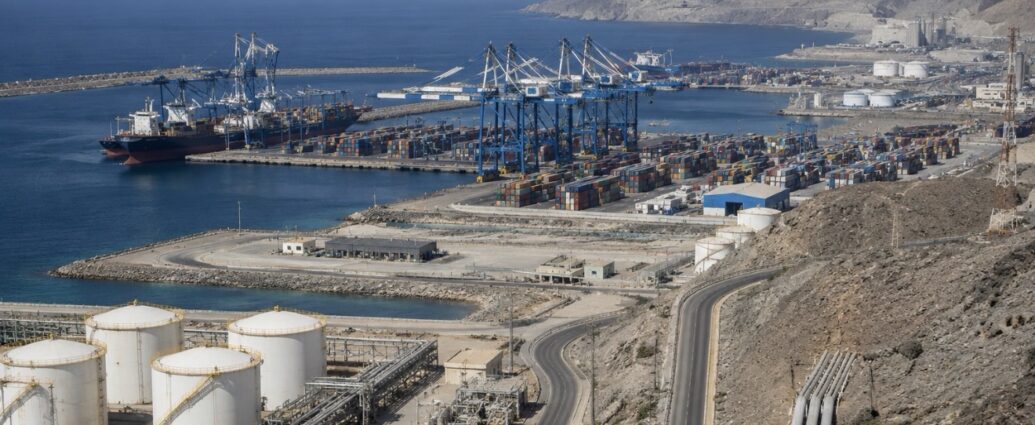
At the center of the plan is a major expansion of the UAE’s eastern ports — Fujairah, Khor Fakkan and Dibba — all of which sit on the Gulf of Oman, outside the strait. Al Zeyoudi said the country also intends to build at least one new harbor along that coastline. The National
Connecting those ports to the country’s oilfields, gasfields and petroleum facilities will require new pipelines, rail lines and roads linking the eastern coast to inland sites. The National
The energy piece is moving fastest. The UAE is accelerating a second pipeline that would double crude export capacity through Fujairah and is evaluating a third petroleum line on top of that. Outlook Business Today a single 1.5 million barrel-per-day pipeline to Fujairah is the country’s only overland crude lifeline. Pipeline-journal Planned expansion could lift total capacity above 3.5 million barrels a day, according to figures cited by Reuters. Marine Insight Officials are also weighing ways to move petrochemicals, LNG and other products without touching Hormuz.
Al Zeyoudi said the projects remain in the planning stage with no disclosed timeline or price tag, but acknowledged they would require billions of dollars. Outlook Business
He was candid about the limits. Crude oil is the easy part, because it can be pushed through pipelines. Liquefied natural gas, aluminum and container imports are far harder to shift. The Liberty Daily The UAE also leans heavily on Gulf ports such as Jebel Ali for imports and regional trade, so moving more cargo east would raise transport costs Marine Insight — though the minister said expanded rail and road links should hold those costs down while Jebel Ali and Khalifa Port keep serving as hubs.
The recent shutdown was a live stress test. During the conflict the UAE kept some crude moving through its existing Fujairah pipeline and leaned harder on eastern ports israelnationalnews, while redirecting cargo through ports in countries including Egypt and India and turning to air freight to keep supply chains intact. israelnationalnews
The Emirates are not racing alone. Saudi Arabia pushed its Hormuz-bypassing East-West Pipeline to a full 7 million barrels a day during the war, diverting oil to Red Sea terminals at Yanbu. Zero Hedge Iraq is expanding its northern pipeline through Turkey, and Kuwait has held early talks with Saudi Arabia and the UAE about cross-border lines. Zero Hedge The states with the fewest options — Kuwait, Qatar and Bahrain — remain almost entirely dependent on Hormuz Council on Foreign Relations, leaving them exposed if Iran revives its threats.
For businesses and households far from the Gulf, the stakes are simple. Every barrel that can skip the strait is a barrel less vulnerable to the next standoff — and less likely to spike prices at the pump, on store shelves and in shipping contracts. Moody’s Ratings expects crude to average between $90 and $110 this year IndexBox, a reminder of how heavily the closure still weighs on the global economy.
The UAE, for its part, is hedging both ways. Even as it builds to escape the chokepoint, the government said this week that the “uninterrupted flow of traffic through the Strait of Hormuz” israelnationalnews remains essential to regional and global prosperity.
JBizNews Desk © JBizNews.com All Rights Reserved. Reproduction or distribution without written permission is prohibited.