By JBizNews Desk
ABU DHABI — May 23, 2026
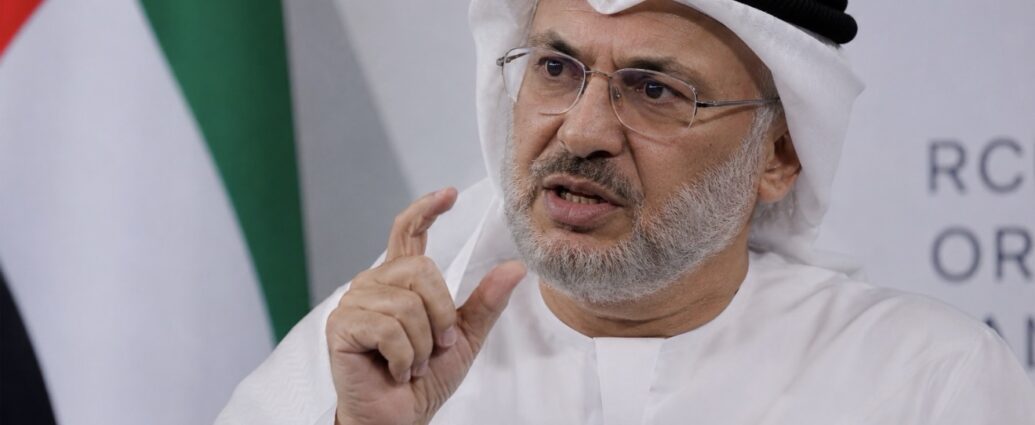
Anwar Gargash, Diplomatic Adviser to the President of the United Arab Emirates, on Thursday delivered the UAE’s sharpest public rebuke yet of Iran’s latest attempt to assert authority over the Strait of Hormuz, dismissing Tehran’s newly declared maritime jurisdiction as a fantasy born of military defeat and accusing the Islamic Republic of decades of regional “bullying” that destroyed Gulf trust.
The immediate trigger was a newly published Iranian maritime map. Iran’s Persian Gulf Strait Authority — a body established by Tehran on May 5 during the current ceasefire with the United States — released what it described as an official “regulatory jurisdiction” zone governing traffic through the Strait of Hormuz. The map outlined an area stretching from the Iranian coast near Kuh-e Mubarak to southern Fujairah in the UAE on the eastern side, and from Qeshm Island toward Umm Al Quwain on the western side. Tehran declared that vessels moving through the corridor must coordinate passage with Iranian authorities.
The claim directly overlaps with Emirati maritime space and places shipping approaches to Fujairah’s strategic oil infrastructure — designed specifically to bypass Hormuz chokepoints — under asserted Iranian oversight.
Gargash responded publicly within hours on X, writing in Arabic that Iran was attempting to “solidify a new reality born from an obvious military defeat.” He called Iranian ambitions to dominate the strait or infringe on UAE sovereignty “nothing but pipe dreams,” adding that Gulf states had endured Iranian “bullying” for decades while Tehran simultaneously issued contradictory messages of friendship.
He said restoring trust would require genuine respect for sovereignty, responsible rhetoric, and a true commitment to regional neighborliness.
The remarks significantly escalate the diplomatic language coming from Abu Dhabi and underscore how seriously Gulf governments are treating Tehran’s latest maritime claims following months of regional conflict and disruption to global energy flows.
The UAE Ministry of Foreign Affairs had already rejected Iranian accusations that Abu Dhabi participated directly in the war, while Khalifa Shaheen Al Marar, the UAE Minister of State, warned at the BRICS Foreign Ministers’ Meeting that using the strait as a mechanism of economic coercion amounted to piracy under international norms.
Al Marar also invoked Article 51 of the United Nations Charter, declaring that the UAE retains the sovereign right to defend its territory, residents, infrastructure, and shipping lanes.
The confrontation has rapidly expanded beyond bilateral rhetoric into an organized Gulf diplomatic campaign.
According to Bloomberg, five Gulf states — Saudi Arabia, the United Arab Emirates, Bahrain, Kuwait, and Qatar — jointly submitted a formal letter to the International Maritime Organization instructing commercial operators not to recognize Iran’s Persian Gulf Strait Authority or comply with Tehran-designated transit routes through Hormuz.
The IMO had already convened an extraordinary session earlier this month in which more than 115 member states co-sponsored a resolution condemning Iranian threats against international shipping and opposing any attempted closure or unilateral control of the strait. UAE officials described the resolution as the largest show of support in the organization’s history on a Gulf maritime issue.
The stakes extend far beyond regional politics.
The Strait of Hormuz remains one of the most economically sensitive waterways on earth, carrying roughly one-fifth of global oil supplies along with major volumes of liquefied natural gas, petrochemicals, and fertilizer shipments. Since the outbreak of the U.S.-Israeli conflict with Iran on February 28, insurance costs, shipping rates, and naval tensions throughout the Gulf have surged sharply.
Reuters previously reported that Iran has begun implementing a layered clearance process for commercial ships moving through Hormuz, including extensive vetting procedures, state-level approvals in some cases, and fees tied to secure passage guarantees.
That creates an increasingly dangerous operational reality for global shipping companies and energy traders.
Commercial vessel owners are now caught between competing sovereign claims over the same strategic waterway: Gulf governments and the broader international maritime community rejecting Iran’s authority, while Tehran attempts to impose de facto enforcement on the water itself.
For Gulf leaders, the dispute is increasingly about who defines the post-war balance of power in the region.
For energy markets, it is about whether one of the world’s most critical trade arteries can continue functioning without military escalation.
And for global shipping operators, the unresolved question remains immediate and practical: whether vessels can safely navigate Hormuz without becoming entangled in a widening geopolitical confrontation between Iran and its Gulf neighbors.
© 2026 JBizNews. All Rights Reserved. Reproduction or distribution without written permission is prohibited.