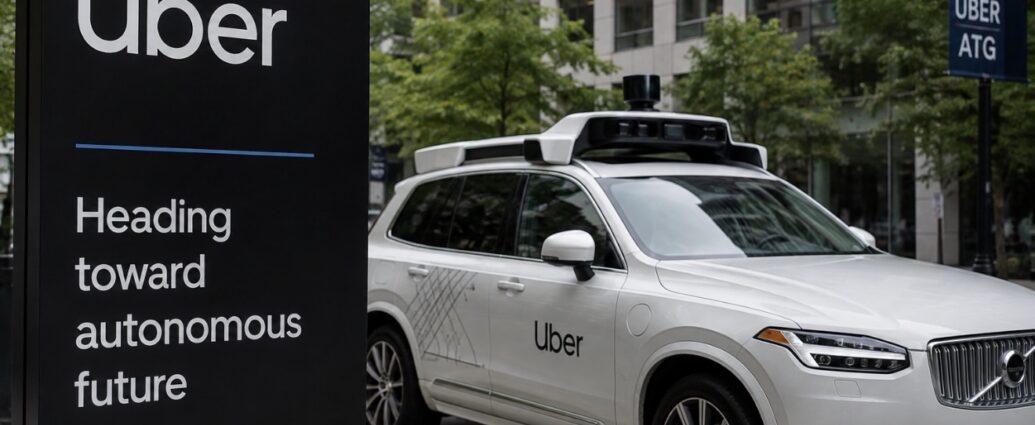
Uber will commit more than $10 billion to autonomous vehicles over the next several years, the company told investors Wednesday, the largest capital pledge in its history and a decisive break from the asset-light model that built the business.
The spending will consist largely of equity investments in autonomous-driving partners and balance-sheet support for fleet operations and vehicle commitments, a structure that puts Uber’s own capital behind cars it does not currently own. Chief Executive Dara Khosrowshahi described the outlay as an effort to build one of the most valuable positions in the autonomous vehicle ecosystem as the sector moves from proving the technology to selling rides at scale. The company did not attach a specific timeline to the spending.
Wall Street’s reaction was cool. Shares fell 4.8% after Uber guided to adjusted third-quarter profit of 84 to 88 cents a share, short of the 89 cents analysts had modeled.
The Business Model Is Changing
For fifteen years Uber’s central advantage was that it owned almost nothing. Drivers supplied the cars, the fuel, the insurance and the maintenance. That arrangement is what made the company scalable, and it is what a $10 billion vehicle commitment begins to unwind.
The shift pulls Uber toward an owns-more, funds-more posture — buying stakes in partners and helping finance vehicles and fleets. That makes the business meaningfully more capital-intensive, tying up cash and shifting the day-to-day operating risk of running cars onto Uber’s books.
Roughly $7.5 billion of the total is directed at fleet purchases, with more than $2.5 billion going into equity stakes in autonomous vehicle developers and manufacturers. The stated goal is robotaxi service in at least 15 cities by the end of 2026, expanding to 28 cities by 2028.
The company is not betting on a fully driverless network. Uber is pursuing a hybrid fleet in which riders may get an autonomous vehicle on one trip and a human driver on the next, depending on availability, route complexity and city — a structure it argues is more reliable than an all-robot approach.
The Waymo Problem
The announcement arrives at an awkward moment for Uber’s most visible partnership. Waymo, Alphabet’s self-driving unit, has reportedly told Uber it intends to end their exclusive arrangement in Atlanta and Austin by early 2028 — a report that pushed Uber shares to their lowest level in over a year.
Khosrowshahi waved off the reports on the analyst call, saying he expects the two companies to keep operating together in both cities while Uber deepens ties with other developers.
That diversification is already well underway. In March, Uber agreed to invest up to $1.25 billion in Rivian, starting with $300 million and funding the balance through 2031 as the automaker hits autonomy milestones, with deployment of 10,000 fully autonomous R2 vehicles beginning in 2028. The agreement carries an option for 40,000 additional vehicles in 2030, with initial launches in San Francisco and Miami and a target of 25 cities by 2031.
Uber has also partnered with Nuro and Lucid, with Nuro’s Lucid Gravity robotaxis slated for driverless testing in California, and its fleet plans lean on Nvidia’s DRIVE platform.
The Numbers Underneath
The operating business is not the problem. Second-quarter gross bookings rose 24% to $58.02 billion, beating expectations, helped by World Cup travel demand. Uber guided third-quarter gross bookings to a range of $58.25 billion to $60.25 billion against consensus near $59.21 billion, and warned that currency movement will shave about a percentage point off reported bookings growth after boosting it for four straight quarters.
What investors are weighing is where the cash goes. The scrutiny is sharper because Uber agreed last month to a $14.8 billion acquisition of Delivery Hero, leaving the company absorbing a major food-delivery integration and a multibillion-dollar vehicle program at the same time.
One shareholder analyst, Adam Ballantyne of Cambiar Investors, said the $10 billion figure matched his own expectations, arguing Uber will need billions over the next four to five years to support autonomous partners as they scale.
The strategic logic is defensible. Uber counts more than 200 million monthly active platform customers and roughly 10 million active vehicles, and if driverless rides can be delivered at prices and wait times comparable to competitors, the demand side is already built. The question is whether a company that spent its entire existence avoiding vehicle ownership can absorb the balance-sheet weight of becoming a fleet operator.
JBizNews Desk | New York
© JBizNews.com All Rights Reserved. Reproduction or distribution without written permission is prohibited.