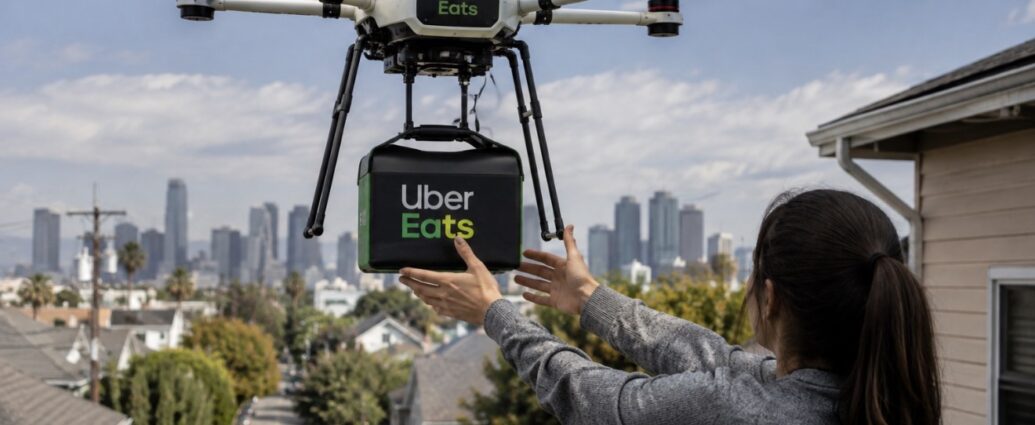
Uber is betting that the next major shift in food delivery will happen above the road, not on it.
The company is partnering with Zipline to bring drone delivery to Uber Eats in the United States, with the first service expected to begin later this year and an ambitious target of reaching 1 million drone deliveries a day by the end of 2029.
Uber is also investing in Zipline, giving it a financial stake in the company building the delivery system.
The move is important because it changes the economics of the last mile.
Today, a restaurant delivery usually depends on a driver, bicycle or motorcycle moving through traffic, finding parking and carrying one order at a time. A drone can potentially bypass congestion, travel a direct route and handle repeated short-distance deliveries with far less labor.
That does not mean drivers disappear.
Dense urban areas, apartment buildings, weather conditions, restricted airspace and larger orders will still require traditional delivery. But for suburban neighborhoods, hospitals, campuses and communities with predictable drop zones, drones could eventually handle a large share of routine orders.
Zipline has already spent years building autonomous delivery systems for medical supplies, food and retail products.
Its aircraft are designed to carry relatively small packages over short and medium distances, with automated systems managing navigation and delivery rather than requiring a human pilot for each trip.
For Uber, that creates another way to increase delivery capacity without adding a corresponding number of drivers.
The company already operates one of the world’s largest delivery networks, but every additional order currently requires labor, transportation and time. Autonomous delivery changes that equation.
If a drone can make multiple trips per hour with relatively low operating costs, the economics of delivering a $15 meal could become far more attractive than paying a driver to sit in traffic.
There is also a bigger competitive question.
DoorDash, Amazon, Walmart and other major delivery companies are all testing different forms of automation, from drones to sidewalk robots.
The first company that can make autonomous delivery work reliably at scale could gain a major cost advantage.
Uber’s target of 1 million drone deliveries per day shows how seriously it is taking that possibility.
The number would equal hundreds of millions of deliveries annually and would move drone delivery from experimental technology into mainstream logistics.
The biggest obstacles remain regulation, weather, noise, public acceptance and the practical challenge of delivering safely in crowded neighborhoods.
But the direction is becoming clear.
Uber began by replacing phone calls to taxi dispatchers with an app. It then expanded into food, freight and other transportation services.
Now it is preparing for a future in which some of those deliveries may no longer need a road at all.
JBizNews Desk | San Francisco
© JBizNews.com All Rights Reserved. Reproduction or distribution without written permission is prohibited.