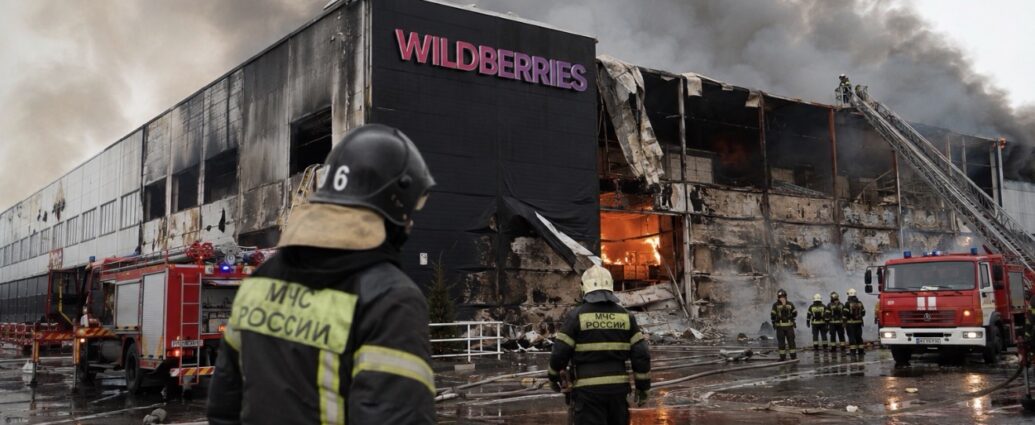
KYIV — Ukrainian President Volodymyr Zelenskyy confirmed Saturday that Ukrainian forces carried out long-range strikes against two major logistics centers operated by Wildberries, Russia’s largest online retailer, saying the facilities were being used to supply sanctioned components for drone production and navigation equipment supporting Russia’s military. The attack marks one of the most significant expansions of Ukraine’s campaign against Russia’s commercial logistics infrastructure since the war began.
The strikes targeted massive Wildberries distribution hubs in Kotovsk in Russia’s Tambov region and Elektrostal in the Moscow region. Russian authorities reported that the attacks killed at least nine people and injured more than 80 others, making them among the deadliest Ukrainian drone operations conducted inside Russia in recent months. Fires engulfed multiple warehouse complexes while emergency crews worked for hours to contain the blazes.
For businesses, the significance extends far beyond the immediate destruction.
Wildberries is Russia’s dominant e-commerce marketplace and distribution network, frequently compared to Amazon because of its nationwide fulfillment system, millions of weekly deliveries, and central role in connecting manufacturers, merchants and consumers across Russia. Any disruption to its logistics network has the potential to ripple through supply chains, delay deliveries, increase transportation costs and place additional pressure on merchants already operating under wartime conditions.
Until now, Ukraine’s long-range drone campaign has focused primarily on military airfields, oil refineries, ammunition depots and energy infrastructure. Saturday’s operation represents a notable strategic shift by targeting commercial logistics facilities that Kyiv alleges were supporting Russia’s military supply chain through the movement of restricted electronic components and navigation equipment.
President Zelenskyy said the warehouses were legitimate military-related logistics targets because they allegedly helped facilitate supplies used in Russian drone manufacturing. Russian officials rejected that characterization, maintaining the facilities were civilian commercial warehouses serving the country’s largest online retailer.
The attacks also illustrate how modern warfare increasingly extends into commercial infrastructure. Distribution centers, transportation hubs, warehouses and logistics providers have become critical economic assets whose disruption can affect both military capability and civilian commerce. Insurance costs, freight routing, inventory management and delivery reliability all become more challenging when large logistics facilities become potential targets.
The economic consequences may extend beyond Wildberries itself. Thousands of independent merchants rely on the company’s fulfillment network to reach customers throughout Russia. Any prolonged interruption could delay shipments, increase warehousing expenses and reduce inventory availability in certain regions while businesses seek alternative distribution routes. Although the company said operations continue and supply-chain disruption has so far remained limited, logistics specialists will be watching closely for longer-term effects if additional facilities come under attack.
Wildberries founder Tatyana Kim described the attacks as a tragedy for both the company and the country while announcing compensation for affected employees and their families. The company stated it would continue operating despite the damage and work to restore normal logistics operations as quickly as possible.
Russia responded within hours by launching one of its largest missile barrages against Kyiv in recent weeks, striking residential neighborhoods and infrastructure while Ukrainian air defenses intercepted many incoming missiles. The exchange underscores how both countries continue expanding the geographic scope and economic impact of the conflict, with commercial infrastructure becoming an increasingly important component of the battlefield.
For global businesses monitoring the conflict, the latest escalation highlights a growing reality: logistics networks, distribution hubs and commercial supply chains are no longer insulated from geopolitical conflict. As the war enters another phase, companies with operations, suppliers or transportation routes connected to the region may face higher operational risks, insurance premiums and contingency planning requirements.
JBizNews Desk | Kyiv / Moscow
© JBizNews.com All Rights Reserved. Reproduction or distribution without written permission is prohibited