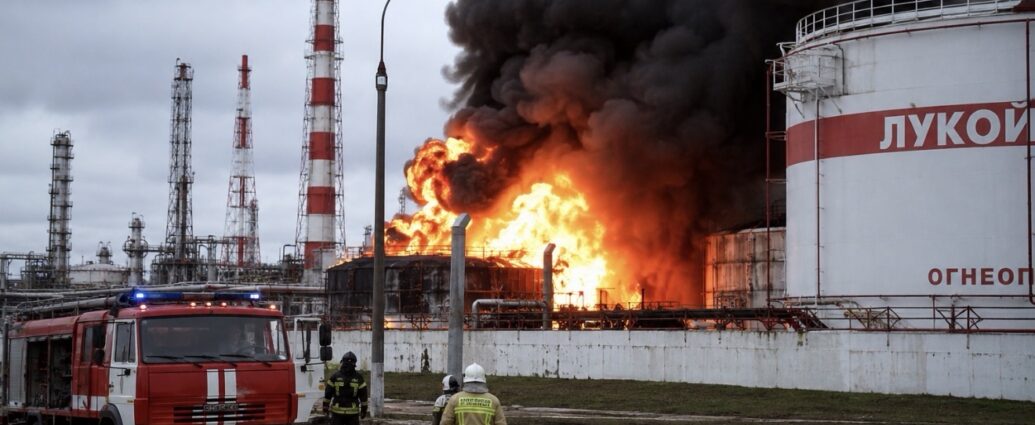
Ukraine intensified its long-range drone campaign against Russia on Sunday, targeting energy infrastructure in a series of attacks that Russian officials say struck a major refinery in the country’s south and further strained domestic fuel supplies.
According to Krasnodar regional Governor Veniamin Kondratyev, debris from intercepted Ukrainian drones ignited a fire at the Slavyansk-na-Kubani oil refinery, one of southern Russia’s largest refining facilities. Officials said one person was killed and another injured during the attack.
The refinery processes approximately 4 million metric tons of crude oil annually and serves as an important supplier of fuel products exported through Russia’s Black Sea ports.
The strike forms part of Ukraine’s broader strategy of targeting Russia’s energy infrastructure.
Ukrainian President Volodymyr Zelenskyy said on Telegram that Ukrainian long-range operations had reached two Russian refineries overnight, describing the attacks as economic pressure designed to reduce Russia’s ability to finance the war.
Zelenskyy also claimed a refinery in Russia’s Yaroslavl region was struck during the operation. Russian authorities acknowledged drone activity in the region but did not immediately confirm damage to refinery facilities.
The repeated attacks are beginning to have measurable economic consequences.
Industry analysts estimate that more than 20% of Russia’s oil-refining capacity has been disrupted following dozens of Ukrainian drone strikes over recent months.
According to the International Energy Agency (IEA), the scale of refinery disruption is unprecedented since the conflict began.
Several of Russia’s largest refining complexes have sustained repeated attacks, including the Kapotnya refinery, a major fuel supplier serving the Moscow region, which officials expect to remain partially offline into late 2026.
The consequences are increasingly visible inside Russia.
According to reporting compiled by Radio Free Europe/Radio Liberty (RFE/RL), at least 55 of Russia’s 83 regions have reported gasoline or diesel shortages or introduced fuel-purchase restrictions.
In parts of Siberia, drivers are now limited to purchasing no more than 50 liters of fuel per visit at certain Rosneft stations, while private fuel retailers have imposed similar limits.
What began as isolated shortages near the fighting has gradually spread across regions thousands of miles from the front lines.
Russian officials are attempting to stabilize domestic supplies.
Deputy Prime Minister Alexander Novak said the government is reviewing fuel-export commitments to ensure enough gasoline and diesel remain available within Russia.
The move highlights a growing challenge for Moscow.
Russia depends heavily on energy exports for government revenue, yet maintaining domestic fuel supplies has become increasingly important as refinery capacity comes under sustained attack.
President Vladimir Putin acknowledged the difficult environment during a speech to members of the ruling United Russia Party in Moscow.
While not directly discussing the refinery strikes, Putin described Russia as facing a “difficult period” and pledged that the government would continue funding social programs, infrastructure projects, employment initiatives and support for domestic businesses.
His remarks sought to project stability despite growing pressure on key sectors of the Russian economy.
The effects extend well beyond Russia.
As one of the world’s largest exporters of crude oil and refined petroleum products, disruptions to Russian refining capacity can tighten global supplies of diesel, gasoline and other fuels.
The refinery attacks also come as global energy markets continue monitoring shipping disruptions around the Strait of Hormuz, adding another layer of uncertainty to world oil markets.
Russia’s Defense Ministry said its air-defense systems intercepted 213 Ukrainian drones overnight.
Nevertheless, Ukraine has steadily expanded both the range and frequency of its long-distance drone operations, increasing pressure on Russia’s energy infrastructure and raising new questions about the long-term resilience of one of the country’s most important economic sectors.
JBizNews Desk
© JBizNews.com All Rights Reserved. Reproduction or distribution without written permission is prohibited.