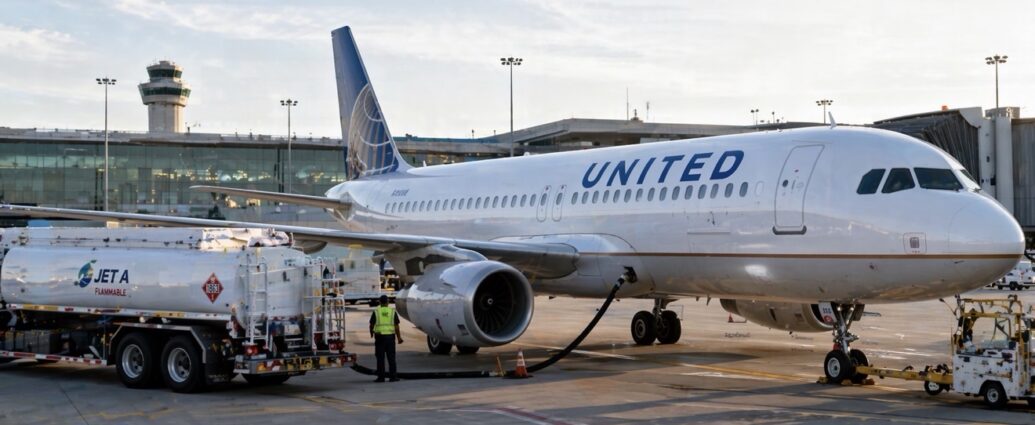
CHICAGO — United Airlines Holdings Inc. (NASDAQ: UAL) cut its full-year profit outlook nearly in half, becoming the first major U.S. carrier to formally reset expectations as jet fuel prices surged because of the escalating U.S.-Iran conflict, even as the airline reported stronger-than-expected quarterly results.
The carrier now expects 2026 adjusted earnings of $7 to $11 per share, down from a prior forecast of $12 to $14 per share issued in January, before hostilities intensified in late February. The revision reflects a sharp deterioration in cost conditions rather than demand, which executives say remains resilient.
First-quarter revenue rose more than 10% to $14.6 billion, driven by continued strength in international and premium travel, according to the company.
Fuel Shock Reshapes Outlook
The earnings reset underscores the sensitivity of airline margins to energy markets.
Data from S&P Global Commodity Insights (Platts) show U.S. jet fuel prices climbed to $4.78 per gallon on April 2, nearly doubling from $2.39 on February 27, the day before the conflict escalated. Prices have since eased to roughly $3.51 per gallon, though they remain well above historical norms.
United said it expects to pay approximately $4.30 per gallon in the second quarter, after absorbing about $340 million in incremental fuel costs in the first quarter compared with a year earlier.
Kirby Signals Demand Strength
Chief Executive Scott Kirby, speaking on CNBC, said the company is not seeing a slowdown in bookings despite higher fares.
“Bookings are strong,” Kirby said, adding that United continues to see stable demand across its network.
To offset rising costs, the airline is scaling back growth plans, trimming capacity by roughly five percentage points. United now expects flat to 2% capacity growth in the second half of the year, compared with 3.4% expansion in the first quarter.
Industry Moves in Tandem
The pressures are rippling across the sector.
Alaska Air Group Inc. (NYSE: ALK) withdrew its full-year guidance, with CEO Ben Minicucci telling analysts the carrier has raised fares by about $25 to offset fuel costs.
Delta Air Lines Inc. (NYSE: DAL) declined to update its outlook, citing volatility in fuel markets, while Deutsche Lufthansa AG warned that higher energy costs could erode margins.
Pricing Power Offsets Costs
Airlines have so far been able to pass through much of the cost increase.
Carriers have raised fares, baggage fees, and fuel surcharges, with demand — particularly among higher-paying travelers — holding up. Analysts say this pricing power has helped cushion the immediate impact of fuel volatility.
According to data compiled by Whalesbook, 63% of analysts covering United rate the stock a “strong buy,” with a consensus price target of $132.85, indicating continued confidence in long-term fundamentals.
Market Reaction and Outlook
United shares fell in after-hours trading following the guidance cut, even as quarterly results topped expectations.
The outlook for airlines now hinges largely on fuel prices, which remain tied to geopolitical developments. With no clear resolution to the conflict in sight, carriers face continued uncertainty over one of their largest cost inputs.
For now, the industry is navigating a familiar equation: strong demand offset by volatile fuel — with margins increasingly dependent on how long elevated energy prices persist.
JBizNews Desk