US Secretary of State Marco Rubio on Tuesday called a US-proposed UN resolution demanding Iran stop attacks and laying mines in the Strait of Hormuz a test of the utility of the United Nations and urged China and Russia not to repeat vetoes.
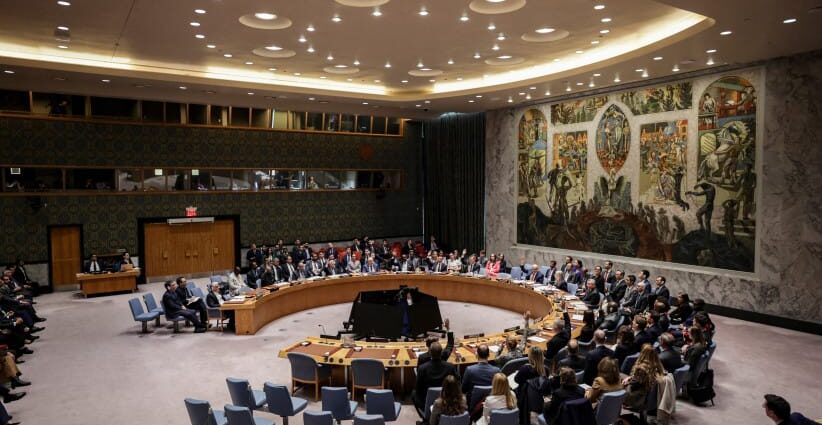
UN Security Council members began closed talks on Tuesday on a text the US drafted with Saudi Arabia, the United Arab Emirates, Kuwait, and Qatar, which, if it were to pass, could lead to sanctions against Iran, and potentially authorize force, if Tehran fails to halt attacks and threats to commercial shipping.
Fresh exchanges of fire on Monday underscored the stakes as the US and Iran struggle for control of the narrow waterway, a vital artery for global energy and trade, shaking a fragile four-week-old truce and reinforcing rival maritime blockades.
A previous Bahraini resolution that was backed by the United States and appeared to open a path to legitimize US military action against Iran failed last month after Russia and China exercised their vetoes in the 15-member Security Council.
The new draft avoids explicit language authorizing force while still operating under Chapter VII of the UN Charter, which allows the Security Council to impose measures ranging from sanctions to military action.
“Everyone wouldn’t want to see this vetoed again, and we’ve made some slight adjustments to the language,” Rubio told reporters at a White House news briefing, while adding: “I don’t know if it will avoid a veto or not.”
“I think it’s a real test to the UN … as something that functions,” he added.
A draft of the resolution seen by Reuters condemns Iran’s alleged violations of the current ceasefire and its “continuing actions and threats aimed at closing, obstructing, tolling” freedom of navigation through the strait.
It demands that Iran immediately cease attacks, disclose the locations of any mines, and not impede clearance operations.
“All we’re asking them to do is to condemn it, to call on Iran to stop blowing (up) ships, to remove these mines and to allow humanitarian relief to come through,” Rubio said.
“To both the Chinese and the Russians, I … have argued, that it is in their interest for that resolution to pass and for pressure to be brought on Iran, because it is in their interest not to see international waterways, particularly the Strait of Hormuz, be closed down and cause economic chaos to dozens and dozens of countries around the world.”
The draft also calls on Tehran to cooperate with UN efforts to establish a humanitarian corridor through the strait, citing the disruption of aid deliveries, fertilizer shipments and other essential goods.
The UN secretary-general would report back within 30 days on compliance and the Security Council reconvene to consider additional steps, including possible sanctions, if Iran failed to implement the resolution.
China says assessing text
Diplomats said Washington hopes to close negotiations quickly, with the aim of circulating a final draft by Friday and holding a vote early next week, although Russia and China still have a competing text under consideration.
Asked if the resolution could avoid another Chinese veto, China’s UN mission said: “The draft was circulated yesterday in the afternoon. We are still doing our assessment.”
Russia’s UN mission did not immediately respond.
UN spokesperson Stephane Dujarric said it was not his place to comment on drafts, but added at a regular briefing: “Obviously we want to see this international waterway open, open safely, and a restoration of the freedom of navigation that is so critical to the world.”
Monday’s escalation, in which the US said it destroyed six Iranian small boats and Iranian missiles hit a UAE oil port, followed Washington’s launch of “Project Freedom,” a US‑led effort to move stranded tankers and other vessels through Hormuz.
Washington has also circulated a proposal, seen by Reuters, to partners for a new multinational maritime coalition, the Maritime Freedom Construct (MFC), aimed at establishing a post‑conflict security architecture for the Middle East and reopening the strait once conditions stabilize.
The MFC would work with a separate Franco‑British maritime mission involving around 30 countries that seeks to lay the groundwork for safe transit through the strait once the situation stabilizes or the conflict is resolved, with Iranian coordination.
Some states have signaled any mission would require a UN mandate before committing military assets.
“The MFC is complementary to other maritime security task forces, including the maritime planning effort the UK and France are leading,” according to an informal diplomatic document sent to governments and seen by Reuters.
“The MFC will remain structurally independent, though close coordination is essential to achieve the strongest maritime security architecture possible.”