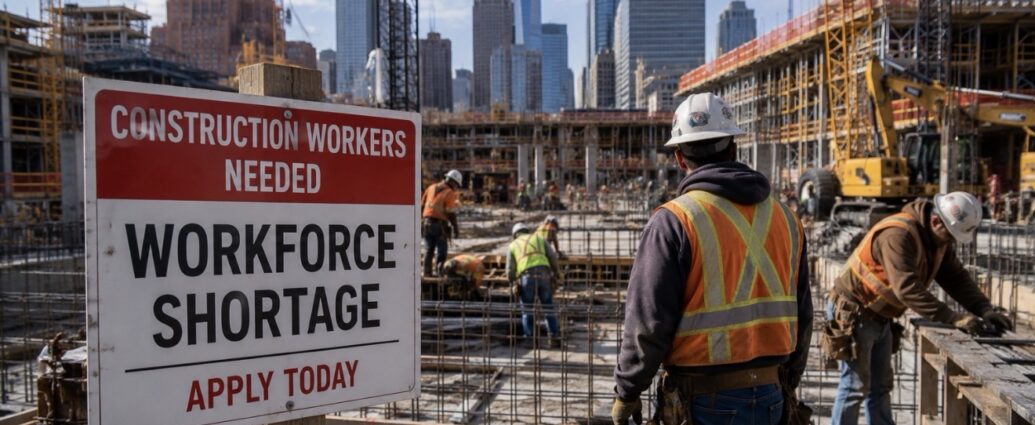
The U.S. construction industry is entering peak building season warning that a worsening labor shortage is delaying major infrastructure projects, increasing costs, and threatening the rollout of federally funded roads, bridges, semiconductor plants, power systems, and artificial intelligence data centers across the country.
Economists and trade groups tracking the sector say the shortage is becoming one of the biggest bottlenecks facing the broader American economy.
Anirban Basu, chief economist at the Associated Builders and Contractors, said the industry needs approximately 349,000 net new workers in 2026 simply to keep labor supply and demand balanced. That gap is expected to widen further to roughly 456,000 workers by 2027 as construction spending continues expanding.
Without those workers, Basu warned, labor shortages will intensify across multiple regions and specialized trades, pushing project costs even higher.
The warning arrives as total U.S. construction spending approaches roughly $2.05 trillion, fueled by the AI infrastructure boom, semiconductor manufacturing expansion, renewable-energy projects, and billions of dollars still flowing from the 2021 bipartisan infrastructure law.
According to ABC economic models, every $1 billion in construction spending generates roughly 3,450 to 3,550 construction-related jobs, meaning even modest spending increases create enormous labor demand.
Aging demographics are now colliding directly with that expansion.
Industry data shows roughly one in five U.S. construction workers is already over the age of 55, while the National Center for Construction Education and Research projects approximately 41% of the current construction workforce could retire by 2031.
Basu said much of the hiring demand now stems not from entirely new projects, but simply from replacing workers leaving the industry through retirement.
Mike Bellaman, president and chief executive of ABC, said the labor squeeze is hitting nearly every major growth segment of the economy simultaneously.
“The macrodynamics at play include an aging and retiring workforce, immigration enforcement, high materials prices, tariffs, office vacancies and rapidly evolving technologies,” Bellaman said in recent remarks addressing the industry outlook.
Specialized skilled trades are facing the most severe shortages.
Electricians, heavy-equipment operators, welders, and advanced industrial technicians are increasingly difficult to recruit as AI-driven data center construction accelerates nationwide. Industry forecasts estimate roughly $86 billion in data center spending alone this year, creating intense competition for highly specialized electrical labor.
The shortages are especially visible around semiconductor manufacturing hubs in Arizona, Ohio, Texas, and New York, where massive fabrication plants backed by the CHIPS Act are already competing for limited labor pools.
Contractors say the strain is now translating directly into delayed projects.
A nationwide workforce survey conducted by the Associated General Contractors of America and NCCER found that 92% of contractors are struggling to fill open positions, while nearly half report labor shortages are actively delaying projects already underway.
Approximately 88% of surveyed firms reported unfilled openings for craft workers, while 80% said they lacked enough salaried project-management staff.
Ken Simonson, chief economist at AGC, said labor shortages are affecting virtually every major category of construction simultaneously, including housing, transportation, manufacturing, energy infrastructure, and data centers.
Federal immigration enforcement has further complicated hiring efforts.
AGC survey data showed roughly 28% of construction firms reported direct or indirect workforce disruption tied to immigration enforcement activity over the past six months. Some contractors reported workers failing to appear at job sites following rumored immigration actions, while others said subcontractors lost substantial portions of their labor force.
The impact has varied heavily by state, with firms in Georgia, Virginia, Alabama, Nebraska, and South Carolina reporting some of the largest disruptions.
Construction companies are responding by aggressively raising wages and increasing training investments.
Industry surveys show roughly 95% of contractors increased base pay during the past year, while many firms also expanded apprenticeship programs and workforce-training initiatives. Larger contractors are investing heavily in prefabrication, modular construction, automation tools, and AI-driven scheduling systems to maximize productivity from limited labor pools.
Industry groups are also lobbying Congress for immigration reforms targeted specifically at construction labor.
AGC Vice President Brian Turmail said the organization is pushing for a construction-specific visa program and expanded legal pathways allowing undocumented workers already employed in the sector to remain active legally.
Industry leaders argue that without a major workforce solution, much of Washington’s infrastructure agenda risks running into delays, cost overruns, and incomplete projects despite the availability of federal funding.
The labor shortage is also colliding with broader cost pressures.
Contractors continue facing elevated prices for steel, aluminum, copper, lumber, transformers, and electrical equipment, while tariffs tied to ongoing trade disputes have added additional volatility to materials costs. Lead times for critical grid equipment and industrial electrical systems now stretch between two and four years in some cases.
For policymakers, the warning from the construction sector is increasingly blunt: the United States has approved the money, announced the factories, and launched the projects — but may not have enough workers available to build them all on schedule.
JBizNews Desk — Midwest
© 2026 JBizNews. All Rights Reserved. Reproduction or distribution without written permission is prohibited.