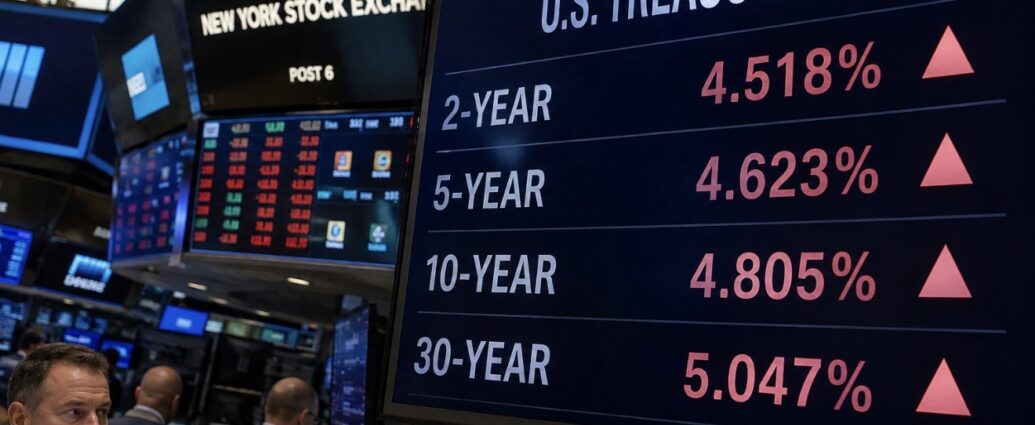
The Treasury offered $25 billion of 30-year bonds at its monthly auction Thursday afternoon, with pre-auction trading pointing to a yield around 5.23% — the highest the government has paid to borrow for three decades since 2001. That was the year the Treasury killed the long bond entirely, a decision leaked to Goldman Sachs traders before the public announcement and reversed in 2005. The circumstances then were the opposite of today’s: budget surpluses had investors worried there was not enough government debt to go around.
The number to sit with is what the interest already costs. Interest on the public debt runs $1.17 trillion for the fiscal year to date, up 15% from a year ago — roughly $3.8 billion a day, every day, before a dollar goes to anything else. Each auction at a higher yield locks part of that bill in for the next thirty years.
The move is fast. July’s 30-year auction cleared at 5.058%, itself the highest since 2007. A month later the market is asking for roughly another 17 basis points. Wednesday’s 10-year sale drew the highest yield for that maturity since 2007.
What makes this awkward is that short rates are going the other way. The Federal Reserve has left its target range at 3.5% to 3.75%. The Fed sets the short end; the long end is set by investors deciding what they need to be paid to hold thirty years of American fiscal policy. Right now they want 1.5 percentage points more than the overnight rate — a market saying the risk is out in the distance, not in the next meeting.
Buyers are not stepping up to lock in multi-decade highs, which suggests the selloff may have further to run. Michal Stanczyk, a portfolio manager on the global fixed income team at Allspring Global Investments, wrote that “a successful auction shouldn’t be confused with strong structural demand for long-duration assets.” An auction clears. That is not the same as investors wanting the paper.
The Treasury adjusted its debt-sales guidance last week in a way that opens the door to trimming long bond supply. Issuing shorter cuts today’s coupon but means refinancing again sooner, which is only cheaper if rates come down. If they do not, the government simply rolls the problem forward at whatever the market charges next time.
For anyone outside Washington, the transmission runs through the mortgage. The 30-year fixed averaged 6.69% for the week ending August 6, up from 6.66% and higher than the 6.63% of a year ago. Rates dipped below 6% in late February, just before the U.S. and Israel struck Iran; the 15-year has since climbed back above 6% at 6.01%. The affordability gains earlier this year are gone.
The arithmetic on a home loan is unforgiving. On a $200,000 loan over 30 years, 6% costs about $1,199 a month against $955 at 4% — roughly $244 more, every month, for 360 months. That is close to $88,000 in extra interest on the same house.
Commercial borrowers feel it in the same place. Long-dated corporate debt, commercial mortgages and project financing all price off the long end of the Treasury curve. A business refinancing a building this year is negotiating against a benchmark that has moved to a 25-year high, regardless of how solid its own numbers look.
There is no quick fix on offer. Elevated financing costs are already working through the broader economy after years of high inflation and government spending, and the timing is a problem for President Donald Trump and Treasury Secretary Scott Bessent heading into November’s midterms. Shortening the maturity of new issuance buys time. Bringing the yield down requires either lower inflation expectations or a smaller deficit, and neither is inside the Treasury’s control.
One thing borrowers can control: Freddie Mac’s research finds that getting a single additional rate quote saves roughly $600 over the life of a loan, and three quotes up to $1,200. Modest against $88,000, but it is the part of the equation that does not depend on the bond market.
The auction result will tell whether 5.23% was enough to draw real demand or merely enough to clear. Either way, the government has now put a 25-year-high interest rate on paper that comes due in 2056.
JBizNews Desk | New York
© JBizNews.com All Rights Reserved. Reproduction or distribution without written permission is prohibited.