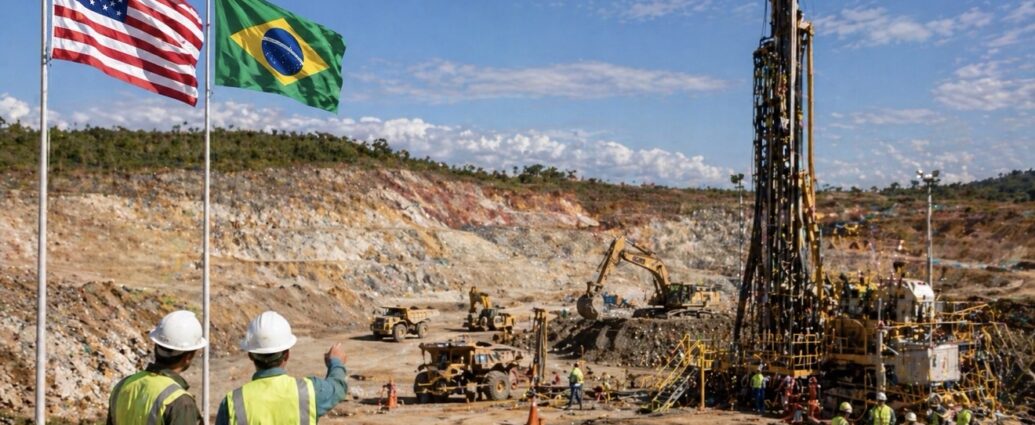
USA Rare Earth said it has agreed to buy Brazil’s Serra Verde in a transaction valued at about $2.8 billion, a move that would sharply expand its access to the magnet rare earths increasingly sought by automakers, defense suppliers and industrial manufacturers outside China. In a statement released April 20, USA Rare Earth said the deal includes $300 million in cash and 126.849 million newly issued shares, implying the valuation based on the company’s April 17 closing price of $19.95, while Chief Executive Barbara Humpton said the acquisition marks “an important step in building a global rare earth platform,” according to the company announcement.
The proposed purchase lands at a time when governments and manufacturers are trying to reduce dependence on Chinese supply chains that dominate mining, separation and processing of rare earths. International Energy Agency Executive Director Fatih Birol has said in recent critical-minerals assessments that “today’s supply chains for many energy minerals are highly concentrated,” and the agency has repeatedly warned that rare earth concentration creates strategic risk for clean-energy and industrial sectors, according to its latest market work. That backdrop helps explain why USA Rare Earth framed the Serra Verde deal as a scale play in ex-China supply, with the company saying the transaction is expected to close in the third quarter of 2026, subject to customary approvals.
Serra Verde already occupies a notable position in the emerging non-Asian rare-earth market because its project in Brazil targets ionic clay deposits that can yield heavy rare earths used in high-performance permanent magnets. In public materials, Serra Verde has said it is “the only scale producer outside Asia” of certain heavy rare earth concentrates from ionic clay, and the company has described Phase 1 as a commercial operation in Minas Gerais focused on neodymium, praseodymium, terbium and dysprosium-bearing material. Those elements matter because, as the U.S. Department of Energy has said in critical-materials strategy documents, dysprosium and terbium remain especially important for heat-resistant magnets used in electric vehicles, wind turbines and defense systems.
The transaction also underscores how quickly rare-earth assets have become strategic corporate targets as Washington pushes domestic and allied-country sourcing. The U.S. Geological Survey said in its 2026 Mineral Commodity Summaries that the United States still relies heavily on imports for rare-earth compounds and metals, while China continues to account for the largest share of global mine production and processing capacity. In that context, Humpton said in the company release that combining USA Rare Earth with Serra Verde would support a broader supply chain serving customers that want alternatives to Asia-centered production, a message likely to resonate with policymakers and industrial buyers alike.
Investors will also focus on how the deal is financed and whether the combined company can execute across mining, processing and magnet manufacturing without stretching its balance sheet. USA Rare Earth said the consideration includes a relatively modest cash component and a much larger stock issuance, meaning existing shareholders face dilution even as the company gains a producing asset. In its announcement, the company said the structure reflects both the strategic value of Serra Verde and the desire to preserve capital for growth, while market participants will likely compare the move with other critical-minerals transactions that have leaned on equity to fund expansion in a capital-intensive sector.
The industrial logic is straightforward: magnet rare earths sit at the center of a supply chain that governments increasingly treat as a national-security issue as much as a commercial one. Reuters has reported in recent years that the United States and allies have accelerated efforts to build rare-earth mining, refining and magnet capacity after export restrictions and geopolitical tensions exposed vulnerabilities in the sector. U.S. Department of Defense officials have also said in public contracting announcements that secure domestic and allied supply of rare-earth materials is essential for advanced weapons systems, adding another layer of urgency for companies trying to assemble integrated platforms.
Brazil’s role in that strategy has grown because the country holds significant mineral resources and offers an alternative jurisdiction for Western buyers seeking diversification. Serra Verde has said in corporate disclosures that its deposit benefits from a lower-strip, clay-based geology that differs from hard-rock rare-earth mining and can support production of valuable heavy rare earths, while Brazil’s mining framework gives international investors a route into a politically important supply source. For USA Rare Earth, the acquisition would add an operating foothold in Latin America at a time when manufacturers increasingly want long-term contracts tied to non-Chinese origin, a trend highlighted in recent industry reporting by Bloomberg and Reuters on critical-minerals procurement.
What comes next will matter as much as the headline valuation. The companies said the deal is expected to close in the third quarter of 2026, leaving time for regulatory review, shareholder processes and integration planning, and investors will watch for more detail on production targets, separation capacity and customer agreements. If USA Rare Earth can turn Serra Verde’s output into a broader trans-American rare-earth chain, the company could emerge as a more credible supplier in a market where governments and manufacturers keep saying diversification is no longer optional but necessary, as the IEA, the USGS and U.S. policymakers have repeatedly made clear.
JBizNews Desk