By JBizNews Desk
May 11, 2026
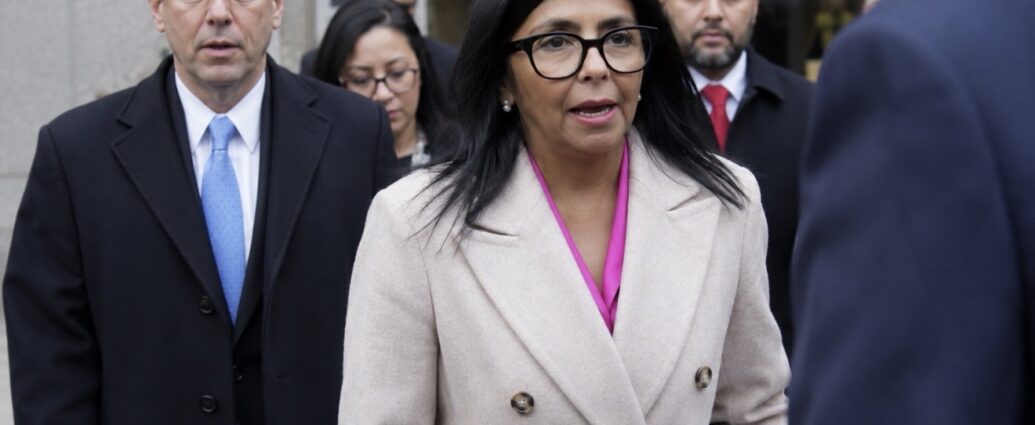
Venezuela’s acting President Delcy Rodríguez arrived in the Netherlands on Sunday to personally defend Caracas’s territorial claim over the resource-rich Essequibo region before the International Court of Justice, escalating one of the world’s most consequential geopolitical disputes over energy, mining, and sovereign territory.
The hearings at the Peace Palace in The Hague center on control of the Essequibo — a vast territory bordering Guyana that sits atop enormous reserves of oil, gold, diamonds, timber, and other strategic natural resources increasingly central to the future economic balance of South America.
The trip marks Rodríguez’s first foreign travel since she assumed power in January following the U.S. military capture of former President Nicolás Maduro.
“It has fallen to me to travel in the coming hours to defend our homeland,” Rodríguez said Saturday during a nationally televised address announcing the trip.
According to reporting from The Associated Press, Venezuela’s final oral arguments before the ICJ’s 15-member judicial panel are scheduled for Monday, concluding a week of hearings that began May 4.
A final ruling from the court — the principal judicial body of the United Nations — could arrive as early as August.
The economic implications stretch far beyond the two countries directly involved.
The Essequibo region covers approximately 62,000 square miles, representing more than two-thirds of Guyana’s total territory.
Its strategic significance increased dramatically over the past several years after massive offshore oil discoveries transformed Guyana into one of the fastest-growing energy producers in the world.
Oil giant ExxonMobil and its partners have already committed billions of dollars to offshore projects adjacent to the disputed territory.
Guyana currently produces roughly 750,000 barrels of oil per day, an extraordinary figure for a country with fewer than one million residents.
Analysts now estimate Guyana possesses the world’s highest per-capita crude oil reserves, fundamentally reshaping the country’s economic future and turning the territorial dispute into one of the most strategically sensitive resource battles in the Western Hemisphere.
The hearings have also intensified political tensions throughout the Caribbean and Latin America.
Guyanese Foreign Minister Hugh Hilton Todd opened proceedings last week by telling the court the territorial dispute “has been a blight on our existence as a sovereign state from the beginning.”
Todd argued that approximately 70% of Guyana’s sovereign territory is effectively under challenge.
At the heart of the dispute are sharply conflicting interpretations of history and international law.
Guyana is asking the court to reaffirm the validity of an 1899 arbitration ruling that established the current border largely in Georgetown’s favor during the British colonial era.
The Guyanese government formally brought the case before the ICJ in 2018.
Since then, the court has twice ruled that it possesses jurisdiction to hear the matter despite repeated objections from Caracas.
Venezuela rejects the legitimacy of the 1899 ruling entirely.
Caracas argues the arbitration process was tainted by collusion between British and Russian representatives and instead insists the dispute should be governed by a separate 1966 agreement signed shortly before Guyana gained independence from Britain.
Under Venezuela’s interpretation of that agreement, the Essequibo River — rather than the current internationally recognized border — should serve as the natural territorial boundary.
Venezuelan representative Samuel Moncada delivered an extended six-hour presentation before the court last week arguing that Venezuela never formally consented to allow territorial disputes to be resolved by international judicial bodies.
Caracas has simultaneously signaled it may not recognize the court’s final ruling regardless of the outcome.
Rodríguez stated publicly in August 2025 that Venezuela would reject any unfavorable ICJ decision.
The government has already taken several symbolic domestic steps reinforcing its claim over the territory.
In December 2023, Venezuela held a national referendum in which voters overwhelmingly supported the creation of a new Venezuelan state called Guayana Esequiba.
The following year, Venezuela’s legislature passed a law formally incorporating the disputed region into Venezuelan territory — moves widely condemned internationally but celebrated domestically by Venezuelan nationalists.
Guyana, meanwhile, has secured broad international backing heading into the hearings.
Regional bloc CARICOM, the European Union, the Commonwealth, and the Organization of American States have all publicly supported Guyana’s position and the authority of the ICJ process.
For global energy markets and multinational investors, the dispute carries enormous financial implications.
A ruling definitively affirming Guyana’s sovereignty would strengthen the legal foundation underpinning billions of dollars of energy investments already flowing into the country’s offshore oil sector.
Any ruling or geopolitical escalation that reopens uncertainty around territorial control could complicate future development projects and raise risks for companies operating in the region.
The stakes therefore extend far beyond diplomacy alone.
At issue is control over one of the world’s fastest-growing oil frontiers, a territory rich in strategic minerals, and a geopolitical contest increasingly tied to the broader global competition for energy and natural resources.
As the hearings conclude in The Hague, the case is emerging not simply as a border dispute between neighboring states, but as a battle over who controls one of the most economically transformative regions discovered in the Americas in generations.
— JBizNews Desk
© JBizNews.com. All rights reserved. This article is original reporting by JBizNews Desk. Unauthorized reproduction or redistribution is strictly prohibited.