By Julia Parker — JBizNews Desk
A subtle but increasingly important shift is emerging inside Wall Street’s derivatives markets as institutional investors seek more sophisticated ways to protect themselves against a potential reversal in the artificial-intelligence stock boom without abandoning the rally altogether.
According to senior derivatives traders at Bank of America and UBS Investment Bank, clients are moving beyond traditional put options and increasingly deploying exotic hedging structures designed specifically for a market dominated by a handful of high-flying AI and semiconductor companies. The activity, highlighted in Bloomberg reporting Sunday, reflects a growing consensus across trading desks that investors still want exposure to the AI trade — but no longer want to remain fully exposed without downside protection.
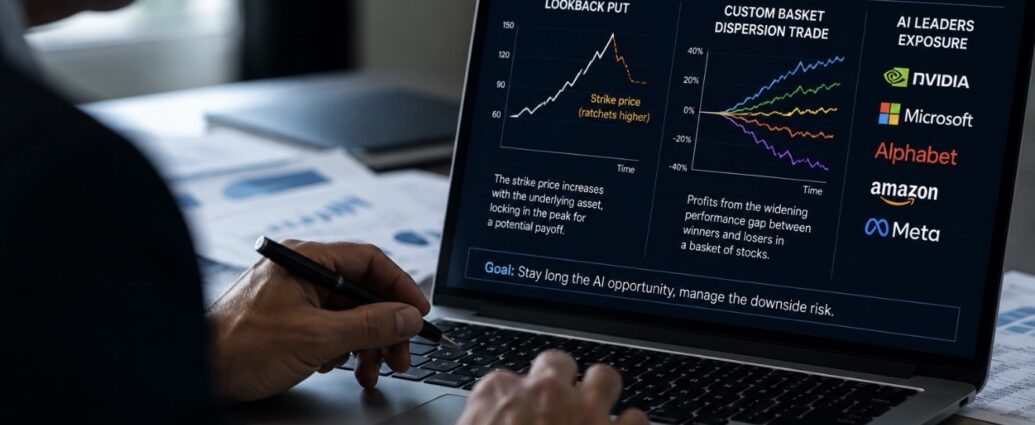
One of the instruments drawing the strongest institutional demand is the “lookback put,” an exotic option structure whose strike price adjusts upward as the market rallies. Unlike standard put options, which lock in a fixed strike at purchase, lookback puts effectively preserve the market’s peak level as the reference point for protection. The contracts are considerably more expensive than traditional hedges, but they are specifically designed for a scenario in which stocks continue climbing before suffering a sharp reversal.
“We have seen decent client demand for lookback puts as clients hedge the scenario where markets can potentially rally before the selloff,” Neeraj Chaudhary, Bank of America’s head of exotics and flow for Europe, the Middle East and Africa, told Bloomberg. Chaudhary also co-heads the bank’s global hybrids trading desk.
A second structure gaining popularity among institutional investors is the thematic custom basket dispersion trade, which UBS says is increasingly tied to AI-heavy portfolios. Rather than betting directly on whether the broader market rises or falls, the strategy profits from widening performance gaps between winners and losers inside a selected group of stocks.
Richa Singh, managing director at UBS Investment Bank, said investors are increasingly seeking ways to hedge concentrated exposure to the dominant AI names while still preserving participation in the broader technology rally.
“In an environment where conviction is high but uncertainty remains elevated, we’re seeing growing interest in thematic custom basket dispersion,” Singh said. “The idea being that single-stock realized volatility on a basket of, for example, AI leaders can pay regardless of market direction.”
The surge in hedging activity comes as Wall Street grows increasingly divided over whether the AI rally represents a sustainable technological transformation or the early stages of another speculative bubble.
Bank of America strategists have already warned that parts of the U.S. technology sector — particularly semiconductors — are beginning to display bubble-like characteristics. The concentration statistics are striking. Roughly 30% of the S&P 500’s market capitalization and approximately 20% of the MSCI World Index are now concentrated in just five companies, the heaviest concentration in roughly 50 years.
The S&P 500 currently trades at approximately 23 times forward earnings, a valuation level not seen since the late stages of the dot-com era. AI-linked stocks accounted for an estimated 80% of total U.S. equity gains during 2025, while Nvidia briefly surpassed a market value of $5 trillion last October — larger than the annual economic output of every country in the world except the United States and China, according to World Bank data.
What has complicated bearish positioning, however, is that the underlying earnings growth has largely justified the rally so far.
Analysts expect the information technology sector to deliver roughly 44% earnings-per-share growth in the first quarter of 2026 and account for approximately 87% of all S&P 500 earnings growth this year. Goldman Sachs estimates that AI infrastructure spending alone could drive about 40% of overall S&P 500 earnings growth in 2026.
Hyperscaler capital expenditures are also continuing to accelerate. Goldman projects spending by major AI infrastructure companies will rise to roughly $527 billion this year, up from about $465 billion projected at the start of 2025.
That strength has left strategists sharply divided over where markets head next.
Morgan Stanley chief U.S. equity strategist Michael Wilson maintains one of Wall Street’s most bullish outlooks with an S&P 500 target of 7,800. By contrast, Savita Subramanian, Bank of America’s head of U.S. equity strategy, has warned of a potential “AI air pocket” if earnings fail to justify valuations and sees only modest upside from current market levels.
The divergence helps explain why many institutional investors are opting for derivatives-based protection rather than reducing exposure outright.
Few investors want to abandon the sector producing the overwhelming majority of corporate earnings growth, but many are increasingly uncomfortable with the scale of concentration risk building beneath the rally.
Global policymakers have also begun issuing more direct warnings. Officials at the Bank of England have cautioned that AI-related valuations could decline sharply if infrastructure costs prove unsustainably high. International Monetary Fund Managing Director Kristalina Georgieva has compared current conditions to the late stages of the dot-com era, warning that a severe correction in AI-related assets could ripple across the broader global economy.
Credit markets tied to the AI buildout are now attracting hedging activity as well.
The five dominant hyperscalers — Alphabet, Amazon, Meta Platforms, Microsoft, and Oracle — issued approximately $121 billion in bonds during 2025, and analysts expect another $100 billion to $300 billion in issuance this year as AI infrastructure spending intensifies.
In response, JPMorgan Chase launched a credit-default-swap basket in March tied to all five companies, allowing institutional investors to hedge or short AI-related corporate credit exposure through a single instrument. Goldman Sachs is separately marketing total-return swap structures that allow hedge funds to speculate on swings in corporate loan pricing without directly owning the underlying debt.
JPMorgan research also highlighted mounting refinancing pressure across the software sector, with roughly $51 billion in B-minus-rated or lower software debt maturing in 2028 and another $50 billion due in 2029.
Friday’s market selloff — driven largely by rising Treasury yields rather than AI-specific news — offered another reminder of how quickly sentiment can shift when macroeconomic conditions tighten.
For now, Wall Street’s message appears increasingly consistent: stay invested in the AI trade, but buy stronger insurance while the rally still lasts.
JBizNews Desk
© JBizNews.com. All rights reserved. This article is original reporting by JBizNews Desk. Unauthorized reproduction or redistribution is strictly prohibited.