
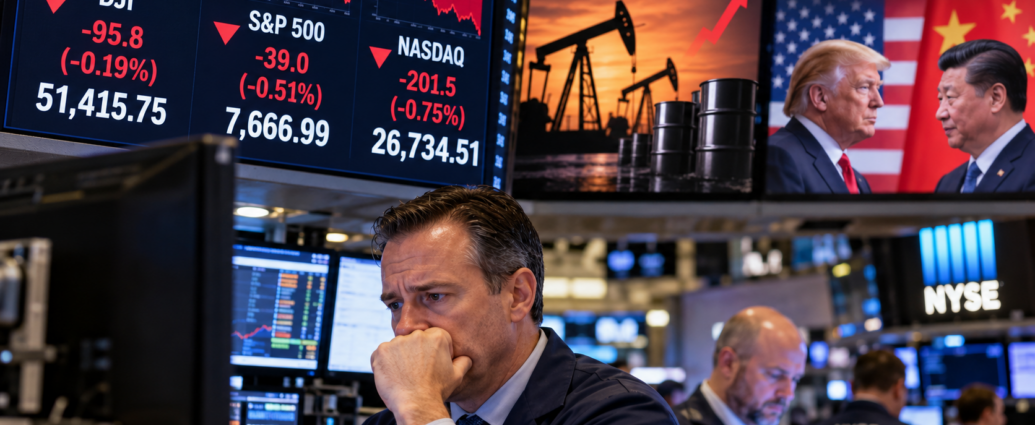
U.S. stocks opened lower Thursday as renewed Middle East uncertainty pushed oil prices and Treasury yields higher, reviving inflation concerns and putting particular pressure on technology shares. Investors were also cautious ahead of the closely watched meeting between President Donald Trump and Chinese President Xi Jinping.
At the opening bell, the Dow Jones Industrial Average fell 95.8 points, or 0.19%, to 51,415.75. The S&P 500 dropped 39.0 points, or 0.51%, to 7,666.99, while the Nasdaq Composite fell 201.5 points, or 0.75%, to 26,734.51. These are Reuters’ verified opening levels; intraday prices continued changing after the bell.
The Nasdaq’s larger decline showed how quickly higher yields can pressure technology shares. When Treasury yields rise, the future earnings of fast-growing companies become less valuable in today’s dollars, making highly valued technology stocks particularly sensitive to changes in interest-rate expectations.
Oil and Treasury Yields Return as the Market’s Pressure Points
Energy prices were again one of Wall Street’s biggest concerns Thursday.
Reuters reported that simmering Middle East tensions were lifting both oil prices and Treasury yields, reversing some of the relief markets received earlier in the week when crude fell below $100.
The combination is particularly important for businesses and households. Higher crude can feed directly into gasoline, diesel, aviation and freight costs, while higher Treasury yields can push up mortgages, corporate financing and other borrowing costs.
That also leaves the Federal Reserve in a difficult position. Cleveland Fed President Beth Hammack warned Thursday that inflation risks remain tilted to the upside, reinforcing investor sensitivity to energy prices and other inflation indicators.
Economic Data: U.S. Current-Account Deficit Widens
The main scheduled U.S. economic release Thursday morning came from the Commerce Department’s Bureau of Economic Analysis.
The U.S. current-account deficit widened by $33.4 billion, or 15.7%, to $246.0 billion in the second quarter, up from a revised $212.6 billion in the first quarter. The deficit represented 3.0% of U.S. GDP, compared with 2.7% during the previous quarter.
The deterioration primarily reflected a larger goods deficit, although that was partly offset by smaller deficits in primary income and secondary income. Exports of goods and services and income received from overseas increased by $58.8 billion to $1.44 trillion.
The $246 billion deficit was nevertheless smaller than the roughly $255 billion economists surveyed by Reuters had expected.
Importantly, there was no new GDP estimate Thursday morning. BEA’s next GDP release — the third estimate for second-quarter growth — is scheduled for September 30. The government’s current estimate shows the U.S. economy expanded at a 1.5% annualized rate during the second quarter.
Technology Stocks Under Pressure
Technology shares were among the weakest parts of the market as higher Treasury yields challenged the powerful AI-driven rally that sent the Nasdaq to records earlier this week.
The Nasdaq’s 201-point opening decline was considerably larger in percentage terms than the Dow’s, reflecting renewed pressure on growth stocks.
That comes after an extraordinary run in artificial-intelligence names. AMD crossed a $1 trillion market capitalization earlier this week after climbing nearly 10% in a single session, while Meta, Intel and other technology companies also posted sharp gains.
Thursday’s pullback therefore represents an important test of whether AI enthusiasm can continue overpowering the pressure from higher energy prices and borrowing costs.
Corporate News Adds to Stock-Specific Volatility
Individual companies were also moving sharply.
Oracle shares were under notable pressure Thursday morning, extending weakness in cloud and AI-infrastructure stocks, while Intel, AMD and Nvidia also traded lower as investors took profits following their recent surge.
TD SYNNEX also reported fiscal third-quarter results Thursday, giving investors another look at demand across the technology-distribution and enterprise-computing markets.
The broader issue for Wall Street is whether corporate earnings can continue supporting valuations if interest rates and energy costs remain elevated.
Trump-Xi Meeting Moves to Center Stage
Investors are also closely watching the meeting between Trump and Xi.
Reuters said caution ahead of the summit was one of the factors weighing on stocks Thursday morning. Trade policy and the economic relationship between the world’s two largest economies remain major variables for businesses, particularly companies exposed to technology, semiconductors, manufacturing and global supply chains.
Markets will be watching for concrete announcements rather than simply diplomatic language. Any developments involving tariffs, technology restrictions or trade arrangements could quickly move individual sectors.
What to Watch
For the remainder of Thursday’s session, oil and Treasury yields remain the clearest market gauges. If crude continues climbing and bond yields move higher, pressure could intensify on technology, housing and other interest-rate-sensitive sectors. A reversal in either could help stocks recover.
The Trump-Xi meeting is the day’s biggest potential headline catalyst. Investors will be looking for confirmed agreements or policy changes involving trade and technology while treating preliminary reports cautiously until details are formally announced.
Federal Reserve commentary also matters after Hammack’s warning about upside inflation risks. With energy costs still volatile, markets remain highly sensitive to any indication that policymakers see another rate increase as necessary.
Finally, watch the Nasdaq and AI stocks. Technology has been one of the market’s strongest engines this year, but Thursday’s opening showed that rising yields can still interrupt that momentum quickly.
For consumers and businesses, the central issue remains the same: energy prices and interest rates are moving together again. If that persists, it could keep pressure on gasoline, transportation and financing costs even as the broader economy continues expanding.
JBizNews Desk | Trenton, N.J.
© JBizNews.com All Rights Reserved. Reproduction or distribution without written permission is prohibited.




