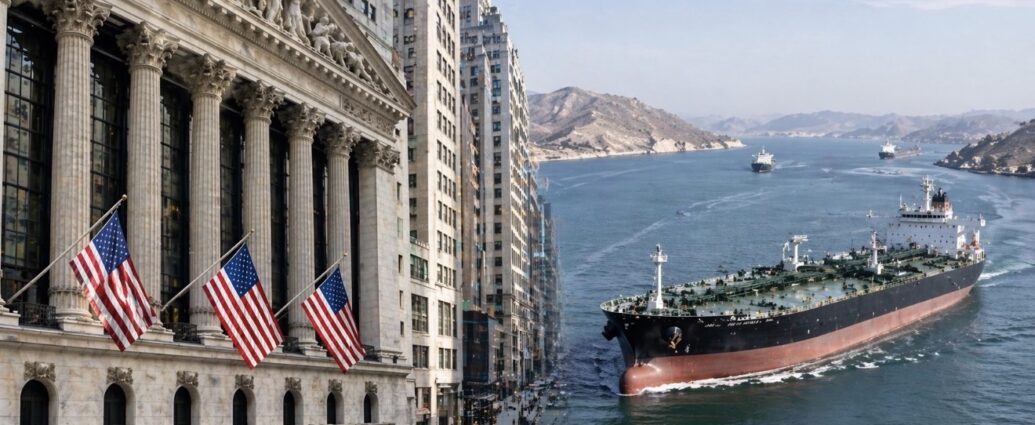
U.S. equities stepped back from record levels Thursday, as investors recalibrated risk in response to escalating tensions in the Middle East while continuing to digest a mixed but resilient corporate earnings backdrop. The pullback was measured rather than disorderly, reflecting a market still supported by strong economic undercurrents but increasingly sensitive to geopolitical shocks tied to the Strait of Hormuz.
The Dow Jones Industrial Average closed at 49,310.32, down 179.71 points, or 0.36%, while the S&P 500 fell 29.50 points, or 0.41%, to 7,108.40. The tech-heavy Nasdaq Composite led declines, dropping 219.06 points, or 0.89%, to 24,438.50, as high-valuation growth stocks faced renewed pressure. Trading volumes remained steady, suggesting rotation—not panic—was the primary driver of the session.
Market participants pointed to a familiar late-cycle pattern: capital shifting out of stretched technology names and into sectors more directly tied to inflation and global supply shocks. That dynamic played out clearly across Thursday’s session.
Strength in industrial and semiconductor names provided a notable counterbalance. United Rentals Inc. (URI) surged more than 22%, with executives citing strong demand tied to U.S. infrastructure expansion and domestic manufacturing. The company’s results reinforced the durability of reshoring trends and capital investment flows into heavy industry.
Meanwhile, Texas Instruments Inc. (TXN) jumped nearly 19%, driven by robust demand for analog and embedded chips supporting artificial intelligence infrastructure. Peers including Microchip Technology Inc. (MCHP) and ON Semiconductor Corp. (ON) also advanced, reflecting continued investor confidence in the AI-driven capital expenditure cycle. Analysts at Morgan Stanley, led by semiconductor specialist Joseph Moore, noted that “industrial and AI-linked demand remains structurally strong despite macro noise,” underscoring a bifurcated tech landscape.
In contrast, software stocks struggled as earnings and forward guidance failed to meet elevated expectations. ServiceNow Inc. (NOW) fell more than 17%, even after topping Wall Street estimates, as investors focused on margin pressures tied to rising energy costs and a slower-than-anticipated pace of enterprise AI monetization. Workday Inc. (WDAY) and other cloud-based enterprise providers also declined, reflecting broader skepticism about near-term growth acceleration in software.
Consumer discretionary names added to the downside. Lululemon Athletica Inc. (LULU) dropped sharply after signaling softer apparel demand trends, suggesting that higher energy costs and inflationary pressures may be beginning to weigh more meaningfully on consumer spending behavior.
Energy markets, by contrast, moved decisively higher. West Texas Intermediate crude settled near $96.50 per barrel, rising approximately 3.8%, while Brent crude pushed above $100, marking a psychologically important threshold. The gains were fueled by renewed concerns over shipping security in the Strait of Hormuz, a critical artery for global oil supply.
President Donald Trump, in remarks Thursday, ordered U.S. naval forces to “shoot and kill any boat” laying mines in the strategic waterway and to intensify mine-sweeping operations. The directive followed reports of vessel seizures and continued Iranian-linked activity in the region. A senior defense official, speaking on background, said the U.S. is “maintaining maximum deterrence while preserving diplomatic channels,” reflecting the administration’s dual-track approach.
Despite the escalation, a fragile ceasefire between the United States and Iran technically remains in place, with diplomatic efforts continuing through intermediaries, including Pakistan. Analysts at Goldman Sachs, led by commodities strategist Daan Struyven, warned that “any sustained disruption in Hormuz flows could materially tighten global energy balances and feed directly into inflation expectations.”
Gold prices edged lower, settling near $4,714 per ounce, as the U.S. dollar held firm and investors refrained from full-scale flight-to-safety positioning. The muted move suggested markets are not yet pricing in a worst-case geopolitical scenario.
On the policy front, the administration continues to walk a narrow line—extending diplomatic timelines while signaling readiness to escalate militarily if necessary. Officials have pointed to strengthening domestic manufacturing activity, driven in part by tariffs and reshoring incentives, as a key pillar supporting economic resilience. Treasury Secretary Scott Bessent said earlier this week that “the underlying U.S. growth trajectory remains strong,” highlighting industrial expansion as a buffer against external shocks.
Still, rising energy prices pose a potential complication. Economists at JPMorgan, led by chief U.S. economist Michael Feroli, noted that “sustained oil above $100 could begin to filter into broader inflation metrics,” potentially complicating the Federal Reserve’s policy outlook.
Looking ahead, markets enter the weekend with a clear focus: geopolitical developments in the Middle East and the next wave of corporate earnings. While Friday’s economic calendar is relatively light, traders expect headline risk to remain elevated.
The broader takeaway from Thursday’s session is not one of breakdown—but of tension. Markets remain fundamentally supported, yet increasingly reactive to global instability. As long as that balance holds, volatility—not direction—may define the near-term path.
Data compiled from major exchanges and official statements as of the 4 p.m. EDT close on April 23, 2026. After-hours trading continues.