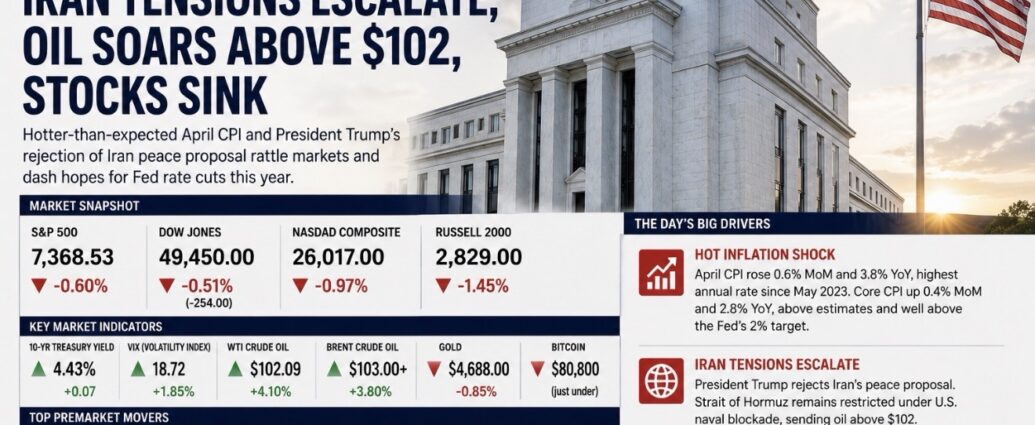
U.S. stocks opened sharply lower Tuesday morning after a hotter-than-expected April inflation report and escalating tensions surrounding Iran pushed oil prices above $102 a barrel, reigniting fears that the Federal Reserve may be forced to keep interest rates elevated far longer than Wall Street anticipated.
The early selloff reflected growing investor concern that rising energy prices tied to the ongoing Iran conflict are now spilling directly into broader consumer inflation — complicating the outlook for both markets and the U.S. economy heading into the second half of 2026.
At the opening bell, the S&P 500 fell 0.60% to 7,368.53, while the Dow Jones Industrial Average dropped more than 250 points. The tech-heavy Nasdaq Composite declined 0.97% to 26,017, leading broader market weakness. The Russell 2000 small-cap index slid 1.45% as investors rotated away from risk assets.
Meanwhile, the 10-year Treasury yield climbed to 4.43%, the Cboe Volatility Index (VIX) rose to 18.72, and crude oil surged higher, with WTI crude jumping above $102 per barrel and Brent crude topping $103. Bitcoin traded below $80,800, while gold weakened as traders shifted toward cash and defensive positioning.
The catalyst was the latest Consumer Price Index (CPI) report released Tuesday morning by the Bureau of Labor Statistics, which showed inflation accelerating significantly faster than economists expected.
Headline CPI rose a seasonally adjusted 0.6% in April and 3.8% year-over-year — the highest annual inflation rate since May 2023. Core CPI, which excludes food and energy, increased 0.4% for the month and 2.8% annually, both above Wall Street consensus estimates and still well above the Federal Reserve’s long-term 2% target.
The data immediately triggered a sharp repricing across interest-rate markets, with traders rapidly dialing back expectations for Federal Reserve rate cuts later this year.
“Inflation is moving higher again as the war in Iran — and the associated closing of the Strait of Hormuz — is impacting both the headline number as expected, but also the core,” said Chris Zaccarelli, Chief Investment Officer at Northlight Asset Management. “Given that inflation is heading in the wrong direction and the labor market is holding up, it’s very unlikely that the Fed will be able to lower interest rates any time soon.”
Some traders are now beginning to openly discuss the possibility that the Fed could eventually consider additional rate hikes in 2027 if energy-driven inflation becomes more deeply embedded throughout the economy.
The geopolitical backdrop worsened overnight after President Donald Trump rejected Iran’s latest ceasefire and peace proposal submitted through Pakistani mediators, keeping pressure on already strained global energy markets and adding fresh uncertainty to Wall Street’s outlook.
The Strait of Hormuz, one of the world’s most critical oil shipping corridors, continues operating at sharply reduced capacity amid the ongoing U.S. naval blockade targeting Iranian exports and regional military infrastructure. Energy traders increasingly fear prolonged disruptions could keep oil prices elevated well into the summer travel season, placing additional pressure on gasoline prices, transportation costs, and consumer spending.
Markets are also closely watching Trump’s scheduled trip to Beijing later Tuesday, where he is expected to meet with Chinese President Xi Jinping on May 13 and 14. Investors are looking for signs that the administration may attempt to separate the Iran crisis from broader U.S.-China economic negotiations involving trade, technology restrictions, and global supply chains.
Beyond the macro headlines, corporate earnings and analyst actions drove sharp individual stock moves across Wall Street.
Wendy’s surged more than 23% after the Financial Times reported that activist investor Nelson Peltz’s Trian Fund Management is exploring a possible take-private bid for the fast-food chain.
PACS Group jumped 22.3% after reporting stronger-than-expected first-quarter earnings and authorizing a $250 million stock buyback program.
Biotech company MacroGenics climbed 23.4% after announcing the sale of its manufacturing operations to Bora Pharmaceutical, while Harmonic rose 13% after earnings and revenue exceeded analyst expectations.
On the downside, software company GitLab fell more than 11% after Chief Executive Bill Staples unveiled a sweeping restructuring tied to the company’s pivot toward “agentic AI,” including layoffs, management reductions, and a geographic downsizing strategy.
ZoomInfo Technologies plunged 33% after slashing full-year revenue guidance, while Hims & Hers Health and AST SpaceMobile also posted steep declines following disappointing forward outlooks.
Wall Street strategists remain divided over whether the current pullback represents a temporary inflation scare or the beginning of a broader repricing across risk assets.
In a mid-year outlook released Monday, JPMorgan Private Bank told clients that “the AI supercycle may just be getting started,” while economists at Goldman Sachs reduced their estimated probability of a U.S. recession over the next 12 months to 25%, citing resilient domestic demand and strong corporate investment trends.
But traders increasingly acknowledge that those bullish forecasts may depend heavily on whether inflation stabilizes — and whether the geopolitical crisis surrounding Iran and global oil supplies begins to ease.
For now, Wall Street appears to be entering a far more volatile phase where inflation, energy prices, and geopolitics are once again driving markets simultaneously — a combination investors have not faced at this intensity since the inflation shocks that rattled the global economy earlier this decade.
JBizNews Desk
© JBizNews.com. All rights reserved.