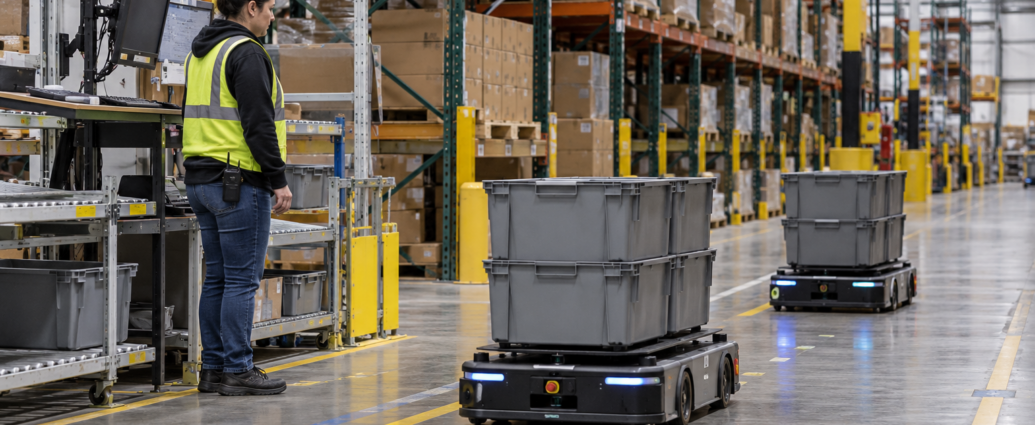
Walmart is spending billions of dollars to have robots do the work of its warehouse employees, but the machines keep running into problems that people handle without thinking: cardboard boxes that are too big, bags of dog food that do not fit, and frozen turkeys. The decade-long push now covers roughly 200 U.S. supply-chain buildings, and the company is trying to rebuild them while they stay open.
Here is what the robots are supposed to do. Today, Walmart relies on more than 140,000 warehouse workers to unload trucks, drive pallets of merchandise into storage, sort and stack goods on towering racks, and then reverse the whole process to ship items out to stores and homes. The plan replaces much of that walking, lifting and sorting with automated systems that move goods from the truck dock to storage and back out again.
The robots are good at heavy lifting. They still struggle with one of the simplest jobs in a warehouse: picking up a single item, something a person does easily.
The problems have stacked up. The cardboard shipping boxes Walmart has used for years turned out to be too large for the automated systems. The small robots that shuttle goods through the buildings break down often enough to disrupt operations. And the systems cannot handle some oversized products, such as large bags of dog food, which means those items still need human hands.
The power bill is another surprise. At Walmart’s automated grocery warehouses, monthly utility costs can top $800,000 during peak periods, compared with about $250,000 when those buildings ran mostly by hand, according to people familiar with the figures. In plain terms, the electric bill can run more than three times higher once the robots take over.
Walmart’s main partner for non-perishable goods is Symbotic, a robotics company based in Wilmington, Massachusetts, in which Walmart owns a 12.6% stake. The Symbotic system is a floor-to-ceiling steel structure in which small robots shuttle cases to storage, while robotic arms build tall pallets for store trucks. Walmart aims to have all of its non-perishable warehouses automated with Symbotic by 2030.
The company has made real progress despite the setbacks. More than 65% of Walmart stores now receive at least some freight that has passed through an automated warehouse, close to 2 out of every 3 stores.
Walmart is also working through the fixes. After years of searching for a workable approach, the company and its robotics partners settled on small wheeled robots equipped with motion and obstacle sensors, and those machines are now being installed in more than a dozen warehouses. The company expects spending on supply-chain automation to peak this year and next, which means the heaviest bills should be behind it after 2027.
For warehouse workers, the shift is gradual rather than sudden. Walmart executives have said automation means the company will eventually need fewer warehouse workers, but that high turnover in those jobs means it does not expect layoffs, and that sales growth could keep headcount close to where it is today. Put simply, Walmart plans to shrink the workforce by not refilling some jobs as people leave, rather than by cutting existing workers.
For shoppers, the stakes are about price and speed. Walmart’s entire pitch rests on low prices, and every dollar it saves moving goods from a truck to a store shelf is a dollar it can use to keep prices down. Faster, more accurate warehouses also mean fewer empty shelves and quicker pickup and delivery orders. If the robots keep breaking down or the power bills keep climbing, those savings shrink.
Competition is raising the pressure. Amazon has a long head start in warehouse automation, and Walmart is racing to close that gap while still running one of the busiest supply chains in the world.
The lesson from Walmart’s experience is that automating a warehouse is not as simple as buying robots and switching them on. It means redesigning boxes, rebuilding buildings that were laid out decades ago, and keeping people on hand for the jobs machines still cannot do. Walmart is betting that once the hardest part of the work is finished over the next two years, the system will pay for itself.
JBizNews Desk | Bentonville, Ark.
© JBizNews.com All Rights Reserved. Reproduction or distribution without written permission is prohibited.