Walk into almost any defense industry conference this year and the mood feels conflicted.
On one side of the room, executives from America’s largest defense contractors are talking about record order backlogs, rising military budgets, and a global security environment that appears to guarantee years of elevated weapons spending. The wars in Ukraine and the Middle East have pushed governments to replenish missiles, drones, ammunition, air-defense systems, and advanced military technology at a pace not seen in decades.
But on the other side of the room, a different conversation is taking shape — one that quietly questions whether the traditional defense industry has become too expensive for the wars governments increasingly expect to fight.
The tension is beginning to reshape both military planning and investor expectations.
The headline numbers still look extraordinarily bullish for the sector.
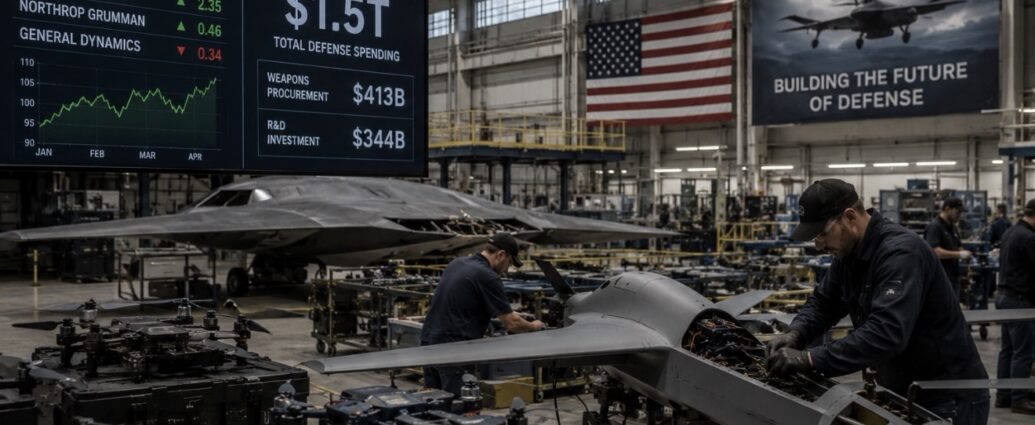
The Trump administration’s proposed fiscal year 2027 defense budget would push total military-related spending to roughly $1.5 trillion, one of the largest defense expansions in modern American history. According to JPMorgan, the increase represents the biggest single-year jump in defense spending since the Korean War buildup in the early 1950s.
Weapons procurement alone would rise to approximately $413 billion, nearly doubling within two years. Research and development spending would climb toward $344 billion.
Global military spending overall is now projected to reach roughly $2.6 trillion in 2026, with industry forecasts approaching $2.9 trillion by the end of the decade.
The large contractors sitting at the center of that system continue reporting enormous demand.
Lockheed Martin entered 2026 with roughly $194 billion in backlog orders. RTX is carrying a record backlog near $268 billion. Northrop Grumman closed last year with nearly $96 billion in pending business.
To investors, those numbers would normally suggest years of reliable growth.
But modern battlefields are beginning to complicate the equation.
The war in Ukraine has exposed something military planners and investors can no longer easily ignore: relatively inexpensive drones and autonomous systems are increasingly capable of destroying extraordinarily expensive military hardware.
A small attack drone costing a few hundred or a few thousand dollars can now damage tanks, ships, armored vehicles, and air-defense systems worth millions. Ukrainian factories are now reportedly capable of producing millions of small drones annually at costs far below traditional Western weapons systems.
At the same time, some of America’s next-generation military programs carry staggering price tags.
The Pentagon’s planned F-47 fighter aircraft is projected to cost roughly $300 million per jet. The B-21 Raider stealth bomber may exceed $600 million per aircraft. The proposed “Golden Dome” missile-defense initiative could ultimately cost hundreds of billions of dollars if fully expanded.
That gap — between cheap mass-produced battlefield technology and increasingly expensive legacy weapons systems — is now becoming one of the defining debates inside the defense industry.
Even some military leaders openly acknowledge the shift.
Former CIA Director and retired General David Petraeus recently described the Ukraine battlefield model as “the future of warfare,” pointing to swarms of drones, AI-assisted targeting, autonomous systems, and low-cost mass production rather than smaller fleets of ultra-expensive platforms.
Inside the Pentagon, pressure is quietly building for contractors to deliver more capability at lower cost and faster speed.
That pressure intensified in January when President Donald Trump signed an executive order titled “Prioritizing the Warfighter in Defense Contracting.” The order specifically instructed major defense contractors to prioritize production capacity and accelerated procurement rather than large stock buybacks and dividend programs that have long helped support shareholder returns.
The message from Washington was unusually direct: national-security priorities may now outweigh traditional Wall Street expectations.
The market has noticed.
While traditional defense giants still benefit from massive contracts, investors are increasingly shifting attention toward newer defense-technology companies focused on drones, AI systems, autonomous vehicles, low-cost munitions, and battlefield software.
Venture-capital investment into defense-tech startups surged approximately 180% year-over-year during the first quarter of 2026, according to industry data, with money pouring into companies building autonomous systems, AI-powered surveillance tools, sensor networks, and mass-manufacturable drone platforms.
Companies such as AeroVironment, which expanded its battlefield presence through its acquisition of BlueHalo, have emerged as key beneficiaries. Private defense startup Anduril Industries has also become one of the sector’s largest magnets for capital as investors increasingly bet that future wars will rely more heavily on software, automation, and scalable drone systems than on traditional legacy platforms alone.
Even inside financial markets, the defense trade is becoming harder to interpret.
The long-term growth outlook remains strong because geopolitical tensions continue intensifying globally. The wars involving Russia, Ukraine, Iran, Israel, and broader NATO military expansion are all driving sustained procurement demand.
But investors are increasingly trying to determine where future defense dollars actually flow.
Do governments continue prioritizing ultra-expensive aircraft, missile shields, and advanced strategic systems? Or does more of the spending shift toward cheaper drones, autonomous warfare, rapid manufacturing, and AI-enabled battlefield systems that can be produced faster and in far greater numbers?
The political environment is also becoming more complicated.
The administration’s proposed budget pairs massive defense increases with tens of billions of dollars in domestic spending cuts across housing, education, agriculture, and healthcare programs, while also seeking additional emergency war funding tied to the conflict with Iran.
That tradeoff is beginning to generate political backlash as voters absorb rising deficits, inflation pressures, and economic strain at home.
For defense investors, the result is a market increasingly split between two visions of warfare.
One still revolves around the traditional giants of American military power: stealth bombers, fighter jets, aircraft carriers, missile systems, and nuclear deterrence.
The other is being shaped in real time on modern battlefields where cheaper drones, AI-assisted targeting, software systems, and mass production increasingly determine outcomes at a fraction of the cost.
Both sides of that market are growing.
The question now confronting investors is which side ultimately captures more of the money.
JBizNews Desk
© JBizNews.com. All rights reserved. This article is original reporting by JBizNews Desk. Unauthorized reproduction or redistribution is strictly prohibited.