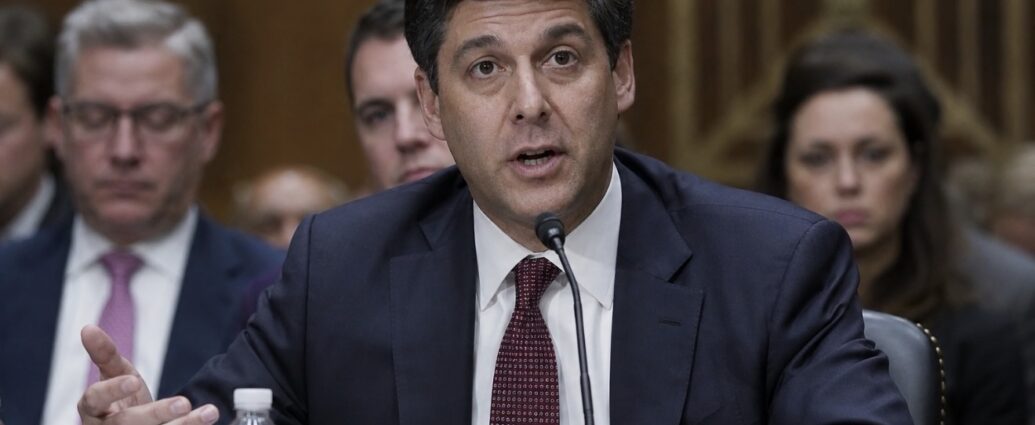
The U.S. Senate on Monday evening cleared the first in a series of procedural votes required to confirm Kevin Warsh as the next chairman of the Federal Reserve, setting in motion a confirmation process that must conclude by Friday if Warsh is to be sworn in before Jerome Powell’s term as Fed chair expires on May 15 — a deadline that is now just days away.
The Senate held a cloture vote at 5:30 p.m. ET on Monday, May 11, on Warsh’s nomination to serve as a Member of the Board of Governors of the Federal Reserve System. Senate Majority Leader John Thune had filed cloture on April 30, separately advancing Warsh’s nomination both as a Fed governor and as chairman — two distinct confirmations that each require Senate approval.
Warsh will still need to clear a separate confirmation vote this week to formally become chairman, though congressional aides and Senate analysts say the nomination could clear its remaining procedural hurdles as early as Wednesday.
The political math currently favors confirmation.
Republicans hold a 53-seat majority in the Senate, and Warsh requires only a simple majority vote. Additional bipartisan support may come from Sen. John Fetterman, D-Pa., who told Semafor he intends to support Trump’s nominee.
The path to Monday’s vote has become one of the most politically charged Federal Reserve nomination battles in modern history.
Much of the controversy centered not on Warsh’s credentials — he previously served as a Federal Reserve governor from 2006 to 2011 — but on the extraordinary pressure campaign launched by the Trump administration against outgoing Chair Jerome Powell.
Earlier this year, the Department of Justice opened a criminal investigation into Powell and the Fed, reportedly tied to cost overruns connected to a multibillion-dollar renovation project at the central bank’s Washington headquarters.
Powell publicly accused the administration in January of targeting him over monetary policy disagreements and the Fed’s refusal to aggressively cut interest rates.
The investigation became a pivotal factor in securing support for Warsh’s nomination.
Sen. Thom Tillis, R-N.C., whose vote was viewed as critical inside the Senate Banking Committee, agreed to support Warsh only after the DOJ formally dropped its criminal probe into Powell on April 24.
Jeanine Pirro, the newly appointed U.S. Attorney for the District of Columbia, said at the time that her office would refer the matter to the Fed’s inspector general while reserving the right to reopen a criminal inquiry if warranted.
Tillis later said he was satisfied the investigation had effectively concluded and voted to advance the nomination.
The Senate Banking Committee subsequently approved Warsh’s nomination on April 29 in a sharply divided 13-11 party-line vote — the first fully partisan committee vote on a Fed chair nominee in the committee’s history, according to Sen. Elizabeth Warren, D-Mass.
Warren emerged as one of Warsh’s fiercest critics.
Speaking before the vote, she accused the Trump administration of attempting to seize political control of the central bank and referred to Warsh as Trump’s “sock puppet” before walking out of the committee session.
Every Democrat on the committee opposed the nomination.
At his confirmation hearing, Warsh attempted to reassure lawmakers that he would preserve the Fed’s institutional independence.
“The president never asked me to predetermine, commit, fix, decide on any interest rate decision,” Warsh testified. “Nor would I ever agree to do so.”
He described Federal Reserve independence as “essential,” while also arguing that presidents expressing opinions on monetary policy does not inherently threaten the institution.
Warsh also outlined what he described as a major operational “regime change” for the Fed.
He told senators he believes central bank officials speak publicly too frequently, rely excessively on forward guidance, and reveal too much about future policy intentions before formal meetings occur.
Warsh specifically criticized the Fed’s long-standing “dot plot” system — the quarterly chart projecting future interest-rate expectations — signaling he may eliminate or significantly reduce its role if confirmed.
He also declined to commit to maintaining Powell’s practice of holding press conferences after every Fed policy meeting.
For financial markets and ordinary borrowers alike, however, the central question remains whether Warsh would ultimately move toward lower interest rates.
President Donald Trump has repeatedly called for rates as low as 1%, while criticizing Powell for keeping monetary policy restrictive.
Yet inflation remains elevated.
The latest Consumer Price Index readings showed inflation running at approximately 3.3% annually, fueled partly by higher energy costs tied to the Iran conflict and lingering tariff-driven price increases still filtering through the economy.
Claudia Sahm, former Federal Reserve economist and creator of the Sahm Rule recession indicator, said Warsh would face significant difficulty pushing through immediate rate cuts even if he personally favored them.
“He doesn’t have the chops to make that argument persuasively on day one,” Sahm said. “The data aren’t there yet.”
Major Wall Street institutions including Bank of America and J.P. Morgan have already pushed their expectations for Federal Reserve rate cuts into the second half of 2027, suggesting investors broadly expect monetary policy to remain tight regardless of who chairs the central bank.
If confirmed by May 15, Warsh would officially assume leadership ahead of the Fed’s next policy meeting scheduled for June 16–17.
Another unusual institutional wrinkle remains unresolved.
Following the Fed’s April 29 policy meeting, Powell announced he intends to remain on the Board of Governors for an unspecified period after stepping down as chair.
“There’s only ever one chair of the Federal Reserve Board,” Powell told reporters. “When Kevin Warsh is confirmed and sworn in, he will be that chair.”
Powell’s board term technically runs through January 2028, meaning the Federal Reserve could temporarily include two former chairs serving simultaneously.
Meanwhile, Democrats continue warning that the broader battle extends far beyond a single appointment.
Warren recently told NPR that if Trump ultimately succeeds in removing current Fed Governor Lisa Cook — a legal fight currently moving through the courts — the administration could gain effective control over a majority of the Fed’s seven-member governing board.
For markets, businesses, homeowners and consumers, the implications are substantial.
The Federal Reserve’s decisions directly influence mortgage rates, credit-card interest, auto loans, business financing costs and the broader direction of the U.S. economy.
And with the Senate now moving rapidly toward a final vote, the leadership of the world’s most powerful central bank may soon undergo one of the most politically contentious transitions in modern American financial history.
JBizNews Desk
© JBizNews.com. All rights reserved. This article is original reporting by JBizNews Desk. Unauthorized reproduction or redistribution is strictly prohibited.