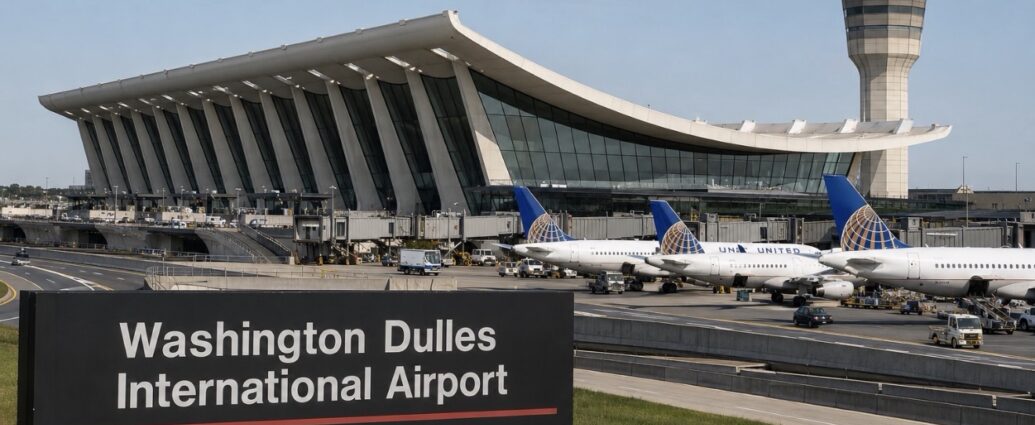
A proposal to rebuild much of Washington Dulles International Airport at an estimated cost of $22 billion is emerging as one of the largest airport infrastructure projects ever proposed in the United States—and a test of whether the country can still deliver massive public construction projects on time. The effort traces back to President Donald Trump, who said in December that Dulles should become a world-class airport. In May, Transportation Secretary Sean Duffy publicly outlined a roughly $22 billion modernization vision, and the Metropolitan Washington Airports Authority (MWAA) has since presented detailed concepts to airlines as discussions continue.
When Dulles opened in 1962, it represented one of America’s most ambitious airport designs. Created by renowned Finnish-American architect Eero Saarinen, the airport’s sweeping curved terminal became an architectural landmark. Yet the airport was also built around features that have become increasingly outdated, most notably the large mobile lounges that transport passengers between the main terminal and distant gates. While the airport expanded over the decades, its original layout has become increasingly inefficient as passenger traffic continued to grow.
The proposed redevelopment would preserve Saarinen’s iconic terminal while transforming nearly everything around it. Current plans call for extending the historic terminal by approximately 300 feet in both directions, constructing four new linear concourses, and expanding the underground AeroTrain system so it reaches every concourse. The modernization would finally eliminate the airport’s aging fleet of mobile lounges and replace temporary concourses originally constructed during the 1980s.
The project’s cost reflects its enormous scope. Preliminary estimates allocate roughly $6.2 billion for expanding and modernizing the main terminal, approximately $3.75 billion for extending the AeroTrain and underground infrastructure, with billions more dedicated to new concourses, passenger facilities and supporting infrastructure. Construction could begin around 2027 and continue through 2034, dramatically accelerating an earlier airport master plan that envisioned similar improvements taking two decades or more.
Supporters argue the investment goes beyond simply improving one airport. Many of the world’s leading aviation hubs—including Singapore Changi, Dubai International Airport and Hamad International Airport in Doha—have invested heavily in modern terminals, advanced passenger facilities and efficient transportation systems. By comparison, many major U.S. airports continue operating with aging infrastructure that has been expanded incrementally over decades rather than comprehensively redesigned.
Advocates believe a modernized Dulles would strengthen America’s international competitiveness, improve tourism, create faster connections through the nation’s capital and support continued growth in both passenger and cargo traffic. Even so, the estimated $22 billion price tag already includes projected inflation and financing costs while still carrying the risk of additional overruns common to projects of this size.
The biggest unanswered question remains funding.
Although the Department of Transportation owns the land occupied by Dulles, the airport itself is operated by the Metropolitan Washington Airports Authority under a lease extending through the year 2100. The authority previously approved a more modest $7 billion master plan in July 2025, while the federal government’s newer proposal envisions a much larger and faster redevelopment.
Financing such a project would likely require a combination of federal funding, municipal bonds, airline fees and potentially private investment. Some proposals have even suggested monetizing concession revenue through long-term private agreements to generate additional capital. At present, however, no comprehensive financing package has received final approval.
Airlines will also play a critical role. United Airlines, which accounts for nearly 70% of passenger traffic at Dulles, operates one of its largest hubs at the airport. Industry analysts note that moving forward without United’s support would be extremely difficult unless Congress were to provide substantially more federal funding.
Airport officials have remained cautious publicly. A spokesperson for the Metropolitan Washington Airports Authority referred questions back to the federal government, while the Department of Transportation has not publicly detailed how the project would ultimately be financed.
The stakes for the Washington region are significant. Dulles handled a record 29 million passengers during 2025, an increase of more than 6% from the previous year. A new 435,000-square-foot, 14-gate concourse serving United Airlines passengers is already scheduled to open later this year.
If completed, the larger redevelopment would generate thousands of construction jobs, reshape one of America’s most important international gateways and dramatically improve the travel experience for millions of passengers. If it fails to move forward, supporters argue it will become another example of the growing difficulty of delivering major infrastructure projects in the United States.
JBizNews Desk | New York
© JBizNews.com All Rights Reserved. Reproduction or distribution without written permission is prohibited.