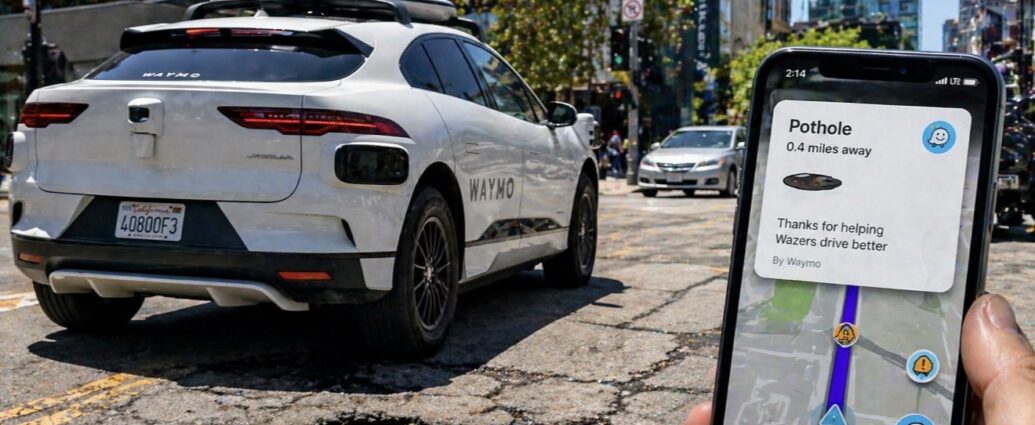
Waymo and Waze are expanding their use of road data beyond navigation and robotaxis, launching a program to flag potholes and other roadway hazards for local governments as Alphabet looks to turn its growing autonomous fleet into a civic infrastructure tool. In an April 9 statement, Waymo said the effort aims to help cities identify road damage faster, while Waze said its crowdsourced reporting network can add another layer of real-time visibility for public agencies.
Arielle Fleisher, policy development and research manager at Waymo, said in the company’s announcement that “Waymo is already making roads safer where we operate” and added that the company wants “to build on the safety benefits of our service by partnering with organizations and city officials to help improve the infrastructure we all depend on.” Waze, in the same announcement, said the partnership will combine data from its driver community with signals gathered by Waymo vehicles, a move that reflects how Alphabet is trying to extract more value from sensor-heavy autonomous systems beyond passenger trips.
The initiative arrives as Waymo scales commercial operations in U.S. cities and faces increasing scrutiny over how autonomous vehicles interact with public streets. Reuters has reported that Waymo has steadily expanded paid robotaxi service in markets including Phoenix, San Francisco and Los Angeles, while executives have argued that the company’s vehicles generate detailed road-level information useful for safety and mapping. In a blog post earlier this year, Waymo co-Chief Executive Tekedra Mawakana said the company is “building the world’s most experienced driver,” underscoring management’s view that its vehicles can contribute data and operational insights at city scale.
For Waze, the pothole effort builds on a long-running model of user-reported road conditions that already includes crashes, stalled vehicles and hazards. Waze said in materials describing its government partnerships that its data products help transportation agencies “make more informed infrastructure decisions,” and the new arrangement with Waymo suggests a deeper push into machine-generated reporting. That matters because potholes carry a measurable economic cost: the American Society of Civil Engineers has repeatedly warned in its infrastructure assessments that deferred road maintenance raises vehicle repair bills and freight inefficiencies, while local agencies struggle with limited inspection capacity.
City officials have increasingly sought automated ways to monitor pavement conditions, particularly as labor shortages and budget pressure complicate manual inspections. The U.S. Department of Transportation said in guidance tied to federal infrastructure funding that better asset management and digital monitoring can improve maintenance planning and reduce lifecycle costs. Against that backdrop, Waymo said the pothole program grew out of conversations with municipalities about “reporting gaps,” indicating that local governments want more continuous street-level intelligence than traditional complaint systems and periodic surveys can provide.
The business logic also fits a broader pattern across autonomous driving and mapping, where companies are trying to monetize data generated in the course of normal operations. Alphabet has not publicly broken out revenue for Waymo, but executives have repeatedly framed the unit as a long-term platform business rather than only a ride-hailing operator. On Alphabet earnings calls, Chief Executive Sundar Pichai has described Waymo as making progress in “building a sustainable business,” according to company transcripts, and the pothole initiative hints at how that sustainability could eventually include municipal and enterprise services tied to road analytics.
The partnership could also strengthen Waymo’s standing with regulators and city leaders at a time when autonomous vehicle operators need public-sector cooperation to expand. In recent years, transportation officials in California and Arizona have pressed AV companies to share more information about safety, traffic interactions and emergency response. By offering road-condition data to public agencies, Waymo can present itself not only as a user of city streets but as a contributor to their upkeep. Fleisher said in the company statement that the goal is to help “improve the infrastructure we all depend on,” language that aligns with a broader effort to position autonomous fleets as public-benefit technology.
What comes next will depend on whether cities can integrate the data into maintenance workflows quickly enough to show visible results. Waymo and Waze have not publicly detailed which municipalities will participate first or how frequently reports will flow, leaving key operational questions open. Still, the direction is clear: as autonomous vehicles move from pilot projects to everyday urban presence, companies like Waymo are under pressure to prove they do more than carry passengers. If the pothole program helps cities repair roads faster and document savings, it could become a template for how robotaxi fleets justify broader access to public streets and deepen their role in transportation infrastructure.
JBizNews Desk