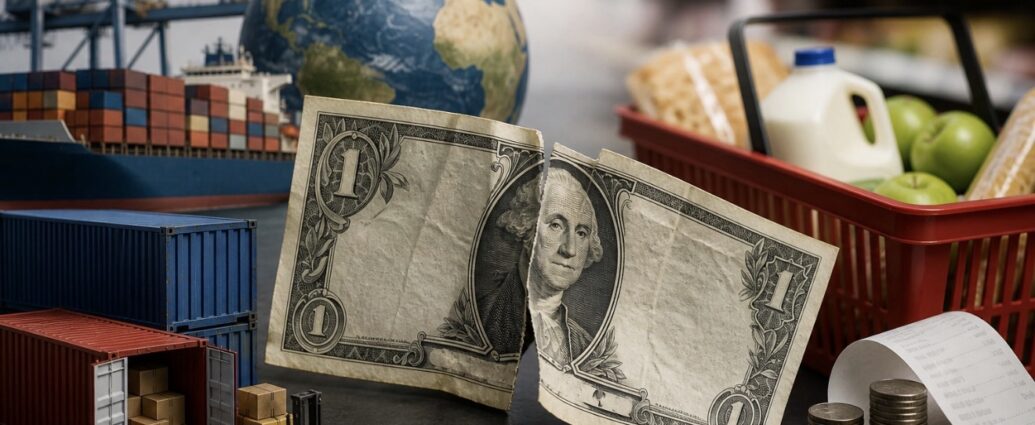
The U.S. dollar’s sharp slide this year is handing multinational companies a translation boost while raising fresh pressure on American households and import-heavy businesses, a shift that investors and policymakers increasingly treat as more than a routine currency move. Reuters reported that the U.S. Dollar Index has fallen about 10% since the start of President Donald Trump’s term, marking one of the steepest six-month declines in decades, while Thomas Savidge of the American Institute for Economic Research said the weaker greenback acts like “a hidden tax” by reducing what U.S. consumers can buy.
That trade-off sits at the center of the current debate over whether a softer dollar helps or hurts the broader economy. John Williams, president of the Federal Reserve Bank of New York, said in remarks cited by Bloomberg that “a weaker dollar can lift export growth but also raise import costs,” a formulation that captures why currency weakness can support corporate revenue abroad even as it feeds price pressure at home. The dollar’s retreat also arrives as markets reassess U.S. growth, rate expectations and the country’s fiscal outlook, themes that currency strategists across Wall Street continue to flag.
President Trump has long argued that a strong dollar undercuts U.S. manufacturing and exports, and that view has become part of the political backdrop to the move. In a televised interview cited by the Associated Press, Trump said, “You make a hell of a lot more money with a weaker dollar,” underscoring his preference for an exchange rate that improves the competitiveness of U.S. goods overseas. That stance matters because foreign-exchange markets often respond not only to economic data but also to signals on trade policy, tariffs and the administration’s broader posture toward growth and competitiveness.
For large global companies, the benefit already shows up in earnings. On an earnings call referenced by company disclosures and reported by financial media, Elie Maalouf, chief executive of InterContinental Hotels Group, said, “In many cases, we’ve got a weaker dollar, which is not unhelpful,” pointing to the way overseas revenue converts into more dollars when the U.S. currency weakens. That dynamic tends to favor companies with broad international exposure in sectors such as consumer brands, travel and industrials, especially when demand abroad remains resilient.
The same effect has appeared in consumer staples. James Quincey, chief executive of Coca-Cola, and the company’s finance team have pointed to favorable currency effects in recent results, with Bloomberg reporting that exchange rates added meaningfully to quarterly performance. Company commentary described a “favorable currency impact,” reinforcing how a weaker dollar can flatter reported sales and profit for U.S. groups that generate a large share of revenue overseas. For investors, that means foreign-exposed blue chips may look stronger in coming quarters even if underlying volume growth stays modest.
Smaller exporters, however, face a more uneven reality because many also rely on imported inputs. Travis Madeira, founder of LobsterBoys, told CNBC that “the exporters are gonna have the advantage when it comes to the dollar weakening,” but he added that higher costs for imported bait and Canadian lobster can quickly eat into those gains. That split helps explain why a falling dollar does not automatically translate into broader relief for small business: companies that sell abroad may gain pricing power, yet those same firms can see margins narrow if supply chains remain tied to foreign suppliers.
Manufacturers with global operations are seeing similar strain. David Navazio, chief executive of medical-supply maker Gentell, told the Wall Street Journal that “a year ago, none of these were concerns,” referring to rising costs linked to operations and sourcing across countries including Brazil, Paraguay, Canada, New Zealand and the U.K. His comments highlight a key point for executives: a weaker dollar can help top-line competitiveness, but it also raises the local-currency cost of imported components, equipment and raw materials, forcing some companies to pass increases through to customers.
Consumers are likely to feel the effect more directly through travel, food and everyday imported goods. Thomas Savidge of the American Institute for Economic Research said the dollar’s decline works like a “hidden tax,” and the Associated Press noted in recent analysis that the dollar has weakened sharply against currencies such as the Mexican peso, making foreign travel more expensive for Americans. When the dollar buys less abroad and imported products cost more at home, households can face a squeeze even if wage growth remains steady, particularly in categories where retailers have limited room to absorb higher costs.
Economists say the bigger question now is whether the move marks a cyclical adjustment or the start of a longer downtrend. Kenneth Rogoff, the Harvard University economist and former IMF chief economist, told the Financial Times that “the dollar had been on a 15-year bull run” and could fall further over the next five to six years. That view suggests the current shift may carry consequences beyond quarterly earnings, affecting commodity prices, capital flows and the relative appeal of U.S. assets if investors conclude the currency’s long period of strength has peaked.
Market strategists say the next test will come through corporate guidance and the Federal Reserve’s messaging on inflation and rates. Analysts cited by MarketWatch and other outlets have said investors should watch consumer discretionary companies and import-heavy sectors closely because exchange-rate swings can drive earnings volatility. If the dollar stays weak into the second half of the year, executives may gain a revenue tailwind abroad but face tougher pricing decisions at home, making upcoming earnings calls and the Fed’s next policy signals critical for judging whether the currency slide becomes a lasting feature of the U.S. business landscape.
JBizNews Desk