
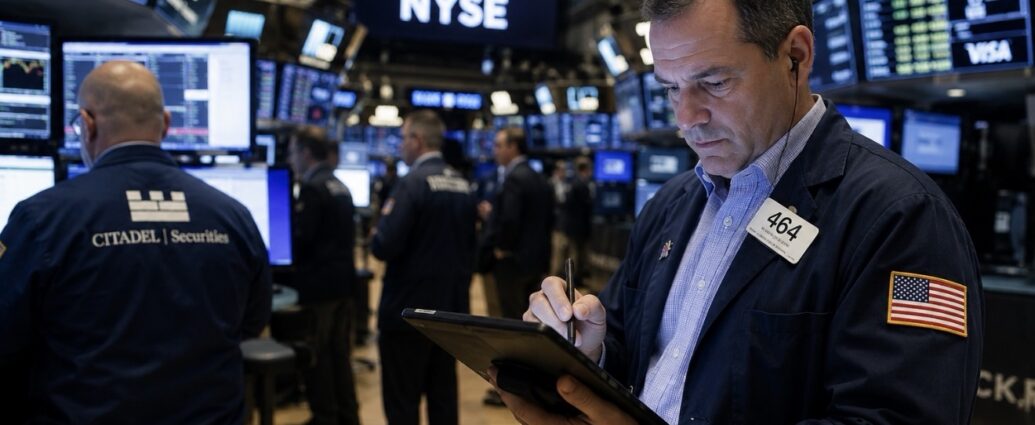
Investors closed out one of the more unsettled weeks of the summer with a split tape Friday, as a sharp retreat in crude oil steadied blue chips while chip stocks kept the Nasdaq underwater.
The S&P 500 finished at 7,411.98, up 3.68 points or 0.05%. The Dow Jones Industrial Average added 235.37 points, or 0.46%, to 51,947.02, while the Nasdaq Composite fell 161.87 points, or 0.64%, to 24,975.82. The Russell 2000 slipped 0.29% to 2,931.73, the VIX settled at 18.83 and gold closed at $4,056.90.
Measured against last Friday’s finish, the week belonged to the sellers. The S&P 500 gave up roughly 0.6%, the Nasdaq shed about 2.1%, and the Dow eased around 0.4% — a second consecutive weekly loss for the S&P and Nasdaq and a third straight down week for the Dow.
The week’s turning point
Thursday was the damage. The Dow dropped 506.93 points, the S&P 500 fell 1.21% and the Nasdaq slid 2.15%, dragged down by a 7% decline in Alphabet and a 14% drop in Tesla following their quarterly reports. Both companies posted negative free cash flow for the second quarter.
The problem was not the top line. Alphabet reported earnings of $9.11 per share on revenue of $103.62 billion, well ahead of expectations — but the stock weighed on the market after the company lifted its 2026 capital expenditure forecast to $195–$205 billion from $180–$190 billion, intensifying concerns about how much the hyperscalers are spending to build out AI capacity. That spending question has become the dominant argument on the Street, and it swamped an otherwise decent earnings beat.
Microsoft, Meta, Amazon and Oracle all fell between 3% and 5% on the session.
Market movers
Friday’s leadership flipped. Apple jumped about 3%, doing most of the work behind the Dow’s advance, while semiconductors stayed under pressure. A gauge of chip firms sank 4.4% and the Nasdaq 100 fell 1.1%.
Intel was the standout casualty of an apparent good report. The chipmaker guided quarterly profit and revenue above Wall Street estimates and laid out plans to raise spending over the next two years — and the stock sold off anyway, finishing the session down close to 8%. The pattern was consistent all week: beat the number, announce heavier capital spending, get punished.
Elsewhere, SpaceX shares dropped to an all-time low as investors continued to reassess the company’s valuation following last month’s IPO. SK Hynix fell 3.5% in Seoul after reports that the chipmaker had fully used up its 2.5% cap on converting Seoul-listed shares into U.S. depositary receipts during its $26.5 billion American offering, halting the arbitrage that had been narrowing a premium of as much as 51%.
Commodities
Energy drove the entire week’s mood. Brent settled above $100 a barrel Thursday for the first time since May, rising 7% after Iran-aligned Houthi forces said they struck two Saudi oil tankers in the Red Sea. The Houthis had declared a naval blockade of Saudi Arabia earlier in the week, targeting the pipeline route Riyadh has been using to work around the closure of the Strait of Hormuz.
Brent then fell 3.3% Friday to the mid-$90s, after reports that Pakistan, backed by China, was seeking to revive negotiations between Washington and Tehran. Even with the pullback, Brent booked a weekly gain of roughly 10% and West Texas Intermediate advanced about 9% — the largest weekly moves for both benchmarks since May.
Adding to the supply picture, Kazakhstan’s energy ministry said producers temporarily curtailed output after suspected drone attacks forced the closure of the country’s main Black Sea export terminal.
Trade and policy
The new tariff regime landed Friday morning. Sixty trading partners now face duties of 10% to 12.5%, taking effect at 12:01 a.m. ET as the administration’s temporary 10% blanket tariff expired. Those partners account for 99.4% of U.S. imports. The measures were issued under Section 301 of the Trade Act of 1974 and are premised on inadequate enforcement of forced-labor import bans. Canada, Mexico, India, the United Kingdom, Indonesia, Malaysia and Bangladesh are among those at 10%; China and 37 others face 12.5%. The European Union rejected the forced-labor characterization outright.
On the data side, U.S. services activity accelerated in July, helped by World Cup and holiday spending, while manufacturing growth slowed to its weakest pace since March. Initial jobless claims for the week ending July 18 came in at 187,000, down 22,000, with the four-week average falling to 207,500.
The week ahead
The calendar is heavy. The Federal Reserve meets Wednesday, with markets pricing roughly a one-in-three chance of a rate hike, up from 12% a week earlier per CME’s FedWatch tool, and PCE inflation data follows the day after the decision. Microsoft, Meta and Apple all report. And the month closes out heading into what has historically been the weakest three-month stretch of the year for the S&P 500.
Oil and the Fed will set the tone. Everything else is commentary.
JBizNews Desk | WalI Street
© JBizNews.com All Rights Reserved. Reproduction or distribution without written permission is prohibited.




