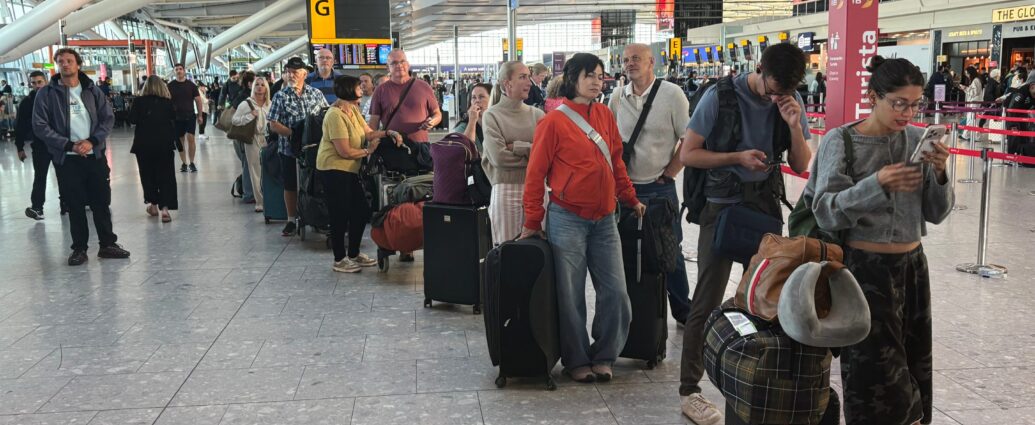
Airlines scrambled Wednesday to dig out from the backlog triggered by technical problems at Britain’s air traffic control system that has forced the cancellation of more than 1,750 flights.
Delays continued for a second day Wednesday, rippling across 15 U.K. airports and beyond as airlines and airports worked to clear a huge backlog of canceled and delayed flights. The problems stranded passengers for hours on airport runways and in terminals.
Flight delays were expected to continue through the day Wednesday as airlines rebook stranded passengers and work to reposition aircraft left at the wrong airports by the cancellations.
NATS, formerly known as National Air Traffic Services, which operates Britain’s air traffic control system, attributed the problems to “an issue in our flight processing system.” The company said it was supporting airlines and airports while they recover from the “ongoing disruption,” although the original technical issue was resolved Tuesday afternoon.
But airlines were furious, demanding that the head of NATS, Martin Rolfe, consider resigning after the second air traffic meltdown in three years.
Transport Secretary Heidi Alexander met with Rolfe on Wednesday and gave him one week to complete a full investigation into the incident to make sure lessons are learned. Prime Minister Andy Burnham’s office said Rolfe retains the confidence of the government.
The UK government owns 49% of NATS, making it the largest shareholder and giving it a veto over key decisions. Airlines, airports, investors and employees own the remaining shares in the public-private partnership.
Rolfe on Wednesday apologized for the inconvenience caused by the outage but said the U.K. air traffic control system remains one of the safest and most efficient in the world.
“Our job is also to make sure that people stay safe,” he told the BBC. “We never do this lightly. We only ever do it when there is an issue that cannot be resolved quickly, and we have to take action to make (sure) those who are flying, who are in the air at that time, are safe. And when we can restore these incredibly complex systems we do so as quickly as we can.”
Meanwhile, passengers were left to fend for themselves.
Cartoonist Charlie Adlard, who worked on the “Walking Dead” comic book series, was traveling from his home in western England to a comic book convention in Palermo, Sicily, when he was derailed by the air traffic issues. After running into the chaos at Heathrow, he tried and failed to reach his carrier, British Airways, by phone.
“Due to the lack of information, due to everything crashing now, due to the fact that apparently BA have now switched off their customer service phone number because there’s so many calls, we’re not really sure what to do,” Adlard, 60, said.
After losing a day of work, spending money on an airport hotel and paying for dinner and breakfast, he decided to turn around and go home.
“So yeah, I’ve lost quite a bit of money on this rather wasteful journey,” Adlard said.
Other airports experience similar problems. At Gatwick Airport, about 30 miles (48 kilometers) south of central London, passengers stretched out on the bare floor beside their suitcases. Others huddled around message boards, hoping for information.
In a statement on X, Heathrow, Europe’s largest airport, urged passengers to check their flight status before traveling to the airport and to “only travel if your flight is confirmed to be operating.″
“We apologize to those affected and have extra colleagues across our terminals to support passengers while we work with NATS and airline partners to restore normal operations as quickly as possible,” Heathrow said.
This story was originally featured on Fortune.com