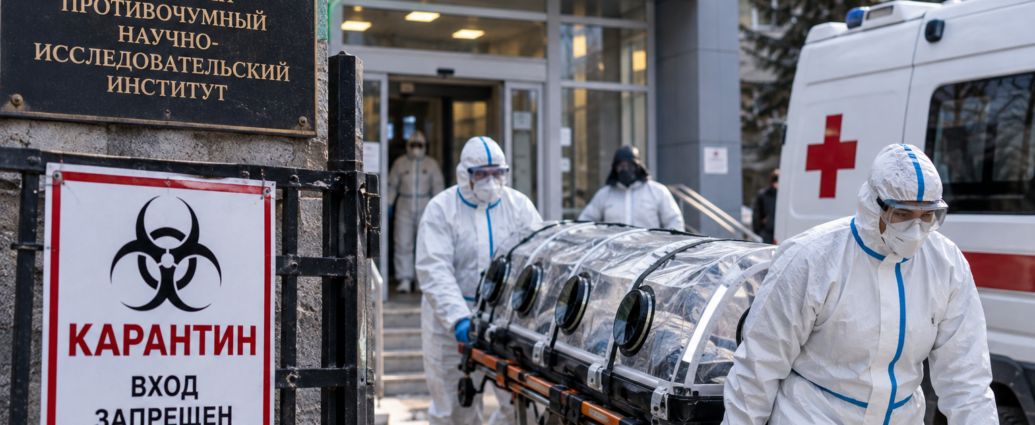
A 28-year-old researcher at a Russian institute that studies plague died last week of a severe lung infection, and unconfirmed reports that she had pneumonic plague have drawn the attention of the World Health Organization, the White House and health officials around the world.
The woman worked at the Irkutsk Anti-Plague Research Institute of Siberia and the Far East, a facility founded in the 1920s to monitor and study plague, which occurs naturally in wild animals in southeastern Siberia. She was first hospitalized with what looked like cold symptoms on Sept. 29 and died three days later, on Oct. 2, at a hospital in Shelekhov, a town just outside the city of Irkutsk. Independent Russian media have identified her as Darya Shipilova.
Here is the key point: no one has officially confirmed that plague killed her.
Russia’s public health agency, Rospotrebnadzor, has said only that she had “pneumonia of unknown etiology,” meaning doctors did not know what caused it. The agency said extensive testing found no evidence that her illness came from any of the germs she worked with. Moscow has told the World Health Organization that no case of plague has been recorded in the Irkutsk region.
At the same time, officials have taken steps that suggest they treated the case very seriously. The hospital where she died was placed under quarantine, no longer admitting or discharging patients. Nearly 200 people were placed under medical observation, according to local reports. Irkutsk Gov. Igor Kobzev said she died of a “particularly dangerous infection,” and Alexei Tsydenov, the head of the neighboring Buryatia region, wrote that she had “died, maybe of the plague.” Neighbors told local reporters that disinfection teams cleaned her apartment several times.
Russia’s health agency said Tuesday the situation in Irkutsk is “calm.” Among the people being monitored, it said, testing has turned up only two cases of COVID-19 and two cases of a common cold virus, and no other dangerous germs.
The WHO is not fully satisfied. The agency said it has asked Russia to explain what caused the woman’s severe pneumonia, which germ prompted the quarantine measures, and whether a second institute employee has also fallen ill with pneumonia of unknown cause, as some media have reported. The WHO said it has offered technical help and is following the situation closely.
In Washington, President Donald Trump said Tuesday he would speak with Russian President Vladimir Putin about the case “very soon” and said the U.S. stands ready to help. Kremlin spokesman Dmitry Peskov said Wednesday no call had been scheduled yet but one could be arranged quickly. The U.S. Centers for Disease Control and Prevention has said it is monitoring the situation.
So what is plague?
It is caused by a bacterium called Yersinia pestis, usually carried by rodents and other small mammals and spread by their fleas. It is the same disease behind history’s deadliest pandemics, including the Black Death.
There are three main forms. Bubonic plague, the most common, infects the lymph nodes and usually comes from a flea bite. Pneumonic plague infects the lungs and is the most dangerous form because it can spread from person to person through respiratory droplets.
The good news is that plague today is treatable. It responds to antibiotics, and recovery rates are high when it is caught early, according to the WHO. The danger is speed. The incubation period for pneumonic plague can be as short as 24 hours, and without quick treatment it can be fatal.
That is why health officials focus on tracing everyone a patient has been in contact with, testing them and giving preventive antibiotics when needed.
For Americans, the risk from this case appears very low based on the information currently available. There is no confirmed evidence that the illness has spread beyond the woman’s immediate contacts, Irkutsk is thousands of miles from the U.S., and no travel warnings have been issued.
Plague is not new to North America either. A handful of human cases typically occur in the United States, particularly in rural areas of the West, usually after exposure to infected rodents or fleas.
The bigger unanswered question is what actually killed the researcher.
Until Russian authorities release definitive laboratory findings, reports that she died of pneumonic plague remain unconfirmed. The precautions taken around the case have attracted international attention, but precautions themselves are not proof of a plague infection.
For now, health authorities are watching Irkutsk closely while waiting for an answer.
JBizNews Desk | Washington
© JBizNews.com All Rights Reserved. Reproduction or distribution without written permission is prohibited.