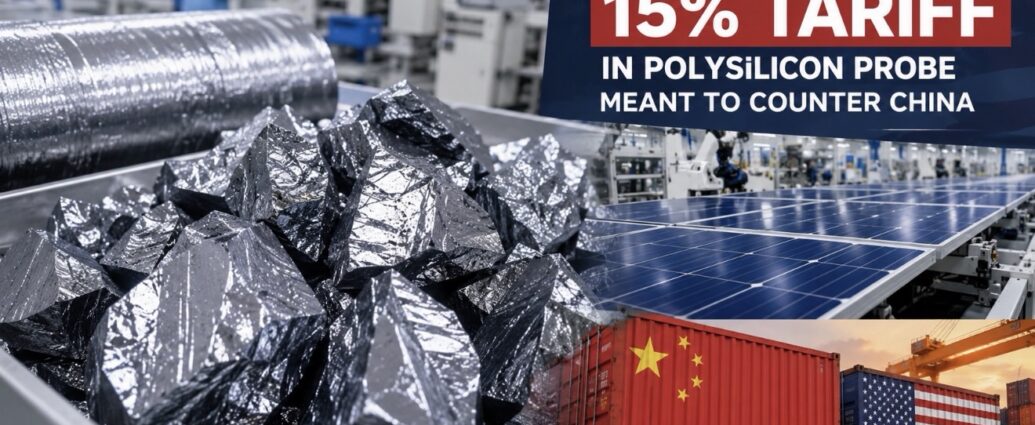
Every solar panel and every computer chip starts out as the same thing: silicon refined to a purity so extreme that only a handful of factories on earth can make it. That material is called polysilicon, and China makes almost all of it. The Trump administration is about to make it much harder to sell the Chinese version cheaply in the United States.
The plan, expected to be announced as soon as Thursday, pairs a 15% tariff on products made from polysilicon with a set of price floors covering polysilicon itself along with wafers, cells and finished solar modules. Four people familiar with the matter described the package, which comes as a presidential proclamation closing out a year-long national security investigation run by the Commerce Department.
The price floor is the part with real teeth. A tariff adds a percentage on top of whatever an importer paid. A minimum import price does something different — it sets a legal floor beneath which the imported goods simply cannot be sold in the U.S. market at all. If Chinese producers cut their prices, the floor does not move. That closes the door on the tactic American producers have complained about for fifteen years: flooding the market at prices below what it costs anyone to manufacture.
Two American plants, one enormous competitor
The reason Washington is acting is a lopsided number. Chinese manufacturers turn out roughly 93.5% of the world’s polysilicon, leaving the United States with essentially two domestic producers — Hemlock Semiconductor in Hemlock, Michigan, and Wacker Chemie’s plant in Charleston, Tennessee. Hemlock is a joint venture between Corning and Japan’s Shin-Etsu Handotai; Wacker is based in Munich. Between them they supply the raw feedstock underneath every chip and every panel built on American soil.
China accounts for more than 80% of manufacturing capacity across the major stages of solar panel production, according to the International Energy Agency, and nine of the world’s ten largest polysilicon producers are Chinese.
Beijing has not been shy about protecting its own side of the trade. In January, China extended anti-dumping duties on solar-grade polysilicon from the U.S. and South Korea for another five years, with American producers facing rates between 53.3% and 57%.
The catch for solar builders
The administration is trying to help two industries that want opposite things. Polysilicon makers want import prices high. The solar developers and chip buyers who purchase the finished product want them low — and demand is surging because of data center construction.
Industry groups representing solar developers and semiconductor buyers have told the administration that tariffs could raise the cost of solar power plants and push up prices on everything from consumer electronics to automobiles. Roth Capital estimates the price floor could add about ten cents per watt to imported solar cells.
There is a release valve built in. Two of the sources said importers that invest in American wafer and cell production will be able to offset the costs of the new trade protections — a structure designed to convert the tariff bill into domestic factory construction rather than simply higher prices.
Investors read the news as good for the American names. Corning rose as much as 10%, First Solar gained 8% and SolarEdge Technologies added 8% after the plan was reported.
How it got here
The Commerce Department’s Bureau of Industry and Security opened the formal investigation on July 14, 2025, examining the national security effects of imports of polysilicon and its derivatives, including wafers, cells and modules. The probe runs under Section 232 of the Trade Expansion Act of 1962, the same statute used for steel and aluminum, which lets the president restrict imports found to threaten national security and permits remedies including tariffs, quotas and minimum prices.Both Hemlock and Wacker make semiconductor-grade material, the higher-specification product, and preserving that capability is the more consequential of the two goals the policy serves.
Solar volume is what keeps those plants running; chips are what makes them strategic.
China has objected. A spokesperson for China’s Embassy in Washington called on the U.S. to “stop the Section 232 tariff measures as soon as possible” and settle the dispute through dialogue between equals.The Commerce Department and the White House did not immediately respond to requests for comment.
The larger point is that polysilicon has quietly become a chokepoint. It sits at the front of two supply chains the country cannot do without, and one nation controls nearly all of it. Thursday’s proclamation is Washington’s attempt to buy its two remaining plants enough room to stay in business.
JBizNews Desk | Washington
© JBizNews.com All Rights Reserved. Reproduction or distribution without written permission is prohibited.