White House Names 40 Countries in China’s Tariff Scam, Builds ‘Detective Border’
The White House said Thursday that more than 40 American trading partners are helping Chinese goods slip into the United States at the wrong tariff rate, and that Customs and Border Protection is being armed with artificial intelligence to catch it. The findings came in a 25-page report titled “The Great Transshipment Scam,” produced by the White House Office of Trade and Manufacturing Policy, which is led by trade adviser Peter Navarro.
The practice at issue is simple. A factory in China makes the goods. Instead of shipping them straight to an American port, where they would face a steep China tariff, the shipment stops in a third country. There it is relabeled, lightly repackaged, or given a minor finishing step, then sent on to the United States as a product of that third country — at that country’s lower rate. The customer gets the same Chinese product; the Treasury gets a fraction of the duty.
Navarro told reporters the scam has let Communist China launder its exports through more than 40 countries. Those named include the European Union and Taiwan, along with America’s land neighbors Mexico and Canada, plus Malaysia, India, Japan, South Korea and Vietnam. Officials singled out China, Mexico and India as the top transshippers and Vietnam as a top enabler.
The report sorted the countries into groups: some where the risk is buried inside otherwise legitimate trade flows, some deeply wired into China-linked supply chains, and a third set whose preferential access to the American market makes them attractive opportunistic targets for rerouting.
Nobody agrees on the size of the hole. The report cites government and private-sector estimates putting the annual value of transshipped goods at roughly $34.2 billion to $303 billion. A separate figure carried in the report puts it at as much as $75 billion a year, which Navarro compared to the entire annual budget of Customs and Border Protection, the Agriculture Department, or Space Force — or about half the Army’s. The spread comes down to methodology: the low number counts only clear-cut origin fraud, the high one counts every barrel of trade that looks statistically suspicious. Either way, the enforcement response is being sized against the big number.
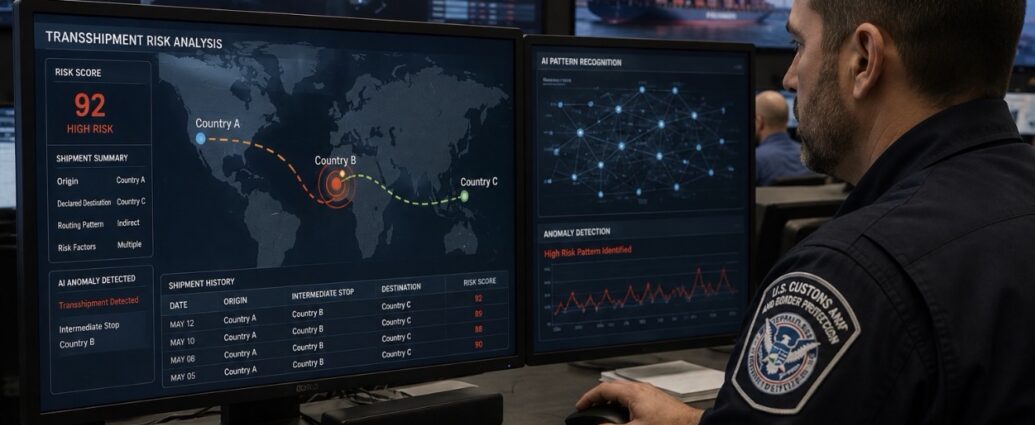
The tool is what Navarro calls the detective border. Trump had already signed an executive order directing Customs and Border Protection to build an artificial-intelligence-enabled protective border to pin down where incoming goods actually come from, and Navarro said the agency has begun using artificial intelligence in a prototype program to detect transshipment. The system is designed to read shipment records, routing histories, product classifications, ownership connections and declared production capacity, using anomaly detection and computer vision to pick out high-risk cargo, with the stated goal of separating legitimate nearshoring and foreign investment from illegal rerouting.
Put plainly, the software is looking for arithmetic that does not work. A country that exports more of a product than its factories could physically build. A trade lane that tripled in a quarter with no new plant behind it. A declared price that does not match the product.
Here is the number importers should write down. Navarro said importers found to have falsified a product’s origin can face tariffs applied retroactively for roughly a year. That is the exposure: not a fine on the next container, but a bill on twelve months of containers already unloaded, sold and booked as profit. Under American customs law the importer of record — not the overseas supplier, not the broker — carries legal responsibility for the accuracy of the origin declaration.
The practical work is documentary and it needs to happen before a shipment is flagged, not after. That means supplier affidavits that actually name the manufacturing site, bills of materials showing where each component originated, factory records and production-capacity evidence for the third country, and contract language that says plainly who absorbs the cost if duties are reassessed. Companies that moved sourcing out of China during earlier tariff rounds are the ones most likely to discover their paperwork was never built to survive this kind of scrutiny.
The competitive argument cuts in the administration’s favor with domestic producers, who have long complained that firms paying full duty are undercut by rivals paying a third-country rate on the same Chinese goods. The counterweight is that legitimate manufacturing has genuinely relocated to Vietnam, Mexico and India over the past eight years, and a screening system tuned to catch cheaters will inevitably slow down honest cargo while it verifies.
Timing is not incidental. The report landed ahead of a planned September visit to Washington by Chinese President Xi Jinping, following Trump’s trip to Beijing in May.
JBizNews Desk | Washington
© JBizNews.com All Rights Reserved. Reproduction or distribution without written permission is prohibited.