Blame the Iran war if you want. The spike in jet fuel prices was real, and it certainly made an already difficult situation worse. But the deeper truth behind Spirit Airlines’ collapse is far more fundamental — and far more damaging to the broader low-cost airline industry.
Spirit Airlines was already failing long before oil prices surged and global aviation costs exploded. The airline’s downfall was driven by years of operational struggles, financial weakness, and perhaps most importantly, a customer experience that millions of travelers increasingly decided simply was not worth enduring — even at bargain-basement fares.
The fuel crisis accelerated the collapse. It did not create it.
Spirit had not posted consistent profitability since before the pandemic and repeatedly warned investors over recent years that its long-term survival was uncertain. By the time geopolitical tensions pushed jet fuel prices sharply higher in 2026, the airline was already under enormous pressure from mounting debt, weaker consumer demand, and a deteriorating reputation among travelers.
Its failure now stands as a warning to the broader airline industry: competing on price alone is no longer enough.
The Customer Experience Problem
Spirit’s biggest issue was not fuel.
It was trust.
For years, the airline ranked among the worst major U.S. carriers in customer satisfaction and complaint levels. Passengers increasingly associated the airline with uncomfortable seating, surprise fees, operational frustration, and an overall experience many travelers actively tried to avoid whenever financially possible.
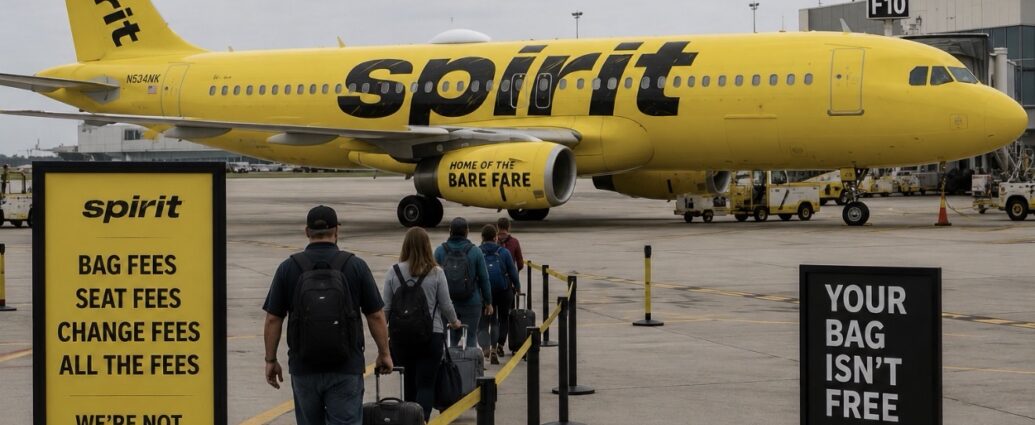
The company built its business around ultra-low base fares while charging separately for nearly everything else — including carry-on luggage, seat selection, snacks, and other basic services many consumers had come to expect as standard.
Even among budget-conscious travelers, frustration steadily grew.
Spirit also operated with some of the tightest seating configurations in the U.S. airline industry. According to travel publication Simply Flying, Spirit offered the smallest average legroom among major American carriers.
“Cramming people into 28-to-29-inch seat pitch is uncomfortable, period. Especially on longer-haul flights,” airline industry consultant Mike Boyd said.
The perception problem eventually became larger than the actual ticket prices themselves.
Passengers who initially booked Spirit to save money often found themselves paying additional fees throughout the travel experience — while still receiving what many viewed as inferior service.
“They stripped out so much from the experience that the folks who ended up stuck on Spirit often kind of despised the experience,” said Zach Griff, author of the airline newsletter From the Tray Table. “And they often were willing to pay $30, $40, $50, even $60 more just to have a better experience on a different airline.”
That dynamic proved devastating because airlines depend heavily on repeat customers and brand loyalty to maintain long-term profitability.
Spirit increasingly struggled to generate either.
“A low percentage of passengers said they would fly the airline again after their most recent experience,” said Michael Taylor, senior managing director overseeing travel and customer service rankings at JD Power. “There will always be a market for airlines that offer the lowest fares possible. The question is: are they making the pizza too cheap to eat?”
Spirit Tried to Reinvent Itself — But Too Late
Spirit was not always viewed as a failing airline.
Originally operating as a charter carrier during the 1980s before transitioning into a passenger airline in the early 1990s, the company spent years building one of the country’s best-known ultra-low-cost brands and remained mostly profitable through 2019.
But consumer behavior changed dramatically after the pandemic.
As travelers returned to flying, many proved willing to pay slightly more for greater comfort, reliability, and convenience — areas where Spirit consistently struggled to compete.
Recognizing the shift, the airline attempted to reposition itself.
Spirit introduced larger front-of-cabin seats, bundled fare packages including Wi-Fi and baggage, and made efforts to soften some of its most criticized policies. But by then, its reputation may already have been too deeply entrenched.
“No one ever compared Delta and Spirit, at least when it comes to service,” Griff said.
The airline’s efforts to change public perception simply failed to gain enough traction before financial pressure intensified.
Cheap Flying Isn’t Dead
Spirit’s collapse does not mean the ultra-low-cost airline model itself is disappearing.
Other discount airlines continue finding success by offering budget pricing without generating the same level of consumer dissatisfaction.
Allegiant Air, for example, operates under a similar low-frills business structure but consistently ranks higher in customer satisfaction surveys.
“People think it’s a great value for the money,” Taylor said. “That’s how you can make money as an ultra-low cost carrier.”
Breeze Airways, launched in 2021, has also emerged as one of the fastest-growing airlines in the United States, demonstrating that demand for affordable travel remains strong.
The difference appears to be execution.
Passengers may accept fewer amenities in exchange for lower fares — but increasingly, they still expect transparency, comfort, reliability, and a basic level of dignity during the travel experience.
A Tough Future for Budget Airlines
Even after Spirit’s collapse, the broader budget airline sector remains under pressure.
The continuing spike in jet fuel prices tied to Middle East tensions has squeezed already-thin operating margins across the industry. A trade association representing several remaining discount airlines recently requested a $2.5 billion federal bailout from Congress and the Trump administration to help stabilize the sector.
Industry analysts warn that the era of relying purely on ultra-cheap fares may be ending.
“Bottom line: the day of being able to maintain business just on the basis of offering a low fare is over,” Boyd said.
For consumers, Spirit’s collapse reinforces a broader lesson that extends well beyond aviation:
The cheapest upfront price is not always the cheapest overall experience — especially when travelers end up paying extra fees, sacrificing comfort, and dreading the journey before it even begins.
— JBizNews Desk
**© JBizNews.com. All rights reserved. This article is original reporting by JBizNews Desk. Unauthorized reproduction or redistribution is strictly prohibited.