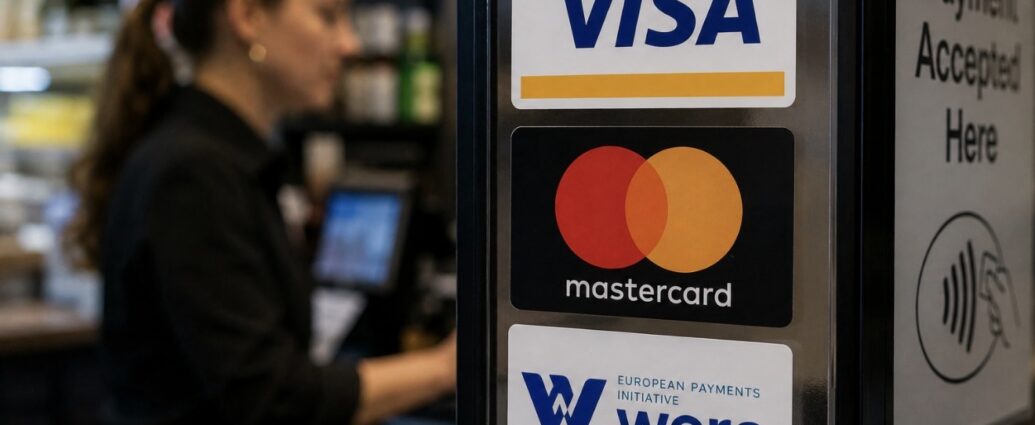
A growing effort is underway across Europe and the United Kingdom to reduce dependence on Visa and Mastercard, as governments and financial institutions push to build homegrown payment networks they say will strengthen economic sovereignty and lower costs.
The movement has gained urgency as policymakers increasingly view payment infrastructure as a matter of national security.
European Central Bank President Christine Lagarde has warned that Europe urgently needs its own digital payment system rather than relying so heavily on American companies.
Today, Visa and Mastercard dominate the global payments business.
Together, the two companies process roughly $24 trillion in transactions annually, including about $4.7 trillion across Europe. In the United Kingdom, approximately 95% of all card transactions travel through one of the two U.S.-based payment networks.
Every payment also generates transaction data that often flows outside national borders, something European regulators increasingly view as a strategic vulnerability.
Europe’s primary response is the European Payments Initiative (EPI) and its new digital payment platform called Wero.
Backed by many of Europe’s largest banks, Wero allows consumers to transfer money directly between bank accounts in seconds without relying on traditional credit-card networks or interchange fees.
Earlier this year, EPI reached an agreement with the EuroPA Alliance, connecting payment systems in Italy, Spain, Portugal, and several Nordic countries. The combined network already serves roughly 130 million users across 13 countries.
Cross-border person-to-person payments are expected to begin this year, with in-store payment capabilities scheduled to launch in 2027.
The United Kingdom is pursuing a similar strategy.
Major British banks have begun discussions surrounding a domestic payment platform known as DeliveryCo, supported by government officials and the Bank of England.
British regulators argue recent geopolitical tensions and cybersecurity concerns demonstrate the importance of maintaining payment systems that cannot easily be disrupted by events outside the country.
The urgency has grown following recent international sanctions and other geopolitical disputes that highlighted how quickly financial infrastructure can become part of broader political conflicts.
For merchants, however, the issue extends beyond national security.
Although Europe has already capped many interchange fees, retailers continue arguing that competition between Visa and Mastercard remains limited, keeping processing costs higher than they would like.
Bank-to-bank payment systems promise nearly instant settlement without traditional card interchange fees, offering potentially meaningful savings for businesses if consumers adopt the technology.
Building a successful alternative will not be easy.
One of Visa’s and Mastercard’s greatest advantages remains their worldwide acceptance. A Visa card issued in Europe works almost anywhere in the world, while newer regional payment systems will initially function only within participating countries.
Earlier efforts to build European payment systems have also struggled to gain widespread consumer adoption.
For the American payment giants, the challenge is significant but unlikely to become an immediate threat.
Visa generated roughly $40 billion in revenue during 2025, while Mastercard reported nearly $33 billion. Both companies continue investing heavily in Europe and are even participating in discussions surrounding Britain’s future payment infrastructure.
Most analysts expect Visa and Mastercard to remain dominant for years to come.
However, the emergence of credible alternatives could gradually increase competition, lower merchant fees, and give governments greater control over their own financial infrastructure.
For consumers, the changes may ultimately mean more payment choices and lower transaction costs.
For Visa and Mastercard, it represents one of the most serious long-term competitive challenges they have faced after decades of dominating the world’s checkout counters.
JBizNews Desk
© JBizNews.com All Rights Reserved. Reproduction or distribution without written permission is prohibited.