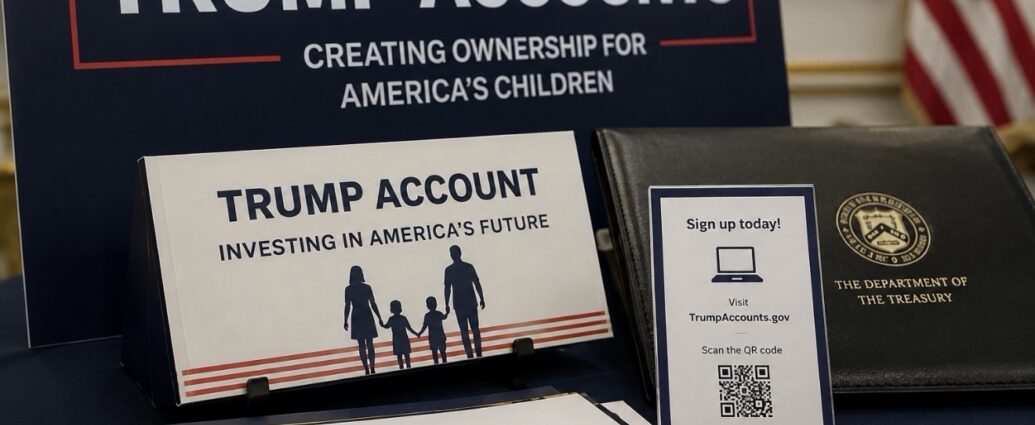
WASHINGTON — In July, the U.S. government will begin depositing $1,000 into investment accounts for millions of American babies under a new program known as Trump Accounts.
The U.S. Treasury Department, which is overseeing the rollout, says accounts officially open on July 4, with registration already underway. Treasury Secretary Scott Bessent has described the initiative as a way to connect ordinary Americans to the financial markets from birth.
But while supporters see the program as a long-term wealth-building tool, a growing number of economists and policy experts question whether it can meaningfully reduce wealth inequality.
Under the program, every U.S. citizen born between 2025 and 2028 qualifies for a one-time $1,000 government deposit, provided a parent or guardian opens the account. The funds are invested in a low-cost stock-market index fund, with annual fees capped at 0.1%, and cannot generally be accessed until the child reaches adulthood.
Families, employers, charities, and others may contribute up to $5,000 annually.
Supporters point to the power of long-term compounding. Government projections estimate that a child who receives only the initial deposit could see the account grow to approximately $15,000 over time.
Critics, however, argue that the larger issue is not the initial deposit but who can afford to keep contributing.
Families able to contribute the maximum $5,000 per year could potentially build accounts worth hundreds of thousands of dollars by adulthood. By contrast, children whose families cannot contribute additional funds may be left with little more than the original government contribution and investment growth.
According to government projections, an account funded at maximum contribution levels could reach approximately $742,000 by age 18, compared with roughly $15,000 for an account receiving only the initial deposit.
That gap has drawn concern from several researchers.
David Radcliffe, policy director at The New School’s Institute on Race, Power, and Political Economy, argues the structure primarily benefits families that already possess financial resources. Connecticut State Treasurer Erick Russell has similarly warned that wealthier households may be positioned to build significantly larger nest eggs than lower-income families.
Another concern involves participation.
Because parents must actively enroll their children, some experts worry that families facing financial hardship or lacking familiarity with investing may be less likely to sign up. The Aspen Institute has noted that automatic enrollment could have increased participation among lower-income households.
Questions have also been raised about whether the program can meaningfully address longstanding racial wealth disparities.
Federal data show substantial differences in median household wealth among demographic groups. Critics note that previous “baby bond” proposals sought to target larger benefits toward lower-income children, while Trump Accounts provide the same initial deposit regardless of family income.
Supporters counter that private-sector participation can significantly expand the program’s impact.
Secretary Bessent has launched a nationwide effort encouraging additional contributions, while several prominent business leaders and corporations have pledged support. Michael and Susan Dell have committed billions toward funding accounts for lower-income children, Ray Dalio has pledged tens of millions of dollars, and companies including JPMorgan Chase and Bank of America have announced matching contributions for eligible employees’ children.
Supporters argue that even modest investments can introduce millions of families to long-term saving and investing, creating opportunities that otherwise might not exist.
Critics acknowledge that the accounts can provide meaningful financial benefits but remain skeptical that a universal $1,000 deposit alone can significantly narrow the wealth gap.
Whether the program ultimately reduces inequality or reinforces existing differences may depend less on the government’s initial contribution and more on who continues contributing after the account is opened.
Washington — JBizNews Desk
© JBizNews.com. All Rights Reserved. Reproduction or distribution without written permission is prohibited.