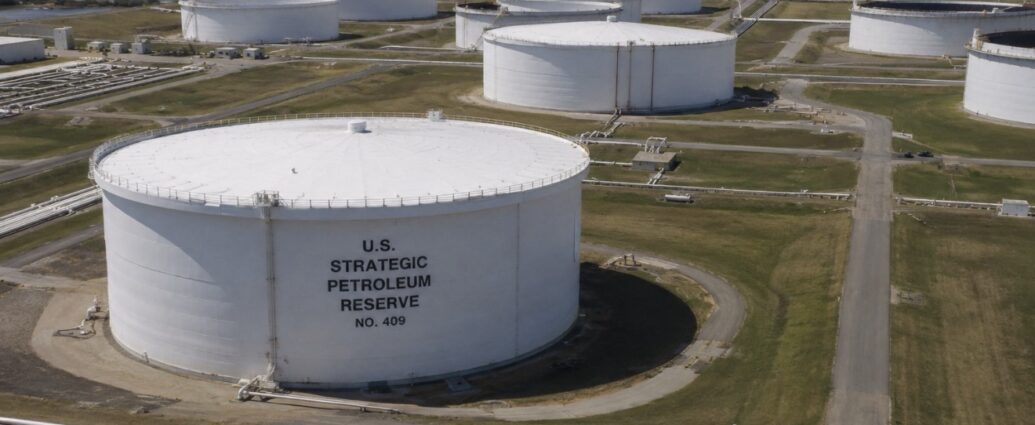
NEW YORK — May 15, 2026 — The numbers look like a double paradox. President Donald Trump has spent recent weeks reminding voters that the United States pumped a record 13.6 million barrels of crude oil per day in 2025 — more than Saudi Arabia and Russia combined — and the U.S. Energy Information Administration’s May 12 Short-Term Energy Outlook confirms domestic output will hold near 13.5 million barrels a day this year. Yet in the same window, the administration has authorized the largest emergency release in the Strategic Petroleum Reserve’s 50-year history, ordering 172 million barrels onto world markets as part of an International Energy Agency coordinated action — more than every other participating nation combined. So if the United States is the world’s biggest producer, why is the reserve draining at all, and why are we selling more of it than anyone else? The answers lie in the math underneath the “energy dominance” slogan, and they are harder than they look.
The first piece of math is the gap between production and consumption. The United States pumps roughly 13.5 million barrels per day. It consumes roughly 20.5 million barrels per day, according to EIA forecasts. That gap of about 7 million barrels a day is filled by imports — overwhelmingly of heavier and sourer crude grades from Canada, Mexico, Saudi Arabia, and historically Venezuela — and by drawdowns of commercial and government inventories during disruptions. The country has been the world’s largest producer for years and the world’s largest consumer for decades; production leadership and net energy independence are not the same thing.
The second piece is quality, and this is where the program really splits from the politics. The shale revolution that took American production from roughly 5 million barrels a day in 2008 to 13.6 million in 2025 has produced almost entirely light, sweet crude from the Permian Basin and other tight-oil formations. But the Gulf Coast refining system that processes the bulk of American petroleum was built decades ago to run on heavier, sourer feedstock. Galveston Bay and the Motiva Port Arthur complex, the two largest U.S. refineries — each capable of processing over 600,000 barrels per day — are designed around coker and conversion units that yield more diesel and jet fuel from medium-sour crude than from light-sweet shale. So the United States simultaneously exports millions of barrels of its own light crude and imports millions of barrels of heavier grades. When the Strait of Hormuz closes, it is the heavy side of that ledger that breaks first. The SPR, which holds both light and medium-sour grades and connects directly via pipeline to refining hubs in Houston, Texas City, Freeport, Port Arthur, Lake Charles, New Orleans, and Baton Rouge, is the only American supply that can deliver heavy and medium-sour barrels into those refineries within days.
The third piece is refining capacity. The United States today operates roughly 131 refineries with a combined throughput capacity near 18.4 million barrels per day, according to the EIA. That number has been shrinking. Seven major refinery closures and conversions since 2019 — including Philadelphia Energy Solutions at 335,000 barrels per day, LyondellBasell’s Houston refinery at roughly 264,000 barrels per day, Phillips 66’s Los Angeles refinery at about 139,000 barrels per day, and Valero Energy Corp.’s Benicia, California, plant at roughly 145,000 barrels per day — have permanently removed more than 1.2 million barrels per day of processing capacity. No new major U.S. refinery has been built in nearly half a century. Even with abundant domestic crude, the country’s refining throughput is now the binding constraint on how much gasoline, diesel, and jet fuel can actually be made and delivered to American pumps. Refiners are running at roughly 95% utilization. There is no more headroom to push.
The fourth piece is the global price. Oil is a globally traded commodity, and U.S. producers sell their barrels at the global price — not a discounted “American” price. When Brent crude jumps to $117 a barrel because of a war in the Middle East, West Texas Intermediate follows it almost minute for minute. American producers do not voluntarily discount to American drivers. WTI closed Thursday at $102. The national average retail gasoline price was $4.45 a gallon on May 4 according to GasBuddy data, with some regions above $6. That math holds regardless of who pumps the most crude, because the crude itself trades at world prices.
The fifth piece is timing. Even when high prices give American shale producers every incentive to drill more — and they are — bringing new wells online from leasing to first production typically takes six to nine months. The SPR can move oil to a refinery dock in days. When the Strait of Hormuz closed on February 28, the administration did not have the option of waiting two quarters for new Permian wells to ramp; global inventories were already drawing down at roughly 4.8 million barrels a day, according to Morgan Stanley.
That answers why we drain. The harder question is why we drain more than anyone else — and the answer has four parts. First, the United States is not technically selling the barrels. The 172-million-barrel release is structured as an exchange: recipients must return every borrowed barrel plus an 18% to 22% premium between September 2026 and September 2028. If the program executes as designed, the SPR ends up larger by roughly 15 million barrels at no cost to taxpayers. The 2022 Biden-era release was a straight sale; the 2026 Trump-era release, on paper, is a loan. Second, the United States is the biggest contributor because we have the biggest reserve and the biggest consumption. The U.S. SPR held about 415 million barrels going into the release — by far the largest single national stockpile. Japan, holding the third-largest at 263 million, contributed 80 million. Germany contributed 19.5 million. The United Kingdom contributed 3.5 million. America’s 172-million-barrel contribution roughly matches our share of global oil consumption and our share of IEA-coordinated stocks.
Third — and this is the structural reason most often missed — the United States is the only country whose emergency reserves physically reach the global market. European, Japanese, and South Korean reserves are largely refiner-held commercial stocks those countries legally require their refiners to maintain. When those nations “release,” local refiners just run down inventories at home. Almost no barrels physically move. The U.S. SPR is structurally different: government-owned crude sitting in salt caverns along the Texas and Louisiana Gulf Coast, connected by pipeline to deep-water export terminals. When America releases, the oil actually ships — which is why nearly half of the current release has flowed to Rotterdam, Asia, and Latin America. Fourth, IEA coordination is the political deal. When the United States wants global market stabilization — and we do, because global prices set our prices — we have to participate proportionally. If America held back, the coordinated release collapses and prices spike harder for everyone, including American drivers.
The unresolved question is whether the exchange structure actually holds. Several Biden-era 2022 loans were quietly restructured or delayed when oil prices fell below the return strike. If Brent drops sharply by 2028, recipient traders such as Trafigura Group, Vitol Group, Shell Plc, and BP Plc will return cheap barrels gladly. If prices stay elevated, the math gets ugly and Washington negotiates. The “no cost to taxpayer” claim is forward-looking; the verdict comes in three years. Production leadership is a real and significant achievement, and the SPR exchange is a legitimately innovative use of government inventory. But neither one shields American consumers from a global price shock, a heavy-crude shortfall at Gulf Coast refineries, or the simple fact that being the biggest stockholder in a shared global insurance pool means being the biggest payer when the claim comes due.
— JBizNews Desk
© JBizNews.com. All rights reserved. This article is original reporting by JBizNews Desk. Unauthorized reproduction or redistribution is strictly prohibited.