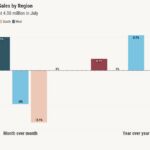
Locked loan data across all borrower credit profiles shows that mortgage rates continue to hover near 7%. But a negative jobs report in July may keep monetary policy makers from initiating a higher path for rates, which some market observers have been predicting for months.
At HousingWire‘s Mortgage Rates Center on Tuesday, rates for 30-year conforming loans averaged 6.91%, down 1 basis point from a week ago. Rates for 30-year jumbo loans dropped 3 bps to 6.92%, while rates for 30-year loans through the Federal Housing Administration (FHA) were up 4 bps to 6.65%.
Rates haven’t moved much following last week’s jobs report from the U.S. Bureau of Labor Statistics, which found that nonfarm payrolls shed a total of 23,000 positions in July. Cotality chief economist Selma Hepp said in response that the pullback “points to a more pronounced slowdown in the labor market than previously understood.” Additionally, data for May and June were revised downward by a combined 103,000 jobs.
“Slower job growth can dampen consumer confidence and make households more cautious about major financial decisions, including home purchases, pressuring the Federal Reserve to take measures to stimulate economic growth,” Hepp said. “The weaker employment data increases the likelihood that the Federal Reserve will resist future rate hikes, and may even consider cutting rates, offering some relief to homebuyers and supporting housing demand later this year.”
‘Breathing room’ from a rate hike?
Joel Kan, vice president and deputy chief economist for the Mortgage Bankers Association (MBA), pointed to wage growth of 3.2% that was surpassed by the most recent inflation data. Additionally, while the unemployment rate dropped slightly to 4.1%, that was driven by a decline in the labor force participation rate rather than new hirings.
“The weaker July employment data might provide a little breathing room for the Federal Reserve as it considers its next policy move, but inflationary pressures are expected to persist through the remainder of 2026 with no clear end in sight for the war in Iran,” Kan said. “We anticipate that the Federal Reserve will raise the fed funds rate in early 2027, but any additional upside surprises to inflation are likely to bring that timetable forward.”
Sam Williamson, senior economist at First American, said that “much of July’s weakness was concentrated in government education, where payrolls fell sharply at the end of the school year, which likely exaggerated the headline decline. Even so, the recent trends make clear that the labor market has lost some of its recent momentum.”
The weakness in the labor data is expected to offset rising upside risks to inflation. For the housing industry, it could mean marginal relief for homebuyers as the Fed will be less inclined to raise rates.
“Slower hiring can also weigh on job mobility and consumer confidence, so the housing benefit is likely to be modest,” Williamson said. “Still, a cooler labor market that takes some pressure off borrowing costs would be a better backdrop for buyers than another leg higher in mortgage rates.”
The CME Group‘s FedWatch tool on Tuesday showed a 50/50 split among interest rate traders that a Fed rate increase is coming in September. The odds move higher in October, with roughly two-thirds of traders saying that rates will be either 25 bps or 50 bps higher.
What are Fed officials saying?
Last week, Anna Paulson, the president of the Federal Reserve Bank of Philadelphia, said she was keeping an “open mind” about the future path for interest rates, according to reporting by Bloomberg. Paulson envisions two possible scenarios for how current monetary policy under Chair Kevin Warsh will play out.
One scenario is that further evidence of cooling inflation and stable expectations for future prices will emerge, showing that current rates are “mildly restrictive” and that inflation will drop back to the Fed’s 2% goal in an “acceptable time frame,” she said. But the alternative scenario would support a higher federal funds rate, she indicated.
“If instead underlying inflation remains stubbornly elevated, the passage of time without progress would itself signal that more restrictive policy is needed,” Paulson said.
While three Fed officials — Beth Hammack, Neel Kashkari and Lorie Logan — voted in favor of a 25-bps rate hike last month, Paulson was firmly in the camp of keeping rates untouched, saying that “the evidence so far suggests we’re in a mildly restrictive stance.
“If we don’t see that progress [on inflation], then we have to be open to recalibrating monetary policy. We need to get to 2%,” she added.
Meanwhile, Fed Gov. Lisa Cook — who continues to be scrutinized by the Trump administration over mortgage fraud accusations — touched on the U.S. economy and monetary policy during an economic development event last week in Anchorage, Alaska.
“This year has brought two unexpected sources of price pressure: The Middle East conflict has driven the cost of energy and certain other goods higher, and companies are ramping up capital spending to build out artificial intelligence (AI) infrastructure,” she said during prepared remarks.
“That investment wave has lifted prices for semiconductors, high-tech equipment, software and utilities. Taken together, these developments have shifted the balance of risks toward inflation and away from the labor market.”
Cook went on to say that while the long-term impacts of the Trump administration’s tariff policies “may no longer provide much inflationary push going forward,” uncertainty remains, prompting her to support stable rates while the economic environment evolves.
“If I do not see signs of continued disinflation soon, I am prepared to act,” Cook said. “With five years of above-target inflation, the risk grows that higher inflation may become entrenched in price- and wage-setting behavior, leading to persistence that would be much harder for us to attack.
“The longer inflation is above target, the more likely this scenario becomes. Thus, while we might be able to afford to wait for longer in a different environment, we do not have that luxury in this one.