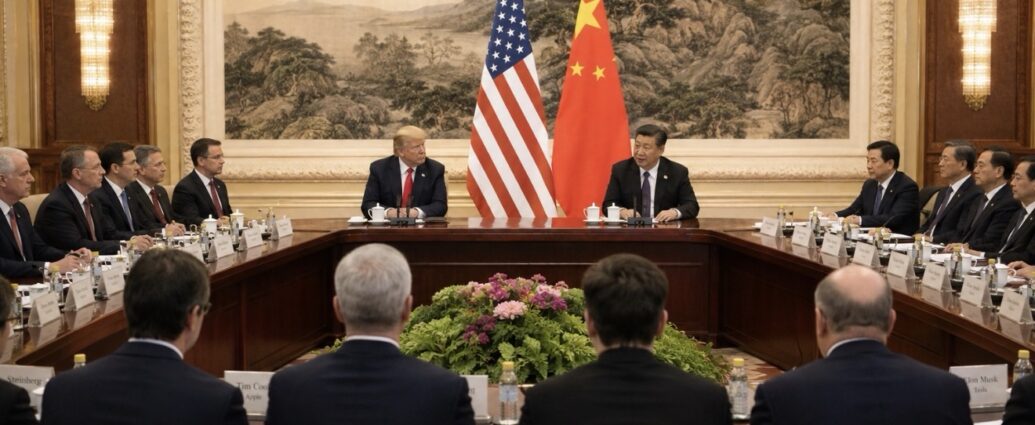
Chinese President Xi Jinping told a group of top American executives Thursday that China’s door to foreign business “will only open wider,” delivering a carefully calibrated message to corporate leaders who traveled to Beijing alongside President Donald Trump for a closely watched summit aimed at stabilizing the world’s most consequential economic relationship.
Speaking inside Beijing’s Great Hall of the People, Xi addressed executives including Apple CEO Tim Cook, Tesla CEO Elon Musk, Nvidia CEO Jensen Huang, BlackRock CEO Larry Fink, and senior leaders from Goldman Sachs, Citigroup, Visa, GE Aerospace, Boeing, and Blackstone.
According to Chinese state broadcaster CCTV and the official Xinhua News Agency, Xi told the delegation that American companies had been “deeply involved in China’s reform and opening up” and emphasized that both countries had benefited from decades of economic cooperation. Executives attending the meeting reportedly told Xi they continued to “highly value” the Chinese market and hoped to expand cooperation further.
The high-profile corporate diplomacy unfolded alongside Trump’s bilateral talks with Xi, which lasted more than two hours and produced what both governments described as a framework for a “constructive strategic stable relationship” over the next three years.
Trump later told Fox News host Sean Hannity that Xi had agreed to purchase 200 Boeing 737 aircraft along with expanded imports of American soybeans, crude oil, and liquefied natural gas — announcements the White House is expected to frame as major economic wins for American manufacturing and agriculture.
While smaller than the 500-aircraft package Bloomberg previously reported was under discussion, the Boeing order would still represent China’s largest aircraft commitment to the U.S. aerospace giant since Trump’s first state visit to Beijing in 2017.
Boeing shares rose roughly 1.6% in premarket trading following the announcement. Tesla gained 2.7%, Nvidia climbed 2.3%, Apple advanced 1.4%, and Micron Technology surged nearly 5% as investors interpreted the summit as a sign that commercial tensions between Washington and Beijing may be easing, at least temporarily.
The delegation accompanying Trump reflected the breadth of American corporate exposure to China. Alongside Cook, Musk, Huang, and Boeing CEO Kelly Ortberg, the trip included some of Wall Street’s most influential financial executives and industrial leaders.
Trump said earlier in the week that when he invited “the top 30 in the world” to join the trip, “every single one of them said yes.”
For Xi, the optics served multiple strategic purposes.
Domestically, the meeting projected confidence at a time when China’s economy faces slowing growth, persistent real estate weakness, and mounting concerns about youth unemployment and foreign capital outflows. Internationally, the summit allowed Beijing to signal that despite years of tariffs, export controls, sanctions disputes, and escalating geopolitical rivalry, China still views American business as indispensable to its long-term economic strategy.
Chinese Premier Li Qiang separately met with executives during the visit to discuss semiconductors, artificial intelligence, electric vehicles, financial services, and broader market access issues, according to China’s foreign ministry.
Public comments from the CEOs were notably optimistic.
Musk described the meetings as “wonderful” and said he hoped to accomplish “many good things.” Cook responded with a thumbs-up gesture when asked about the summit, while Huang called both Trump and Xi “incredible.”
Yet beneath the diplomatic warmth, major tensions remain unresolved.
According to Chinese government summaries, Xi warned Trump directly that Taiwan remains “the most important issue in China-U.S. relations” and cautioned that mishandling the matter could push ties into a “highly dangerous situation.”
The two leaders also discussed the Strait of Hormuz, the critical oil-shipping corridor increasingly affected by the ongoing U.S.-Israeli conflict with Iran. A White House official said both sides agreed the waterway “must remain open” given its central role in global energy markets.
Despite Xi’s promise that China’s economic door will “open wider,” many structural challenges for American firms remain firmly in place.
Beijing continues aggressively supporting national champions such as state-backed aircraft manufacturer COMAC, whose C919 jet directly competes with Boeing’s 737 MAX and Airbus’ A320neo family. Chinese industrial policy also continues prioritizing domestic semiconductor firms, electric vehicle makers, software companies, and artificial intelligence infrastructure providers.
That means China’s openness may remain selective — welcoming imports and partnerships in sectors where Beijing still needs foreign expertise while maintaining tighter barriers in industries it ultimately aims to dominate itself.
For the United States, however, the immediate economic implications are significant.
If finalized, Boeing’s 200-aircraft deal would support years of production activity at the company’s Renton, Washington assembly facilities. Expanded soybean purchases could provide relief to American farmers who have increasingly lost market share to Brazilian and Argentine competitors during recent trade tensions. Additional LNG and energy purchases could further strengthen U.S. export capacity during a period of elevated global energy prices tied to the Iran conflict.
Trump is scheduled to depart Beijing on Friday, while Xi is expected to make a reciprocal state visit to the United States later this year.
JBizNews Desk
© JBizNews.com. All rights reserved. This article is original reporting by JBizNews Desk. Unauthorized reproduction or redistribution is strictly prohibited.